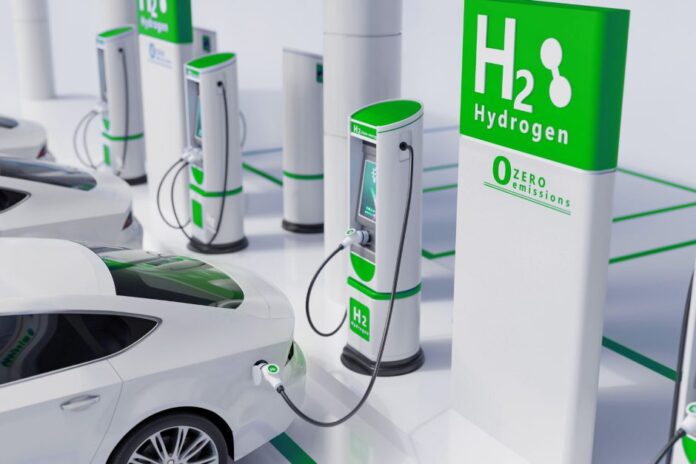
The world’s biggest green hydrogen projects are moving from ambitious gigawatt announcements toward a tougher test in 2026: securing investment, renewable power, customers and financing. NEOM’s $8.4 billion project, Namibia’s $10 billion-plus Hyphen development, AM Green’s 1.3 GW Kakinada project and new European investments from Moeve and OMV illustrate the different business models emerging.
The global hydrogen industry has reached an important transition point. Installed electrolysis capacity more than doubled in 2025 to exceed 4 GW, while another 2.5 GW was under construction and targeting operation during 2026, according to the International Energy Agency. Low-emissions hydrogen production reached almost 1 million tonnes in 2025.
Investment is accelerating as well. Capital spending on low-emissions hydrogen projects almost doubled to nearly $7 billion in 2025 and could approach $10 billion in 2026, with electrolysis representing around 70 percent of this year’s investment.
But there is a growing gap between announced and bankable projects. The IEA says more than 100 GW of announced electrolyzer capacity risks missing operation by 2030 unless investment decisions are made before the end of 2027.
That makes financing, offtake and construction status as important as electrolyzer size when identifying the world’s leading green hydrogen projects.
NEOM: $8.4 Billion Project Sets the Benchmark for Green Hydrogen Scale
Saudi Arabia’s NEOM Green Hydrogen project is among the most advanced hydrogen mega-projects globally.
The $8.4 billion development at Oxagon combines around 4 GW of dedicated solar and wind generation with more than 2.2 GW of electrolysis capacity. The renewable portfolio includes more than 250 wind turbines providing 1.6 GW and solar generation of up to approximately 2.2 GW.
Once fully operational, NEOM is designed to produce up to 600 tonnes of carbon-free hydrogen per day, which will be converted into as much as 1.2 million tonnes of green ammonia annually.
The project’s biggest competitive advantage may be its commercial structure rather than its size.
Financial close included $6.1 billion in non-recourse financing from 23 banks and financial institutions, while Air Products has a 30-year exclusive offtake agreement covering the project’s green ammonia output.
NEOM Green Hydrogen’s integrated plant combines renewable electricity, electrolysis, ammonia production, storage and export infrastructure within a single development.
As of September 2026, construction is approaching final completion and commissioning has started through energization, with product availability targeted for 2027.
NEOM demonstrates what bankability looks like for export-scale green hydrogen: large renewable resources, downstream conversion into ammonia, project finance, export infrastructure and a long-term customer.
Hyphen Namibia Targets $10 Billion-Plus Investment
Namibia’s Hyphen green hydrogen project represents one of Africa’s largest planned green hydrogen investments.
The development near Lüderitz and Aus is structured around two phases, with each targeting approximately 4 GW of renewable generation and 1.5 GW of electrolyzers.
Combined, Hyphen would therefore have approximately 8 GW of renewable capacity and 3 GW of electrolysis.
Each phase is designed to produce around 1 million tonnes of green ammonia annually, giving the complete development a target of approximately 2 Mtpa. Total investment is expected to exceed $10 billion.
Hyphen also illustrates the potential economic impact of hydrogen investment in emerging markets. The developer estimates the project could support around 15,000 construction jobs over four to five years and approximately 3,000 permanent jobs, with a goal of filling about 90 percent of positions with Namibians.
However, the scale also illustrates the execution challenge facing green hydrogen export hubs. Renewable generation, electrolysis, desalination and water infrastructure, ammonia production, transmission, storage and port facilities all need to progress together.
AM Green Kakinada Combines 1.3 GW Electrolysis With 4.5 GW Renewables
India’s AM Green Kakinada project provides another model for producing export-oriented green molecules.
AM Green has taken a final investment decision on the first 1 million tonnes per annum green ammonia project at Kakinada in Andhra Pradesh.
The facility will use 1.3 GW of advanced pressurized alkaline electrolyzers supplied by John Cockerill.
Producing hydrogen continuously from intermittent renewable energy presents a major challenge. AM Green plans to address it through approximately 4.5 GW of solar and wind capacity, combined with 950 MW of pumped-storage capacity, to provide around 1.3 GW of round-the-clock carbon-free power.
AM Green’s green molecule strategy is also supported by long-term electricity arrangements and international offtake development.
A 25-year fixed-price PPA with NTPC covers approximately half the project’s round-the-clock electricity requirement, while the remaining requirement is expected to be supplied by Gentari. AM Green has progressed ammonia offtake arrangements involving companies including Uniper, Yara and Keppel.
Kakinada has also been pre-certified for compliance with European Union Renewable Fuels of Non-Biological Origin requirements, which is strategically important for exports to Europe.
AM Green ultimately targets 5 Mtpa of green ammonia capacity by 2030, although that figure represents its wider portfolio rather than the first Kakinada plant.
ACME Duqm Targets 800,000 Tonnes of Green Ammonia
Oman is emerging as another major green hydrogen investment destination because of its solar resources, industrial zones and access to maritime export routes.
ACME’s Duqm development includes approximately $4.2 billion of investment in the downstream component of phases two and three.
Each phase is designed to produce 71,000 tonnes of green hydrogen and 400,000 tonnes of green ammonia annually.
Combined production from the two phases would therefore reach 142,000 tonnes of hydrogen and 800,000 tonnes of ammonia per year. Commercial operation is targeted for 2030 for phase two and 2033 for phase three.
The project reinforces the importance of green ammonia to hydrogen economics.
Pure hydrogen is difficult and expensive to transport over long distances. Converting hydrogen into ammonia creates a commodity that can use established chemical storage, shipping and handling infrastructure.
Moeve Starts Construction of €1 Billion Onuba Project
Europe’s green hydrogen market reached another important milestone in September 2026 when Moeve launched construction of the first phase of its Andalusian Green Hydrogen Valley.
The Onuba project in Huelva, Spain, represents investment exceeding €1 billion and will initially provide 300 MW of electrolysis capacity, expandable by another 105 MW.
Production is expected to reach approximately 45,000 tonnes of renewable hydrogen annually, avoiding around 250,000 tonnes of CO2 emissions per year.
Moeve estimates the project will generate an economic impact equivalent to more than 8,000 direct, indirect and induced jobs across the value chain.
Moeve’s Andalusian Green Hydrogen Valley is particularly important because it has crossed the thresholds that many hydrogen announcements have struggled to reach: FID and construction.
Moeve holds a 51 percent stake, with partners including Hy24, COFIDES, Enagás Renovable and Alter Enersun.
OMV Secures €450 Million EIB Loan for 140 MW Hydrogen Plant
Austria’s OMV project is considerably smaller than NEOM or Hyphen but provides an important lesson about hydrogen bankability.
OMV is investing approximately €600 million in a 140 MW green hydrogen facility at Bruck an der Leitha in Lower Austria.
The plant is already under construction and is expected to start operations by the end of 2027, producing up to 23,000 tonnes of green hydrogen annually.
The European Investment Bank is providing a €450 million loan, covering nearly three-quarters of the projected investment. Austria is separately providing production funding of up to €123 million.
The hydrogen will travel through a 22-kilometre pipeline to OMV’s Schwechat refinery, where it will progressively replace fossil-based hydrogen.
OMV expects the project to reduce refinery CO2 emissions by approximately 150,000 tonnes annually, equivalent to around 10 percent of the facility’s current direct emissions.
The project demonstrates why smaller projects with identifiable industrial customers can sometimes offer a clearer commercial pathway than much larger export developments.
Stegra Shows Another Model: Turn Hydrogen Into Green Steel
Sweden’s Stegra project highlights an alternative to selling hydrogen or converting it into ammonia.
Stegra plans to integrate renewable hydrogen directly into iron and steel production, targeting 5 million tonnes of green steel annually by 2030.
Hydrogen replaces coal-based reduction in the steelmaking process.
This approach changes the project’s economics because hydrogen becomes an intermediate feedstock rather than the final commodity. Its value is captured through a higher-value downstream product — green steel.
The same principle is becoming increasingly important across the hydrogen industry. Developers are examining green fertilizers, methanol, sustainable fuels and direct-reduced iron as potential routes to create greater value from renewable hydrogen.
Why Green Ammonia Is Winning the Hydrogen Export Race
Several of the world’s biggest projects share one characteristic: they plan to export ammonia rather than hydrogen itself.
NEOM targets 1.2 Mtpa, Hyphen targets approximately 2 Mtpa across two phases, and ACME’s Duqm phases target 800,000 tonnes annually.
Ammonia already has a global industrial market and established shipping infrastructure.
The IEA estimates that international trade could underpin more than 40 percent of announced low-emissions hydrogen volumes by 2030 if all projects materialize.
Long-term contracts are particularly important because developers need revenue visibility before banks will finance multibillion-dollar projects.
The Biggest Green Hydrogen Challenge Is No Longer Announcing Gigawatts
Despite enormous project pipelines, green hydrogen remains a relatively small part of the global hydrogen industry.
Total hydrogen demand surpassed 100 million tonnes in 2025, but almost all demand remained concentrated in traditional refining and industrial uses. Low-emissions hydrogen represented only about 1 million tonnes.
Meanwhile, new final investment decisions for low-emissions hydrogen production fell below 0.8 Mtpa in 2025, after remaining around 1 Mtpa during each of the previous two years. The 2030 project pipeline also contracted by approximately 10 Mt to 27 Mt because of delays, pauses and cancellations.
These figures explain why project rankings based solely on announced electrolyzer capacity can be misleading.
A credible green hydrogen project increasingly needs competitive renewable electricity, high electrolyzer utilization, financing, firm customers, infrastructure and a commercially valuable downstream product.
Green Hydrogen Investment Outlook 2026
The leading projects show several distinct routes to commercial scale.
NEOM has the most advanced integrated mega-project model, combining $8.4 billion of investment, 4 GW of renewable power, more than 2.2 GW of electrolysis and a 30-year ammonia offtake agreement.
Hyphen Namibia represents a potential $10 billion-plus African export platform, while AM Green Kakinada combines 1.3 GW of electrolysis with approximately 4.5 GW of solar and wind plus pumped storage.
In Europe, the emphasis is increasingly on projects that have crossed into investment and construction. Moeve has started building its €1 billion-plus, 300 MW Onuba project, while OMV has secured €450 million of EIB financing for its €600 million Austrian plant.
The IEA expects low-emissions hydrogen investment to approach $10 billion in 2026, but the bigger challenge is converting investment into competitive output.
That is the defining change in the green hydrogen market in 2026: gigawatts announced are becoming less important than projects financed, under construction and backed by real customers.
The projects most likely to shape the next phase of the industry will be those capable of turning renewable electricity into hydrogen at competitive cost — and then converting that hydrogen into products such as green ammonia, steel, fertilizers and synthetic fuels that customers are actually prepared to buy.
SHAFANA FAZAL