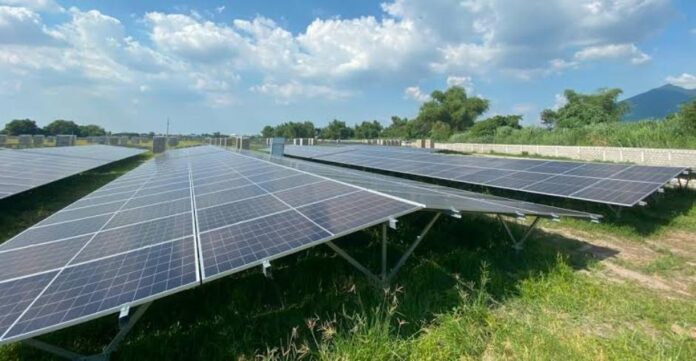
Africa’s utility-scale solar market is expanding in 2026 as new projects in the Democratic Republic of Congo, Namibia, Uganda, Zambia and Zimbabwe attract private and international capital, while transmission investments improve the ability of national grids to absorb renewable electricity.
The latest project pipeline shows that Africa’s solar story is moving beyond established markets such as South Africa and Egypt. New utility-scale projects are emerging across Southern, East, Central and West Africa, with investment models ranging from traditional independent power producers (IPPs) to merchant solar plants selling electricity through regional power markets.
Africa installed approximately 4.5 GW of new solar PV capacity in 2025, up 54 percent year over year, according to the Global Solar Council. South Africa added 1.6 GW, followed by Nigeria with 803 MW, Egypt with 500 MW and Algeria with 400 MW.
Utility-scale projects represented about 56 percent of Africa’s 2025 solar additions, while distributed systems accounted for 44 percent. The market is also becoming geographically broader: eight African countries installed at least 100 MW during 2025, compared with four a year earlier.
The Global Solar Council’s Africa solar outlook indicates that Africa could add more than 33 GW of solar capacity by 2029, more than six times the capacity installed during 2025.
Against this backdrop, several projects illustrate where Africa’s next wave of utility-scale solar investment is emerging.
DRC Targets 650 MW Solar Pipeline
The Democratic Republic of Congo is targeting 650 MW of solar capacity through cooperation involving its rural electrification agency and a French partner, creating one of the larger planned solar development pipelines in Central Africa.
The initiative is intended to expand electricity access across rural and peri-urban areas while attracting private investment into renewable-energy infrastructure.
A 650 MW program would be significant for a country where enormous renewable-energy resources coexist with limited electricity access. Solar also provides an alternative to relying exclusively on major hydroelectric projects, particularly for regions located far from existing transmission infrastructure.
For investors, however, converting announced capacity into operating projects will depend on financing, bankable electricity offtake arrangements, transmission connections and regulatory approvals.
These challenges are common across Africa. The Global Solar Council has previously estimated that capital costs for solar projects in Africa can be three to seven times higher than in developed economies, despite the continent having some of the world’s best solar resources.
The DRC’s 650 MW target therefore demonstrates both the opportunity and the financing challenge facing Africa’s emerging utility-scale solar markets.
Namibia’s 19.3 MW Gerus Plant Introduces Merchant Solar
One of the most interesting African solar developments in 2026 is occurring in Namibia, where Solarcentury Africa’s 19.3 MWp Gerus solar PV plant has reached commercial operation.
Developed with Sino Energy, the project was completed in around 12 months and attracted approximately $20 million of international funding from BB Energy.
Gerus is expected to generate around 50.8 GWh of electricity annually, enough to supply more than 14,000 Namibian homes, while avoiding approximately 17,000 tonnes of CO2 emissions each year.
But its significance goes beyond capacity.
Gerus is Namibia’s first purpose-built merchant solar project selling electricity through the Southern African Power Pool (SAPP) and only the second such purpose-built merchant solar facility in Africa.
Instead of depending entirely on a conventional long-term power purchase agreement with a single national utility, merchant projects can sell electricity through a competitive regional market.
This could create an important new financing and development model for African renewables.
Solarcentury Africa is now targeting more than 320 MWp of fully merchant solar capacity by 2027, demonstrating the developer’s confidence that regional electricity trading can support a larger renewable-energy portfolio.
Zambia’s Mailo Solar Project Targets 118 MWp
Zambia is becoming another testing ground for merchant renewable power.
Solarcentury Africa has started trading electricity from the 25 MWp first phase of its Mailo Solar Plant through the Southern African Power Pool. The full development is planned to reach 118 MWp across three phases.
The initial plant was developed, financed and constructed in less than 12 months.
More importantly for investors, Solarcentury has secured a $40 million loan from Standard Bank South Africa to support the project’s next expansion and its wider merchant-power portfolio.
Construction will initially expand Mailo from 25 MWp to 60 MWp, before a subsequent phase takes total capacity to 118 MWp. The project occupies approximately 204 hectares in Zambia’s Chitambo district.
At 25 MWp, Mailo is expected to generate more than 60 GWh annually, equivalent to the electricity consumption of around 25,000 Zambian households.
The Mailo merchant solar development is particularly important for Zambia because drought has exposed the country’s dependence on hydropower.
Solar can diversify generation while the SAPP enables electricity to be sold to utilities, industrial consumers and power traders across national borders.
Uganda Starts Commercial Operation of $27 Million Ituka Solar
Uganda has added another utility-scale project with the commercial operation of AMEA Power’s 24 MWp Ituka Solar PV plant in Uleppi, Madi Okollo District.
The project represents an investment of approximately $27 million, financed through debt and equity from AMEA Power and the Emerging Africa Infrastructure Fund.
Ituka is the first solar IPP in Uganda’s West Nile region and AMEA Power’s first operational project in the country.
The project demonstrates why transmission infrastructure is as important as generating capacity.
A 25 MVA, 132/33 kV substation was energized in July 2026, enabling reliability testing and electricity delivery to the national grid through Uganda Electricity Transmission Company Limited.
The plant is expected to generate approximately 53,940 MWh annually and, according to the developer, supply electricity equivalent to the needs of more than 192,640 households while avoiding about 26,600 tonnes of CO2 emissions annually.
The Emerging Africa Infrastructure Fund previously committed nearly $18 million toward the project, illustrating the role development-finance-backed capital continues to play in making African renewable projects bankable.
The AMEA Power Ituka solar project also has wider strategic importance because West Nile was connected to Uganda’s national electricity grid only in 2024.
Zimbabwe’s $100 Million Solar Project Targets 100 MWp
Zimbabwe is another market where large solar investments could help address persistent electricity shortages.
The China-Zim Green Energy Solar Project at Mapanzure Solar Park in Zvishavane represents approximately $100 million of investment and targets total capacity of 100 MWp.
The development is structured in two stages. Phase One covers approximately 150 hectares and targets 60 MWp, while Phase Two would add another 40 MWp.
Once fully operational, the project is expected to generate approximately 200 million kWh — or 200 GWh — of electricity annually.
For Zimbabwe, new solar capacity could reduce pressure on a power system affected by supply shortages and hydropower variability while providing additional electricity for industrial users.
The project’s public-private structure also demonstrates the growing importance of international capital and Chinese participation in African energy infrastructure.
Ghana Invests in Transmission for Solar Integration
Africa’s solar expansion cannot be measured by generation projects alone.
Transmission infrastructure is becoming a critical part of the investment requirement because new solar plants cannot operate effectively without sufficient grid capacity.
Ghana Grid Company has completed a 4-kilometer, 161 kV transmission connection linking the Yendi solar development with the Tamale-Yendi transmission network.
The infrastructure also incorporates a 66 MVA transformer.
Although considerably less visible than a new solar farm, projects such as Yendi’s grid connection are strategically important. Weak transmission systems, congestion and delayed interconnections can prevent completed renewable-energy projects from delivering their full output.
This issue will become more important as solar development spreads beyond Africa’s largest electricity markets.
696 MW of Stalled South African Solar Shows Development Risks
Africa’s expanding project pipeline also contains a warning for investors.
South African utility Eskom has reclaimed land previously allocated to private solar developments after projects failed to progress toward construction and long-term leases.
The affected developments, including the proposed Majuba Solar Energy Facility, represented approximately 696 MW of potential capacity.
The projects reportedly failed to secure all the environmental and regulatory approvals required to advance.
The land has now been returned to Eskom’s Green portfolio for possible development through alternative arrangements.
The episode demonstrates that announced megawatts should not automatically be treated as future generating capacity.
African projects must navigate land rights, environmental permits, grid-connection agreements, financing, currency risks and electricity offtake before reaching financial close and construction.
Southern African Power Pool Changes Solar Investment Model
Perhaps the most strategically important development among the latest projects is the increasing role of the Southern African Power Pool.
SAPP creates a regional electricity market linking Southern African countries and enables power to move across national borders.
Merchant solar projects such as Zambia’s Mailo and Namibia’s Gerus show how developers can potentially build generation assets that serve a regional market rather than depending solely on one utility and one long-term PPA.
The model could be particularly attractive to mines and other large industrial customers seeking reliable renewable electricity.
Solarcentury’s Gerus project has become Namibia’s first merchant solar plant trading through SAPP, while Mailo represents the first dedicated merchant solar project to use the regional power pool.
If the model proves bankable at larger scale, it could help unlock private capital for solar projects across Southern Africa.
Africa Could Add More Than 33 GW of Solar by 2029
The individual projects form part of a much bigger transition.
Africa imported approximately 18.2 GW of solar modules during 2025, while the Global Solar Council estimates countries could install about 14.3 GW of mainly utility-scale capacity during 2026 and 2027 combined under its medium scenario.
The Africa Market Outlook for Solar PV 2026-2029 projects more than 33 GW of installations by 2029 as utility-scale and distributed solar expand simultaneously.
But generation capacity alone will not determine whether Africa reaches that level.
The next phase requires investment in transmission networks, substations, battery storage, cross-border interconnectors and electricity markets alongside solar plants.
The latest projects already show that transition taking shape. The DRC is targeting a 650 MW pipeline, Zimbabwe has a $100 million, 100 MWp development, Uganda has commissioned its $27 million Ituka project, and Solarcentury is using Namibia and Zambia to establish a new merchant-power model.
Africa’s utility-scale solar market is therefore evolving from isolated government-backed projects toward a more diversified investment landscape involving IPPs, development finance, commercial banks, private capital and regional electricity trading.
That combination — rather than solar capacity alone — could determine how quickly Africa converts its exceptional solar resources into reliable electricity and investable renewable-energy infrastructure.
SHAFANA FAZAL