Solar Energy Investment 2026: Global solar investment is entering a new phase as billions of dollars move beyond photovoltaic projects into battery storage, domestic manufacturing, transmission networks and grid infrastructure. China remains the world’s largest solar ecosystem, while the United States, India, Europe and the Middle East are emerging as major destinations for solar-related capital.
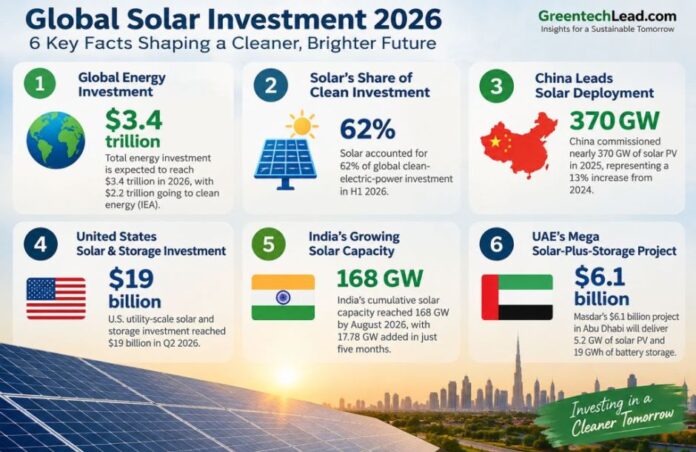
The global investment opportunity is enormous. The International Energy Agency (IEA) expects total energy investment to reach $3.4 trillion in 2026, with clean-energy investment reaching $2.2 trillion, almost twice the amount directed toward fossil fuels. The World Energy Investment 2026 outlook shows that electricity systems, including generation, grids, storage and electrification, are attracting an increasing share of global capital.
Solar remains at the center of this investment cycle. Solar represented 62 percent of global clean-electric-power investment in H1 2026, although investment declined from the exceptional levels recorded in 2025.
According to the latest global clean investment data from Rhodium Group, global clean investment in H1 2026 was 17 percent below H1 2025 but broadly in line with H1 2024. Q2 investment increased 5 percent sequentially to $395.4 billion.
China: World’s Largest Solar Investment Ecosystem
China remains the dominant solar market because it combines enormous deployment with the world’s largest photovoltaic manufacturing supply chain.
The country’s investment footprint stretches across polysilicon, wafers, solar cells, modules, inverters, batteries and manufacturing equipment. This vertically integrated ecosystem has enabled Chinese companies to lower production costs while supporting huge domestic and international solar pipelines.
China commissioned nearly 370 GW of solar PV in 2025, representing an increase of about 13 percent from the previous year. The country accounted for more than 60 percent of worldwide renewable-capacity growth during the year.
China’s broader clean-energy investment exceeded $625 billion in 2024, according to the IEA. Although this figure covers technologies beyond solar, photovoltaic generation and its associated manufacturing supply chain represent a major component of the country’s clean-energy economy.
China is also investing heavily in battery storage, transmission and grid modernization as solar penetration increases.
The IEA expects China to remain by far the world’s largest solar manufacturing center through 2030, supplying more than 70 percent of global module demand and more than 80 percent of upstream wafer and polysilicon requirements.
United States: Solar, Storage and Manufacturing Attract Billions
The United States represents another major center for solar investment, with capital increasingly spread across utility-scale generation, battery storage and domestic manufacturing.
U.S. utility-scale solar and storage investment reached approximately $19 billion in Q2 2026, according to Rhodium Group’s Clean Investment Monitor.
Solar manufacturing investment approached $1 billion during the quarter, while clean-manufacturing investment announcements totaled about $10 billion. Solar represented approximately 77 percent of those announcements.
First Solar illustrates the scale of the manufacturing opportunity. The company expects cumulative U.S. manufacturing and research investment to reach approximately $4.5 billion by 2027.
Battery storage is also becoming inseparable from new solar investment. Batteries allow developers to move low-cost daytime electricity into higher-value evening periods, reduce curtailment and improve the commercial value of renewable projects.
The U.S. solar investment story is therefore increasingly based on three interconnected areas: solar generation, battery storage and domestic manufacturing.
India: Solar Investment Expands into Manufacturing
India is becoming one of the world’s most important solar investment destinations as capital flows simultaneously into generation and manufacturing.
According to the latest India solar capacity and deployment data from the Ministry of New and Renewable Energy, India’s cumulative solar capacity reached 168.04 GW by August 31, 2026.
This included 123.99 GW of ground-mounted solar, 32.59 GW of grid-connected rooftop solar, 4.83 GW of solar capacity within hybrid projects and 6.63 GW of off-grid solar. India added another 17.78 GW between April and August 2026, following a record 44.61 GW of solar additions during FY2025-26.
Manufacturing is becoming an equally important investment opportunity.
India’s Production Linked Incentive scheme for high-efficiency solar PV modules has an outlay of ₹24,000 crore, encouraging investment across domestic solar manufacturing.
Saatvik Green Energy secured a ₹1,041.63 crore SECI order covering 600 MWp of solar modules. The company operates a 4.86 GW module facility in Ambala and is developing an Odisha manufacturing operation targeting 4 GW of modules and 6 GW of solar cells.
Vikram Solar has signed a ₹1,250 crore agreement with Avaada Electro covering 1 GW of domestically manufactured N-Type G12R TOPCon cells. Vikram Solar is also developing 9 GW of high-efficiency solar-cell manufacturing capacity.
Tata Power has committed another ₹6,500 crore toward upstream solar ingot and wafer manufacturing.
India is therefore shifting from primarily being a solar deployment market toward becoming an integrated manufacturing and generation hub.
Europe: Investment Moves Toward Solar, Storage and Grids
Europe remains one of the world’s biggest solar markets, but its investment priorities are changing.
The European Union installed almost 70 GW of solar PV in 2025, with Germany adding approximately 17 GW and Spain around 14 GW.
As solar penetration rises, Europe increasingly needs investment in transmission networks, distribution systems, batteries and demand flexibility.
Public auctions and corporate power purchase agreements supported around 92 GW of EU solar installations between 2022 and 2025, illustrating the importance of long-term electricity contracts in attracting investment.
SolarPower Europe estimates that accelerating solar and storage deployment could reduce annual EU electricity-system operating costs by approximately €55 billion by 2030 and potentially lower average wholesale electricity prices by 14 percent.
Europe’s solar investment opportunity is therefore moving beyond installing panels toward building the infrastructure needed to integrate and monetize renewable electricity.
UAE: $6.1 Billion Solar and Battery Megaproject
The Middle East is emerging as another major destination for global solar capital.
One of the strongest examples is Abu Dhabi, where Masdar reached financial close on a $6.1 billion gigascale solar-plus-storage investment combining 5.2 GW of solar PV with 19 GWh of battery storage.
The project is designed to provide 1 GW of continuous clean electricity, demonstrating how solar investment is moving toward dispatchable renewable power.
Masdar is contributing $1 billion in equity, while a consortium of 13 banks is providing $5.1 billion in project financing.
This investment model could become increasingly important globally because storage enables solar developers to sell electricity beyond daylight hours and support more predictable power delivery.
Saudi Arabia: Gigawatt-Scale Solar Investment Accelerates
Saudi Arabia is also rapidly emerging as a major solar investment market as the kingdom diversifies its electricity system under Vision 2030.
Saudi solar PV additions increased sharply to around 7 GW during 2025, demonstrating the rapid acceleration of the country’s renewable-energy program.
Saudi Arabia is developing multigigawatt solar portfolios through competitive procurement and long-term power purchase agreements. These contracts provide predictable revenue streams that help developers secure substantial project financing.
Together, Saudi Arabia and the UAE are turning the Gulf into an important destination for solar, battery storage, transmission and renewable-energy infrastructure investment.
Solar Manufacturing Investment Is Shifting
Manufacturing represents another important front in the global solar investment race.
Actual global solar manufacturing investment dropped from $25.7 billion in Q4 2023 to $4.2 billion in Q2 2026, an 83 percent decline as manufacturers responded to global overcapacity and falling equipment prices.
However, announced solar manufacturing investment reached $18.3 billion in H1 2026, more than double the $7.9 billion announced during H2 2025.
China continues to dominate global production, but India and the United States are attracting increasing manufacturing investment as governments seek greater supply-chain resilience.
India is particularly significant because new investment is moving upstream from module assembly toward solar cells, wafers and ingots.
Solar Plus Storage Becomes a Major Investment Theme
Battery storage is becoming one of the most important components of the solar investment market.
Standalone solar farms generate most electricity during daylight hours, when abundant production can sometimes depress wholesale electricity prices. Batteries allow project developers to store this electricity and sell it during periods of stronger demand.
Solar-plus-storage can also reduce curtailment, support electricity grids and make renewable projects more attractive for long-term PPAs.
The 5.2 GW solar and 19 GWh battery project in Abu Dhabi and ACME Solar’s solar-wind-BESS development in Rajasthan demonstrate how storage is increasingly being designed into renewable projects from the beginning.
Which Markets Offer the Biggest Solar Investment Opportunity?
There is no directly comparable global dataset that accurately ranks countries by solar-only investment because markets report generation, manufacturing, batteries and grid spending differently.
However, the direction of capital is clear.
China remains the world’s largest solar ecosystem through manufacturing and deployment. The United States is directing billions of dollars toward solar farms, battery storage and domestic factories. India is combining rapid capacity additions with major investments in cells, modules, wafers and ingots.
Europe increasingly needs investment in grids and batteries to support its huge installed renewable base, while Saudi Arabia and the UAE are demonstrating a different investment model centered on multibillion-dollar utility-scale solar-plus-storage projects.
Solar Investment Outlook 2027-2030
Solar investment through 2030 will increasingly extend beyond photovoltaic panels.
Capital will flow toward battery storage, domestic manufacturing, transmission infrastructure, grid modernization, power electronics and long-term electricity contracts.
Falling module prices can continue improving project economics, but grid access, financing costs, curtailment risk, storage economics and PPA pricing will increasingly determine investment returns.
China is likely to retain its manufacturing leadership, while India could capture a larger share of new manufacturing investment. The U.S. will continue building generation, storage and factories, while Europe will require substantial investment in grids and flexibility.
Meanwhile, the Middle East could emerge as one of the most important markets for extremely large solar-plus-storage developments.
The biggest change in solar energy investment in 2026 is therefore not simply the amount of new photovoltaic capacity being installed. Solar is becoming part of a much larger investment ecosystem covering generation, manufacturing, batteries and electricity networks.
Countries and companies capable of combining low-cost solar generation with storage, manufacturing capacity, grid infrastructure and reliable long-term electricity contracts are likely to capture the largest opportunities in the global solar investment cycle through 2030.
SHAFANA FAZAL