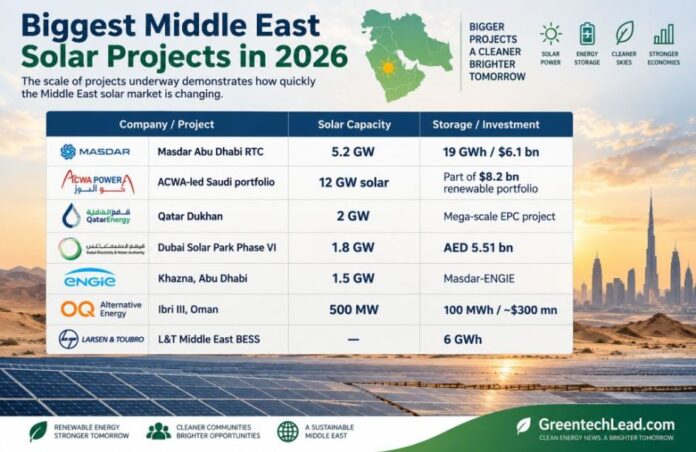
The Middle East solar market is accelerating in 2026 as Masdar, ACWA Power, QatarEnergy, DEWA and other energy companies advance multi-gigawatt projects backed by billions of dollars in investment.
The Middle East and North Africa (MENA) is expected to add a record 18 GW of solar capacity in 2026, while battery additions are forecast at 4 GW and 16 GWh, according to the BloombergNEF MENA Clean Energy Market Outlook 2026. Renewable-energy investment reached a record $22 billion in 2025, with regional investors accounting for 85 percent of financing activity.
BloombergNEF expects cumulative MENA solar and wind capacity to rise from around 49 GW to 404 GW by 2035, creating opportunities across solar development, battery storage, EPC, substations and transmission infrastructure.
Masdar: 5.2 GW Solar and 19 GWh Battery Project
Abu Dhabi-based Masdar is setting one of the most important benchmarks for solar-plus-storage development in the Middle East.
In July 2026, Masdar achieved financial close on a $6.1 billion round-the-clock renewable-energy project in Abu Dhabi combining 5.2 GW of solar PV with 19 GWh of battery energy storage.
The project is designed to deliver 1 GW of continuous clean electricity, addressing one of solar power’s biggest limitations — intermittent generation.
Under the financing structure, Masdar is providing $1 billion of equity, while 13 international and regional banks are backing a $5.1 billion financing package. More details are available in Masdar’s $6.1 billion solar and battery project announcement.
Masdar is also participating in Oman’s 500 MW Ibri III solar project, which incorporates 100 MWh of battery storage.
ACWA Power: 12 GW Solar Portfolio in Saudi Arabia
ACWA Power remains one of the most influential renewable-energy developers in Saudi Arabia, where large government-backed procurement programs are creating one of the world’s biggest solar pipelines.
ACWA Power, Badeel and Saudi Aramco Power Company have secured financial close for 15 GW of renewable projects representing $8.2 billion of investment.
The portfolio contains 12 GW of solar PV across five projects:
Bisha: 3 GW
Humaij: 3 GW
Khulis: 2 GW
Afif 1: 2 GW
Afif 2: 2 GW
Another 3 GW will come from the Starah and Shaqra wind projects.
The overall portfolio has secured $5.9 billion in senior debt financing and is expected to become operational between the second half of 2027 and first half of 2028.
ACWA Power’s solar and wind portfolio in Saudi Arabia has expanded to more than 34 GW across 21 projects, making it a central participant in the country’s renewable-energy strategy. The ACWA Power 15 GW renewable financing announcement provides further details.
QatarEnergy: Targeting Around 4 GW of Renewable Capacity
QatarEnergy is building solar into Qatar’s long-term electricity and industrial energy strategy.
The company already has the 800 MW Al Kharsaah Solar PV project, while the upcoming 2 GW Dukhan Solar project will significantly increase Qatar’s photovoltaic capacity.
Qatar is targeting approximately 4 GW of renewable generation capacity by 2030, with solar increasingly supporting electricity diversification and lower-carbon industrial operations.
The 2 GW Dukhan development also represents a significant opportunity for solar equipment, engineering and construction companies.
DEWA and Masdar: Dubai Adds 1.8 GW Solar Capacity
Dubai Electricity and Water Authority (DEWA) continues to expand the Mohammed bin Rashid Al Maktoum Solar Park, one of the Middle East’s largest solar developments.
Phase VI is adding 1.8 GW of solar PV capacity through a DEWA-Masdar partnership at an investment of up to AED 5.51 billion.
The project achieved a levelised cost of electricity of just 1.6215 US cents per kWh.
DEWA had already connected 1 GW from Phase VI to the grid, with the remaining 800 MW scheduled for the fourth quarter of 2026.
The project uses around 3.7 million solar cells and is expected to reduce carbon emissions by approximately 2.36 million tonnes annually while supplying clean electricity equivalent to the requirements of around 540,000 residences.
The wider Mohammed bin Rashid Al Maktoum Solar Park is planned to exceed 5 GW by 2030, with investment of approximately AED 50 billion.
OQ Alternative Energy: Expanding Oman’s Solar and Storage Market
OQ Alternative Energy is emerging as an important domestic player as Oman increases renewable generation.
Its participation alongside Masdar and other partners in the 500 MW Ibri III solar PV project places OQ at the centre of Oman’s first utility-scale solar project integrated with battery storage.
Ibri III includes 100 MWh of BESS, with total project costs estimated at around $300 million.
The development supports Oman’s ambition to generate around 30 percent of electricity from renewable sources by 2030.
ENGIE: Expanding Through Abu Dhabi’s Khazna Solar Project
ENGIE is among the international energy companies participating in the Gulf’s expanding renewable market.
The French energy group is partnering with Masdar on the 1.5 GW Khazna Solar PV project in Abu Dhabi, demonstrating the growing role of international developers alongside regional energy companies.
Large projects such as Khazna also create opportunities for project financing, solar modules, inverters, substations, grid connections and long-term operations and maintenance.
Samsung C&T: EPC Opportunity in Qatar’s 2 GW Dukhan Project
Samsung C&T represents another important part of the Middle East solar value chain: engineering, procurement and construction.
The company is involved in EPC work for Qatar’s 2 GW Dukhan Solar project.
As individual solar developments move into the 1 GW-5 GW range, the ability to manage engineering, procurement, construction and grid infrastructure in demanding desert environments is becoming increasingly important.
Larsen & Toubro Targets 6 GWh Middle East Battery Market
India’s Larsen & Toubro (L&T) is positioned to benefit from the rapid convergence of solar, batteries and grid infrastructure.
In August 2026, L&T’s renewables business secured an order covering three Middle East BESS projects with a combined 6 GWh of storage capacity.
Each development will use a four-hour battery system, while L&T’s scope also includes pooling substations, underground cables and grid-interconnection infrastructure.
The L&T Middle East 6 GWh battery storage order highlights how storage is developing into a major infrastructure segment alongside solar.
Solar-Plus-Storage Becomes the Next Investment Opportunity
Battery storage is emerging as the next major investment segment accompanying Middle East solar expansion.
BloombergNEF forecasts MENA battery additions of 4 GW and 16 GWh in 2026, double the previous year’s capacity. Masdar’s 19 GWh Abu Dhabi development and L&T’s 6 GWh BESS order illustrate the scale of projects now entering the market.
Storage enables surplus daytime solar electricity to be delivered during evening demand peaks and provides additional flexibility for electricity grids handling rapidly growing renewable capacity.
The opportunity therefore extends beyond photovoltaic plants to battery systems, transmission lines, substations, power electronics, grid management and renewable-energy integration.
Middle East Solar Market Outlook to 2030
Saudi Arabia and the UAE are emerging as the two biggest engines of Middle East solar investment. Saudi Arabia is building a multi-gigawatt project pipeline through ACWA Power and other developers, while Abu Dhabi is moving aggressively into gigascale solar-plus-storage.
Dubai continues expanding one of the world’s largest single-site solar parks, Qatar is building toward approximately 4 GW of renewable capacity, and Oman is introducing utility-scale battery storage alongside solar generation.
With MENA solar additions expected to hit 18 GW in 2026, renewable investment already reaching $22 billion annually, and regional solar and wind capacity potentially climbing toward 404 GW by 2035, the next phase of Middle East solar growth will increasingly be defined by companies capable of combining gigawatt-scale development, competitive financing, battery storage and grid infrastructure.
Masdar and ACWA Power currently stand out for project scale and investment, while QatarEnergy and DEWA are driving national solar programs. OQ Alternative Energy and ENGIE are expanding the developer ecosystem, while Samsung C&T and L&T demonstrate the substantial EPC, battery and grid infrastructure opportunities being created by the Middle East’s solar investment boom.
SHAFANA FAZAL