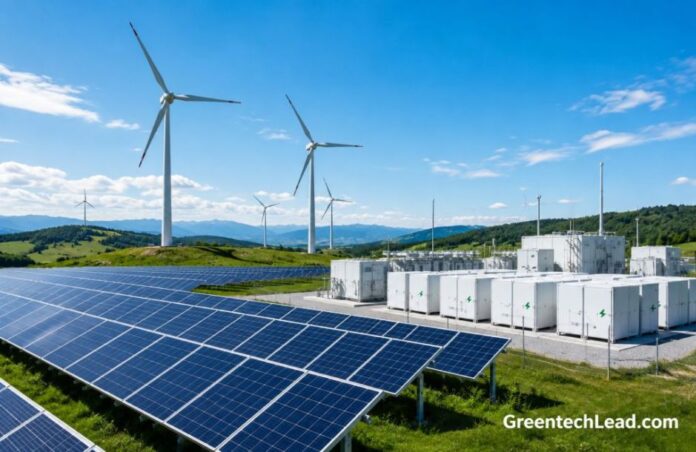
Solar-plus-storage is emerging as a new power-plant model as renewable energy developers move beyond simply generating low-cost electricity toward delivering clean power when utilities, industries and data centers actually need it.
Global investment in co-located renewable energy and storage reached a record $25 billion in the first half of 2026, nearly double the level in the second half of 2025 and three times H1 2025 investment. In contrast, financing for standalone utility-scale solar dropped 20 percent to $75.4 billion.
The investment shift reflects challenges including solar curtailment, grid congestion and falling midday electricity prices. Batteries allow developers to move surplus daytime solar production into evening peaks and other higher-value periods.
From Abu Dhabi and California to Australia, India and Chile, these are 10 of the biggest and most strategically important solar-plus-storage projects and platforms shaping the global energy market.
1. Masdar-EWEC: 5.2 GW Solar and 19 GWh Battery in Abu Dhabi
Masdar and Emirates Water and Electricity Company’s Abu Dhabi development is one of the world’s most ambitious attempts to transform solar into continuous clean power.
The project combines 5.2 GW of solar PV with 19 GWh of battery storage, backed by $6.1 billion of capital investment. Financing includes $5.1 billion from 13 banks and approximately $1 billion of Masdar equity.
Most importantly, the Masdar 5.2 GW solar and 19 GWh battery project is designed to deliver 1 GW of continuous clean electricity.
This changes the role of batteries from a supporting grid asset into an essential part of the power plant’s electricity-delivery model.
2. Darden Clean Energy: 1.15 GW Solar and 4.6 GWh BESS
California’s Darden Clean Energy Project combines 1,150 MWac of solar capacity with up to 4,600 MWh of battery storage, with commercial operation expected in 2028.
The project has secured $4.95 billion of construction debt, $929 million of tax-equity commitments and agreements covering $2.13 billion of investment tax credits.
Darden demonstrates the increasingly sophisticated financing behind large U.S. solar-plus-storage developments.
The wider market is expanding rapidly. U.S. renewable investment increased 54 percent in H1 2026, while solar investment reached $45.8 billion.
3. Smoky Creek and Guthrie’s Gap: 720 MW Solar, 2.4 GWh Storage
Edify Energy’s Queensland projects combine approximately 720 MW of solar generation with a 600 MW/2,400 MWh battery system.
A broader financing package of approximately A$3.3 billion covers these facilities and other approved projects.
A major advantage is long-term customer demand. Rio Tinto is expected to purchase approximately 90 percent of the electricity and storage capacity under a 20-year agreement.
The arrangement illustrates why industrial customers could become major drivers of solar-plus-storage investment. Long-term power demand can improve project bankability while helping large industrial companies secure renewable electricity.
4. Richmond Valley: Eight-Hour Battery Changes Storage Economics
Ark Energy’s Richmond Valley Energy Centre combines 200 MW of solar with a 275 MW/2,200 MWh battery, providing approximately eight hours of storage at rated output.
The project secured A$1.3 billion in financing, including A$586 million of equity and A$716 million of debt.
The Richmond Valley solar and BESS project is particularly significant because it demonstrates the move toward longer-duration battery systems.
While four-hour batteries can shift midday solar production into evening demand, eight-hour storage can potentially provide flexibility across a much larger portion of the electricity cycle.
5. Khavda: India Builds a Massive Renewable and Battery Hub
Adani Green Energy’s Khavda development represents a different model: an enormous integrated renewable-energy hub incorporating solar, wind and storage rather than a conventional standalone solar-plus-battery facility.
Adani Green’s operational renewable portfolio exceeded 20 GW in 2026, while operational battery-storage capacity reached 3,551 MWh. The company commissioned 1,972 MWh of BESS capacity at Khavda during the June quarter.
Storage is becoming increasingly important to India’s renewable strategy because batteries can reduce curtailment, shift output toward evening demand and help renewable projects provide more predictable electricity.
6. Serentica: 600 MW Assured Peak Renewable Power in India
Serentica Renewables’ project demonstrates India’s shift from renewable generation toward firm and dispatchable clean electricity.
The development combines approximately 600 MW of hybrid renewable capacity with 2,400 MWh of battery storage. The system is designed to provide 600 MW of assured peak renewable power for four hours.
7. Red Sea Project: 358 MW Solar and 1.2 GWh Battery
Saudi Arabia’s Red Sea development combines approximately 358 MW of solar generation with around 1.2 GWh of battery storage.
8. Guohua Rudong Integrates Solar, Batteries and Hydrogen
China’s Guohua Rudong development combines approximately 400 MW of photovoltaic capacity with a 60 MW/120 MWh battery system and green-hydrogen production.
Completed in June 2026, the project represents an increasingly integrated clean-energy model.
9. Oasis de Atacama: 2.5 GW Solar and 14.1 GWh Storage
Grenergy’s Oasis de Atacama in Chile is among the world’s largest solar-plus-storage platforms.
The development combines approximately 2.5 GW of solar capacity with 14.1 GWh of storage across multiple phases.
The Oasis de Atacama solar and battery platform addresses one of the biggest problems facing high-solar markets: massive daytime electricity production can depress prices and increase curtailment.
Battery storage enables electricity generated during Chile’s exceptionally sunny daytime hours to be sold during evening and other higher-value periods.
10. Andes Solar Hub: $1.3 Billion Investment in Chile
AES Andes’ Andes Solar Hub combines approximately 692 MW of photovoltaic capacity with 510 MW of battery power capacity, representing investment exceeding $1.3 billion.
The development includes Andes Solar III, where 171 MW of solar capacity is paired with a 171 MW battery providing approximately three hours of storage.
Why Solar-Plus-Storage Investment Is Accelerating
The fundamental investment case for renewable energy is changing.
Standalone solar remains one of the cheapest sources of new electricity generation, but adding more solar to the same market can create an economic problem: thousands of megawatts produce electricity simultaneously during daylight hours, depressing prices and increasing curtailment.
Battery storage changes that equation.
Developers can store low-value midday electricity and sell it during evening peaks, while batteries can also potentially earn revenue from ancillary services, capacity markets and grid balancing.
That helps explain why co-located renewable and storage investment reached $25 billion in H1 2026.
AI Data Centers Could Strengthen Battery Demand
Rapid expansion of AI infrastructure and data centers adds another growth driver.
Large technology companies require enormous amounts of electricity, but their demand operates around the clock rather than only when solar panels are producing power.
Solar-plus-storage cannot independently guarantee unlimited 24-hour electricity because battery duration remains constrained. However, combining solar, BESS, transmission and other firm-generation resources can significantly improve the match between renewable production and data-center demand.
This could create a major new customer base for solar-plus-storage projects.
Solar-Plus-Storage Becomes the New Power Plant
Masdar’s 19 GWh battery, Oasis de Atacama’s 14.1 GWh storage platform and Richmond Valley’s eight-hour battery system demonstrate where the market is heading.
The industry’s competitive benchmark is shifting from simply asking how many megawatts of solar a developer can build toward determining how reliably that electricity can be delivered when customers need it.
The next generation of renewable projects will therefore compete on battery duration, electricity delivery, grid access, financing, customer contracts and project economics.
Solar remains the source of low-cost clean electricity. Batteries increasingly determine when that electricity becomes valuable.
That transformation is turning solar-plus-storage from a renewable-energy add-on into one of the most important investment models for the global power industry.
SHAFANA FAZAL