
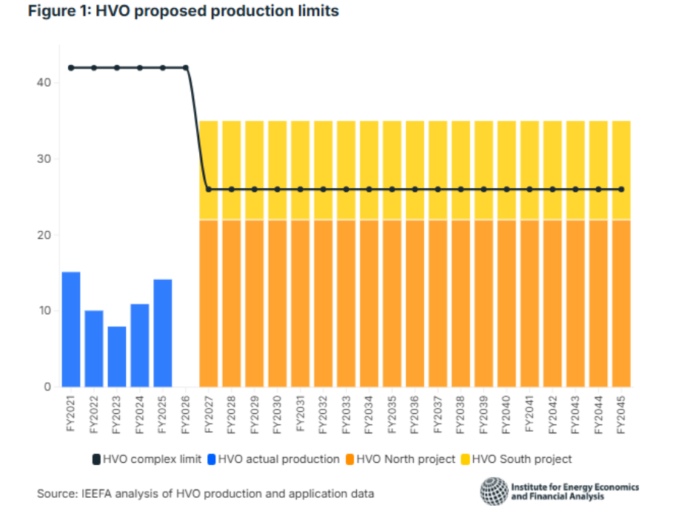
Hunter Valley Operations (HVO) is becoming a major test of Australia’s future coal investment strategy as regulators consider whether two large open-cut mines should continue operating into the mid-2040s.
The HVO Continuation Project proposes a combined maximum extraction limit of 26 million tonnes of coal a year from 2027, extending HVO North beyond its current 2026 lease expiry and HVO South beyond 2030. The proposal has attracted more than 8,000 public submissions, reflecting concerns around coal demand, employment, emissions, methane management, carbon accounting and the Hunter Valley’s long-term economic transition.
HVO is jointly owned by Yancoal Australia with 51 percent and Glencore with 49 percent. The operation employs approximately 1,500 people, making the regulatory decision important for both regional employment and Australia’s coal export industry.
HVO Targets 26 Million Tonnes of Annual Coal Production
The proposed continuation would allow HVO to produce up to 26 million tonnes per annum from 2027 and potentially operate into the mid-2040s.
Established rail, port, workforce and mining infrastructure gives HVO an advantage over new coal developments requiring substantial greenfield investment. However, an operating life extending another two decades would expose the mine to changing coal prices, emissions regulations, fuel costs, infrastructure charges and shifts in global thermal-coal demand.
Australia’s thermal-coal exports are forecast to decline from 209 million tonnes in 2025 to 197 million tonnes in 2031. Thermal-coal export earnings are projected to fall from approximately A$30 billion in 2025-26 to A$23 billion in real terms by 2030-31.
Metallurgical coal has a comparatively stronger outlook. Australian metallurgical-coal exports are expected to reach 163 million tonnes in 2028-29 before easing to 157 million tonnes by 2030-31.
The divergence means coal companies are increasingly focused on asset quality, production costs, coal type, mine life and infrastructure access rather than production growth alone.
HVO Extension Could Generate 15.3 Million Tonnes of CO2e
Emissions are central to the HVO approval debate.
IEEFA estimates that the continuation project could generate approximately 15.3 million tonnes of carbon dioxide equivalent emissions over its proposed operating life.
Diesel consumption represents a major part of the footprint. HVO could consume around 3.2 billion litres of diesel, generating approximately 8.86 million tonnes of CO2e.
Diesel would therefore account for almost 60 percent of the project’s estimated emissions.
The figures highlight the decarbonisation challenge facing large open-cut coal mines, where haul trucks, excavators, drills and other heavy equipment remain heavily dependent on diesel.
Reducing this exposure could require investment in fleet efficiency, haulage optimisation, trolley-assist systems, battery-electric equipment, renewable electricity and alternative fuels.
Methane Management Becomes Another HVO Risk
Methane emissions are also becoming increasingly important as regulators and investors demand more accurate mine-level greenhouse-gas reporting.
IEEFA argues that HVO’s application does not provide a firm commitment to a specific onsite methane-abatement strategy.
Measurement practices are already changing elsewhere in Australia’s coal sector. Glencore said its Hail Creek, Clermont and Collinsville open-cut operations moved to Method 2 fugitive-emissions measurement in 2024.
More sophisticated methane measurement could affect reported emissions, abatement requirements and the future operating costs of Australian coal mines.
HVO Carbon Cost Debate Ranges From A$3.8 Million to More Than A$2.2 Billion
One of the largest disagreements surrounding HVO concerns the economic value assigned to its emissions.
IEEFA says HVO’s economic assessment values the emissions cost of more than 15 million tonnes of project emissions at approximately A$3.8 million.
Using reported Scope 1 and Scope 2 emissions together with the NSW Treasury cost of carbon, IEEFA estimates an alternative cost of more than A$2.2 billion.
That figure is approximately 580 times higher than the amount used in the project assessment.
The difference demonstrates how carbon-accounting methodologies can materially change the estimated economics of long-life mining investments.
The HVO assessment reportedly calculates a net economic benefit to New South Wales of approximately A$5.71 billion. Under another IEEFA scenario, emissions costs could reach approximately A$5.64 billion, potentially absorbing most of that calculated economic benefit.
The debate is particularly important because NSW economic-assessment guidelines date from 2018, while climate policies and carbon-cost assumptions have evolved significantly since then.
Australia Climate Targets Raise the Bar for Long-Life Coal Mines
HVO’s proposed operating life must also be assessed against Australia’s changing climate-policy framework.
Australia is targeting a 43 percent reduction in greenhouse-gas emissions from 2005 levels by 2030, followed by a 62-70 percent reduction by 2035 and net-zero emissions by 2050.
The country is also targeting 82 percent renewable electricity generation by 2030.
These targets do not eliminate Australia’s coal-export market, but they increase the pressure on long-life coal assets to demonstrate competitive costs, lower operational emissions and credible methane and carbon-management strategies.
For HVO, an extension into the mid-2040s would mean operating through most of Australia’s transition toward its 2050 net-zero target.
Yancoal’s US$2.4 Billion Kestrel Deal Highlights Metallurgical Coal Appeal
HVO majority owner Yancoal Australia is also investing in long-life metallurgical coal.
Yancoal has pursued an 80 percent interest in Queensland’s Kestrel coal mine in a transaction valued at up to US$2.4 billion.
The consideration includes US$1.85 billion upfront and up to US$550 million in contingent payments.
The investment shows that substantial capital remains available for Australian coal, particularly for metallurgical-coal assets that supply steelmaking customers and may have a more resilient long-term demand profile than thermal coal.
Glencore Targets 1.6 Million Tonnes of Copper by 2035
Glencore’s 49 percent stake in HVO places the coal operation inside a highly diversified global mining portfolio.
Glencore is targeting approximately 1.6 million tonnes of annual copper production by 2035, demonstrating the scale of capital opportunities competing with coal inside the group.
This creates an important strategic consideration for HVO. The mine must compete for capital not only against other coal assets but also against commodities benefiting from electrification and energy-transition investment.
Whitehaven Coal Produces 40.3 Million Tonnes in FY2026
Whitehaven Coal provides another benchmark for the competitive Australian coal market.
The company reported 40.3 million tonnes of managed ROM coal production in FY2026, increasing 3 percent year over year, alongside 26 million tonnes of equity sales of produced coal.
Its revenue mix comprised 57 percent metallurgical coal and 43 percent thermal coal, providing greater exposure to steelmaking demand.
Whitehaven reported a FY2026 unit cost of approximately A$132 per tonne, capital expenditure of approximately A$350 million and annualised cost savings of A$60-80 million.
Net debt stood at approximately A$1.3 billion as of June 30, 2026.
The figures demonstrate how scale, coal mix and cost discipline are becoming increasingly important as Australian coal producers compete for capital.
New Hope Expands Existing Coal Assets
New Hope is also investing in established mining operations.
Bengalla is expected to return to a 13.4 million tonnes per annum ROM production rate during the second half of FY2026, while New Acland is ramping toward approximately 5 million tonnes annually.
Access to the Manning Vale West pit is scheduled for the final quarter of calendar 2026.
New Hope has also increased its equity interest in Malabar Resources to 25.97 percent, expanding its exposure to metallurgical coal.
The strategy reinforces a broader industry trend toward established assets with existing infrastructure and clearer production pathways.
Hunter Valley’s 1,500 HVO Jobs Add Economic Weight
HVO directly employs approximately 1,500 people and supports contractors, transport providers, suppliers and service businesses across the Hunter Valley.
Continued operation into the mid-2040s could therefore extend regional employment and economic activity for many years.
However, the long mine life also raises questions about closure planning, land rehabilitation and the timing of economic diversification.
IEEFA has recommended rejecting the continuation proposal in its current form. If it receives approval, the organisation has suggested limiting operations to around 2030, allowing additional time for mine-closure planning, rehabilitation, workforce transition and development of alternative industries.
HVO Decision Could Shape Future NSW Coal Extensions
The regulatory decision could have implications beyond one mine.
Approval of HVO into the mid-2040s could influence how other established NSW coal projects seek extensions, particularly around emissions accounting, methane measurement, carbon offsets and onsite emissions reduction.
The project also exposes the increasingly selective nature of Australia’s coal market.
Yancoal’s potential US$2.4 billion investment in Kestrel shows continuing demand for long-life metallurgical coal. Whitehaven’s 40.3 million tonnes of managed FY2026 production and 57 percent metallurgical-coal revenue mix demonstrate the importance of scale and product diversification. New Hope’s 13.4 Mtpa Bengalla operation highlights the value of established infrastructure.
For HVO, the proposed 26 Mtpa production ceiling remains commercially significant, but production volume alone will not determine its long-term competitiveness.
HVO Becomes Test of Australia’s Next Coal Investment Cycle
The HVO Continuation Project brings together the key pressures reshaping Australian coal: declining long-term thermal-coal demand, stronger metallurgical-coal investment, tighter climate targets and increasing scrutiny of operational emissions.
The mine could produce up to 26 million tonnes annually from 2027, employ around 1,500 people and remain operating into the mid-2040s. But its estimated footprint of 15.3 million tonnes of CO2e, including 8.86 million tonnes linked to approximately 3.2 billion litres of diesel, makes emissions management a major economic consideration.
The carbon-cost debate is equally significant. Estimates ranging from approximately A$3.8 million to more than A$2.2 billion, and potentially A$5.64 billion under another scenario, demonstrate how future carbon valuations could materially affect the economics of long-life coal projects.
With Australia targeting emissions reductions of 43 percent by 2030, 62-70 percent by 2035, net zero by 2050 and 82 percent renewable electricity by 2030, HVO will need to remain competitive in a substantially different energy and regulatory environment.
SHAFANA FAZAL
