
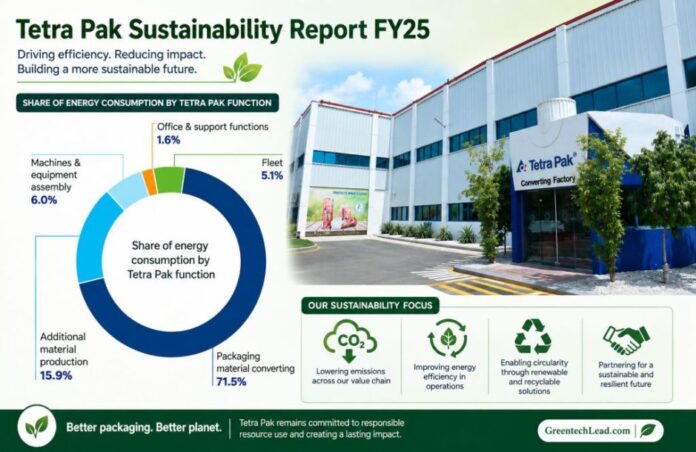
Tetra Pak accelerated its sustainability and net-zero transition in FY25, cutting value-chain greenhouse gas (GHG) emissions by 34 percent from its 2019 baseline, while renewable energy reached 97 percent of consumption across its operations.
According to Tetra Pak’s Sustainability Report 2025, total value-chain emissions declined from 13,119 kilotonnes of CO2e in 2019 to 8,667 kilotonnes in FY25. The reduction improved by 12 percentage points compared with 2024, moving the food-processing and packaging company closer to its target of reducing value-chain GHG emissions by 46 percent by 2030 and reaching net-zero emissions by 2050.
Operational GHG emissions declined even faster, falling 56 percent, from 236 kilotonnes of CO2e in 2019 to 104 kilotonnes in FY25. GHG emissions intensity dropped 30 percent from the 2019 level to 702 tonnes of CO2e per €1 million of revenue.
Tetra Pak Scope 1 and Scope 2 Emissions Decline
Tetra Pak reduced market-based Scope 1 emissions by 32 percent from 2019 to 54,417 tonnes of CO2e in FY25.
Market-based Scope 2 emissions fell 80 percent to 22,569 tonnes of CO2e, reflecting the growing contribution of renewable electricity. Location-based Scope 2 emissions were considerably higher at 343,712 tonnes of CO2e.
Renewable energy represented 97 percent of Tetra Pak’s operational energy consumption during FY25, leaving a gap of just 3 percentage points to its goal of achieving 100 percent renewable electricity by 2030.
The company’s global solar photovoltaic capacity has exceeded 8.47 MW. At its Kunshan operation in China, a 6,500-square-meter rooftop solar installation generates approximately 1,200 MWh of electricity annually and avoids around 850 tonnes of CO2 emissions every year.
Tetra Pak is supplementing solar power with hydro, geothermal and wind energy in different markets as it works to decarbonize its global operations.
Scope 3 Emissions Remain the Biggest Net-Zero Challenge
Tetra Pak’s Scope 3 footprint demonstrates why suppliers, materials, logistics, customer operations and recycling will be critical to achieving its climate targets.
Emissions from purchased goods and services declined 25 percent from 2019 to 3,213,874 tonnes of CO2e, while upstream transportation and distribution generated 543,002 tonnes of CO2e.
Business travel emissions dropped 36 percent from the 2019 baseline to 27,311 tonnes of CO2e.
Downstream emissions also declined substantially. Emissions from the use of sold products fell 43 percent from 2019 to 3,987,926 tonnes of CO2e, while emissions associated with end-of-life treatment decreased 20 percent to 747,664 tonnes of CO2e.
Purchased goods and services and the use of sold products alone therefore represented more than 7.2 million tonnes of CO2e in FY25, highlighting the importance of reducing emissions beyond Tetra Pak’s own facilities.
Energy-Efficient Equipment Cuts Customer Carbon Footprint
Tetra Pak is also targeting emissions generated when customers operate its food-processing equipment.
Its integrated heat-pump technology can reduce energy consumption in pasteurization processes by as much as 77 percent. The system can produce up to 2 kWh of usable heat from 1 kWh of electricity.
Tetra Pak’s HD21 homogenizer models 15C and 20C can reduce energy consumption by up to 25 percent.
Equipment sold during 2025 is expected to have a 43 percent lower carbon impact over its operational lifetime compared with equipment sold in 2019. Improving equipment efficiency could further reduce Scope 3 emissions associated with the use of Tetra Pak products.
Tetra Pak Invests €100 Million in Sustainable Packaging R&D
Tetra Pak invested approximately €100 million in packaging research and development during FY25, targeting lower-carbon materials and more sustainable packaging technologies.
Renewable materials accounted for 72 percent of packaging materials by weight, compared with 28 percent for non-renewable materials.
One of its key innovations is a paper-based barrier for juice packaging that delivers a 43 percent lower carbon footprint compared with an aseptic package using an aluminum foil layer and fossil-based polymer.
Reducing dependence on higher-carbon packaging materials could help Tetra Pak address emissions from purchased goods and services, one of the largest components of its Scope 3 footprint.
€42 Million Recycling Investment Supports Circular Packaging
Tetra Pak invested another €42 million globally in recycling infrastructure during FY25, supporting collection, sorting and processing capacity.
The company facilitated the collection and recycling of 1,286 kilotonnes of used beverage cartons worldwide.
Operational waste totaled 182,127 tonnes, of which 164,234 tonnes was directed to material recycling. Waste sent to landfill declined 23 percent year over year to 1,228 tonnes.
These initiatives are designed to improve packaging circularity while reducing environmental impacts linked to the end-of-life treatment of beverage cartons.
Food Loss Drops 23% and Dairy GHG Emissions Fall 35%
Tetra Pak reported a 23 percent reduction in food loss under its best-practice measurement, against a target of reducing food loss by 50 percent.
GHG emissions associated with dairy processing declined 35 percent, moving toward another 50 percent reduction target.
Lower food losses can reduce the energy, water and other resources consumed throughout food production, while more efficient dairy processing can reduce both energy demand and associated carbon emissions.
Tetra Pak Targets 46% GHG Reduction by 2030 and Net Zero by 2050
Tetra Pak’s FY25 performance shows significant progress in operational decarbonization. Value-chain GHG emissions are down 34 percent, operational emissions have declined 56 percent, market-based Scope 2 emissions have fallen 80 percent, emissions intensity is down 30 percent, and renewable energy consumption has reached 97 percent.
The company is now working toward 100 percent renewable electricity by 2030, a 46 percent reduction in value-chain GHG emissions by 2030 and net-zero emissions by 2050.
Martin Scott, Executive Vice President for Sustainability & Communications at Tetra Pak, is leading a sustainability agenda spanning climate action, circularity, resilient food systems, nature and resource efficiency.
With €100 million invested in packaging R&D, €42 million committed to recycling infrastructure, more than 8.47 MW of solar PV capacity, and continued investment in energy-efficient food-processing technologies, Tetra Pak’s next phase of decarbonization will increasingly depend on tackling its much larger Scope 3 footprint through lower-carbon materials, suppliers, logistics, customer equipment and packaging recycling.
SHAFANA FAZAL
