Leonhard KURZ is accelerating its decarbonisation programme with investments in renewable electricity, industrial electrification, energy efficiency, heat recovery, circular materials and lower-carbon products. The company’s Sustainability Report 2025 sets out a pathway towards CO2 neutrality by 2040, supported by quantified targets for Scope 1 and Scope 2 greenhouse gas emissions.
Leonhard KURZ sustainability report indicated that it has already reduced Scope 2 emissions by almost 100 percent by purchasing 100 percent green electricity and expanding its own renewable-energy generation. With electricity-related emissions substantially reduced, the company is shifting its attention to fossil-fuel-based process heat, solvents and carbon emissions embedded in raw materials.
Solar electricity generation exceeds 13 GWh
All electricity purchased for KURZ’s production facilities in Fuerth and Sulzbach-Rosenberg comes from renewable sources. Local photovoltaic systems met more than 13 GWh of the company’s electricity demand in 2025.
KURZ is adding self-generation systems to raise the share of electricity produced at its facilities. In China, the company’s rooftop solar infrastructure has expanded to approximately 20,000 square metres.
The combination of green purchased electricity and on-site renewable generation has enabled KURZ to reduce Scope 2 emissions by almost 100 percent. This means future emissions reductions will increasingly depend on electrifying heat, replacing fossil-based solvents and reducing upstream material emissions.
KURZ develops 2030 emissions transition plan
KURZ has established a transition plan to sharply reduce Scope 1 and Scope 2 emissions by 2030. Its longer-term objective is to achieve net-zero Scope 1 emissions after 2030 and reach company-wide CO2 neutrality by 2040.
Following 2030, the company is targeting a minimum annual Scope 1 emissions reduction of 5.3 percent through additional decarbonisation projects.
Scope 1 emissions are primarily associated with solvents used in production, followed by natural gas. Smaller sources include heating oil, vehicle fuels and refrigerants.
KURZ calculates its corporate emissions under the GHG Protocol, covering all seven climate-relevant greenhouse gases and applying global-warming-potential values over a 100-year timeframe.
Solvent programme targets 8,500 tonnes of CO2e savings
KURZ aims to cut solvent-related Scope 1 emissions by 8,500 tonnes of CO2e annually. The company plans to achieve this through bio-based alternatives, improved solvent recovery and additional process changes.
A separate programme targets an annual reduction of 4,000 tonnes of CO2e from fossil-fuel-based heat generation. KURZ intends to replace natural gas and heating oil with electrical heating systems powered by renewable energy.
Together, these two programmes have the potential to eliminate 12,500 tonnes of CO2e per year from direct production emissions.
Power-to-heat system to cut 700 tonnes of CO2
KURZ plans to commission a power-to-heat system with thermal storage at Sulzbach-Rosenberg in summer 2026.
The project will combine a 3 MW electric heater with 12 MWhth of thermal energy storage. It will use surplus electricity from a nearby photovoltaic park to supply industrial process heat, including during periods when solar power is not immediately available.
Once operational, the system is expected to replace approximately 3.5 GWh of natural gas per year and reduce annual CO2 emissions by around 700 tonnes.
KURZ has also installed electric heaters that use surplus photovoltaic electricity instead of natural-gas burners.
Energy projects target 4.76 million kWh in annual savings
Three energy-efficiency projects scheduled for 2026 are expected to generate combined annual savings of 4.76 million kWh.
A heat-pump conversion at the Fuerth production facility is projected to save 160,000 kWh per year by replacing fuel oil. The Sulzbach-Rosenberg power-to-heat and high-temperature storage project is expected to save 3.5 million kWh of natural gas annually.
Heat recovery from a lacquer machine at Fuerth is forecast to deliver another 1.1 million kWh of annual savings involving natural gas and fuel oil.
KURZ’s post-combustion plants operate at approximately 95 percent efficiency. Heat recovered from exhaust-air treatment is returned to production, reducing the amount of additional energy needed for industrial processes.
Energy mix shows continued dependence on fossil fuels
At the Fuerth facility, non-renewable fuel consumption represented 58.4 percent of total energy use in 2025, down from 59.3 percent in 2024. Electricity’s share rose from 37.6 percent to 38.2 percent, while recovered heat increased from 3.1 percent to 3.4 percent.
Within Fuerth’s fuel consumption, natural gas declined from 79.9 percent to 76.5 percent, while fuel oil increased from 12.9 percent to 18.9 percent. Regenerated solvent fell from 5.7 percent to 3.1 percent, and other fuel remained at 1.5 percent.
At Sulzbach-Rosenberg, non-renewable fuel consumption increased from 40.2 percent in 2024 to 43.2 percent in 2025. Electricity declined from 42 percent to 41.1 percent, while recovered heat fell from 17.8 percent to 15.7 percent.
Natural gas represented 97.2 percent of the site’s fuel consumption in 2025, compared with 96.8 percent in 2024. Fuel oil declined from 2.1 percent to 1.9 percent, while other fuel remained at 1 percent.
Raw materials generate 72 percent of product emissions
KURZ conducts product carbon-footprint assessments under ISO 14067, using a cradle-to-gate methodology that has been validated externally.
For a representative 10-micrometre cold-transfer product, PET input accounts for 39 percent of lifecycle emissions, while other raw materials contribute 33 percent. Raw materials therefore generate a combined 72 percent of the product’s carbon footprint.
KURZ’s production operations account for 14 percent, while product use, the transfer process and distribution represent 6 percent. End-of-life treatment contributes the remaining 8 percent.
The figures show that upstream materials produce around two-thirds of product-related emissions, making recycled inputs, thinner PET carriers and lower-carbon formulations essential to future reductions.
Product carbon footprint records multiple reductions
KURZ’s product carbon-footprint programme recorded a 25 percent reduction in 2019, supported by the switch to green electricity and updated production processes.
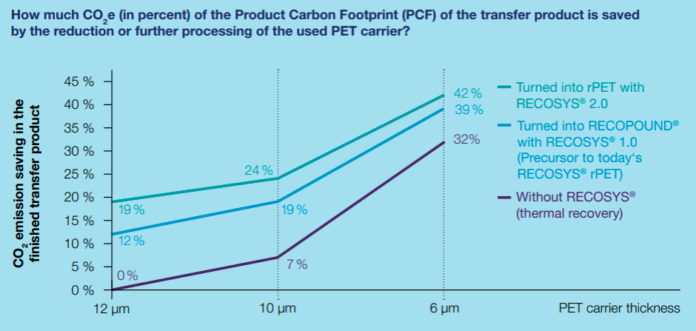
The company recorded another 20 percent reduction in 2023, with RECOSYS 2.0 providing the principal improvement. A further 30 percent reduction was reported in 2024 following the introduction of a slimmer PET programme.
The initiative reduced PET carrier thickness from 12 micrometres to 6 micrometres, cutting material demand by 50 percent.
KURZ’s LUXOR cold-transfer decoration technology has a reported carbon footprint of approximately 1.5 grams of CO2e per square metre and requires about 15 watts per square metre during application.
RECOSYS expands PET recycling and circularity
KURZ uses RECOSYS to recycle internally generated PET waste and encourages customers to return used carrier material through its collection and recycling network.
The company aims to increase the recycling rate for post-consumer waste by collecting used product materials and converting them into high-quality recycled PET.
Where mechanical recycling is not possible, PET can be used for energy recovery. Its polyester substrate has a calorific value of approximately 34,000 kilojoules per kilogram, enabling it to replace fossil fuels such as coal and heating oil in applications including cement production.
KURZ evaluates waste streams at least once a year and trains employees in waste avoidance, separation, recovery and safe handling.
Supplier assessments support emissions reductions
The high contribution of raw materials to product emissions makes supplier sustainability a major component of KURZ’s climate strategy. Supplier evaluations include environmental criteria such as ISO 14001 certification, alongside quality, logistics and purchasing performance.
KURZ is also collecting more primary Scope 3 data to improve its understanding of indirect emissions. However, the Sustainability Report 2025 does not disclose absolute company-wide Scope 1, Scope 2 or Scope 3 emissions.
Most of the report’s detailed environmental indicators cover the German facilities at Fuerth and Sulzbach-Rosenberg rather than KURZ’s entire global operation.
Social sustainability covers trainees, mobility and remote work
KURZ hired 11 trainees in 2025 and reported an employee turnover rate of approximately 7 percent.
The company supports lower-emission employee mobility through its Job Bike Scheme. It also offers flexible working arrangements, including remote work for up to 40 percent of working time in eligible roles and up to 80 percent for certain IT positions.
KURZ provides 48 working-time models to accommodate different employee requirements. At its German sites, the lowest tariff-based remuneration is approximately 36 percent above the statutory minimum wage.
EcoVadis places KURZ among top 15 percent
KURZ received an EcoVadis Silver Medal in 2025, placing the company within the top 15 percent of assessed companies globally and the top 6 percent in its industry.
The company recorded five potential business-ethics non-compliance cases during the reporting period. One case was confirmed, and remedial measures were identified.
KURZ reported zero significant monetary fines and zero non-monetary sanctions associated with social and economic non-compliance.
Renewable energy supports KURZ’s 2040 climate target
KURZ’s decarbonisation programme is moving from electricity-related improvements towards more challenging sources such as industrial heat, solvents and upstream raw materials.
The company has nearly eliminated Scope 2 emissions, generated more than 13 GWh of solar electricity and established projects targeting 12,500 tonnes of annual CO2e savings from solvents and heat generation.
Additional projects scheduled for 2026 could save 4.76 million kWh of energy annually, while the Sulzbach-Rosenberg power-to-heat installation alone is expected to avoid around 700 tonnes of CO2 per year.
At product level, the 72 percent contribution from PET and other raw materials underlines the importance of recycled content, thinner carrier films, supplier engagement and lower-carbon material formulations. These measures provide the operational foundation for KURZ’s ambition to achieve CO2 neutrality by 2040.
SHAFANA FAZAL