DEN Networks reduced its combined Scope 1 and Scope 2 greenhouse gas emissions by 18.2 percent in FY 2025-26, reflecting progress in electricity efficiency, fuel conservation and operational decarbonisation. However, the company reported zero renewable energy consumption and has not announced a fixed net-zero deadline or quantified renewable electricity target.
Total Scope 1 and Scope 2 emissions declined to 3,003.73 tonnes of CO2 equivalent in FY 2025-26 from 3,672.01 tonnes in FY 2024-25. Electricity continued to dominate the emissions profile, making the transition to renewable power critical to DEN Networks’ future sustainability performance.
Scope 1 Emissions Fall 49.8 Percent
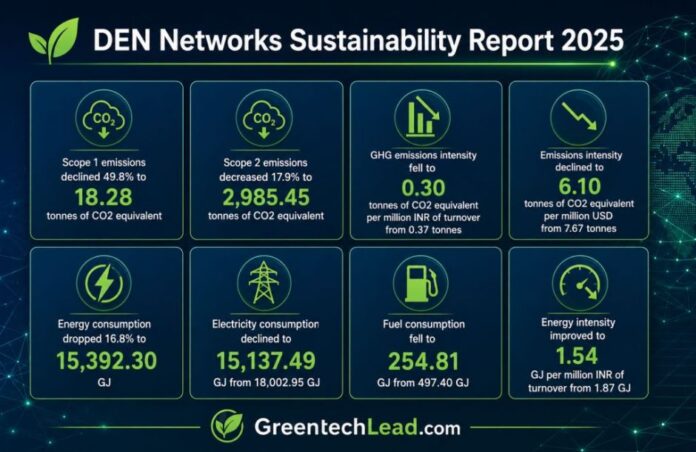
DEN Networks’ Scope 1 emissions decreased 49.8 percent to 18.28 tonnes of CO2 equivalent from 36.42 tonnes. Scope 2 emissions, primarily associated with purchased electricity, declined 17.9 percent to 2,985.45 tonnes from 3,635.59 tonnes.
GHG emissions intensity per million INR of turnover improved to 0.30 tonnes of CO2 equivalent from 0.37 tonnes. Emissions intensity adjusted for purchasing power parity decreased to 6.10 tonnes of CO2 equivalent per million USD from 7.67 tonnes.
Scope 3 emissions are not currently captured or reported by DEN Networks. No independent external assessment or assurance was conducted for the disclosed Scope 1 and Scope 2 emissions data.
Energy Consumption Drops 16.8 Percent to 15,392.30 GJ
Total energy consumption declined 16.8 percent to 15,392.30 GJ in FY 2025-26 from 18,500.35 GJ in FY 2024-25.
Electricity consumption fell 15.9 percent to 15,137.49 GJ from 18,002.95 GJ, while fuel consumption dropped 48.8 percent to 254.81 GJ from 497.40 GJ.
Energy intensity per million INR of turnover improved to 1.54 GJ from 1.87 GJ. Energy intensity adjusted for purchasing power parity decreased to 31.28 GJ per million USD from 38.64 GJ.
The decline in electricity consumption is particularly important because Scope 2 accounted for around 99.4 percent of the company’s combined Scope 1 and Scope 2 emissions in FY 2025-26.
Renewable Energy Consumption Remains at Zero
DEN Networks reported zero electricity, fuel and other energy consumption from renewable sources in both FY 2025-26 and FY 2024-25. Consequently, all 15,392.30 GJ consumed during FY 2025-26 came from non-renewable sources.
The company is exploring cleaner electricity through open-access arrangements, but it has not disclosed a quantified renewable energy generation or consumption figure. It also has not announced a specific renewable energy percentage target.
Increasing renewable electricity procurement could provide one of the most direct routes for reducing Scope 2 emissions, which totaled 2,985.45 tonnes of CO2 equivalent during the year.
DEN Networks Has Not Announced a Net-Zero Target
DEN Networks has not disclosed a fixed-year net-zero target or quantified interim targets for reducing Scope 1, Scope 2 or Scope 3 emissions.
The company also stated that it does not currently operate a project dedicated exclusively to GHG reduction. Its existing measures include replacing diesel generators with electric generators, deploying energy-efficient LED lighting, reducing printer usage, digitising business processes and promoting green electricity through open-access arrangements.
Establishing a net-zero deadline supported by interim emissions and renewable-energy targets would provide measurable benchmarks for assessing the company’s long-term climate progress.
Set-Top Box Refurbishment Rate Rises to 29.96 Percent
DEN Networks is strengthening circular resource management through the refurbishment, cleaning, repackaging and redistribution of used set-top boxes.
Refurbished equipment represented approximately 29.96 percent of all set-top boxes distributed to customers in FY 2025-26. This marks a substantial improvement from the 11.66 percent refurbishment figure reported for the earlier period referenced in the company’s previous sustainability information.
The initiative extends equipment lifecycles, reduces demand for newly manufactured set-top boxes and limits the environmental impact associated with electronic equipment disposal.
E-Waste and Battery Waste Decline to 38.49 Metric Tons
DEN Networks generated 32.32 metric tons of e-waste in FY 2025-26, down from 41.63 metric tons in FY 2024-25. Battery waste declined to 6.17 metric tons from 19.74 metric tons.
Combined e-waste and battery waste therefore decreased 37.3 percent to 38.49 metric tons from 61.37 metric tons. The materials were managed through approved buy-back arrangements and registered recycling partners.
The company reported zero plastic, biomedical, construction and demolition, radioactive and other hazardous waste in FY 2025-26.
Zero Fatalities and Lost-Time Injuries Support Social Sustainability
DEN Networks recorded zero fatalities and zero lost-time injuries during the reporting period. Workplace safety measures and health and accident insurance coverage form part of the company’s approach to employee protection and social sustainability.
Renewable Electricity Is the Next Sustainability Opportunity
DEN Networks achieved measurable improvements in FY 2025-26 by reducing combined Scope 1 and Scope 2 emissions to 3,003.73 tonnes of CO2 equivalent and cutting total energy consumption to 15,392.30 GJ.
The reduction in emissions, lower energy intensity, 29.96 percent set-top box refurbishment rate and decline in e-waste and battery waste demonstrate operational progress. However, zero renewable energy consumption, the absence of Scope 3 reporting and the lack of a time-bound net-zero target remain important gaps in the company’s climate strategy.
SHAFANA FAZAL