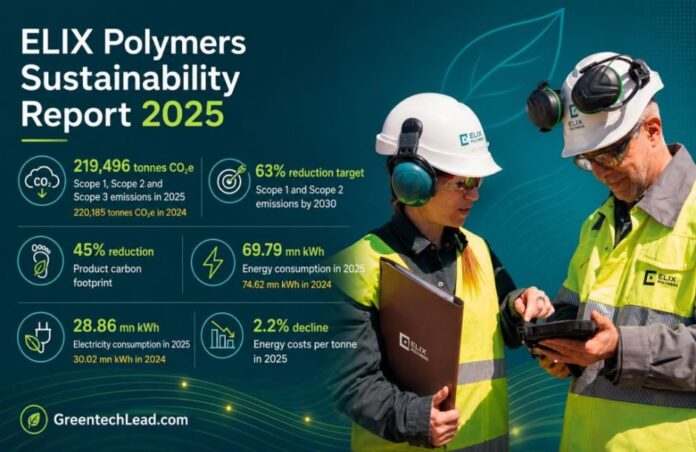
ELIX Polymers is accelerating its sustainability strategy through lower greenhouse gas emissions, renewable-certified electricity, energy efficiency, product decarbonisation and circular resource management. The company aims to achieve net-zero emissions by 2050 and reduce Scope 1 and Scope 2 emissions by 63 percent by 2030 from the 2020 baseline, in line with Science Based Targets initiative criteria.
Its emissions-intensity roadmap targets a decline from 0.215 tonnes of CO2 equivalent per tonne of sales in 2020 to 0.077 tonnes by 2030. ELIX also plans to reduce Scope 3 emissions by 2030 using SBTi requirements and methodologies, ELIX Polymers CEO David Castaneda said.
ELIX Polymers GHG emissions decline in 2025
ELIX Polymers sustainability report indicated that total market-based Scope 1, Scope 2 and Scope 3 emissions declined to 219,496 tonnes of CO2 equivalent in 2025 from 220,185 tonnes in 2024.
Scope 1 emissions decreased to 3,732 tonnes from 4,220 tonnes, while market-based Scope 2 emissions edged down to 5,570 tonnes from 5,588 tonnes. Combined market-based Scope 1 and Scope 2 emissions fell to 9,301 tonnes from 9,808 tonnes.
Location-based Scope 2 emissions declined to 12,855 tonnes of CO2 equivalent from 13,705 tonnes.
Scope 3 remained the dominant component of ELIX Polymers’ carbon footprint, reaching 210,194 tonnes of CO2 equivalent in 2025, compared with 210,377 tonnes in 2024. Upstream Scope 3 emissions increased to 208,122 tonnes from 206,321 tonnes, while downstream emissions dropped to 2,072 tonnes from 4,056 tonnes.
Overall organisational emissions intensity improved marginally to 2.96 tonnes of CO2 equivalent per tonne of ABS and sales from 2.97 tonnes in 2024. ELIX said its 2025 emissions data are provisional and have not yet been validated by the Catalan Office for Climate Change.
Product carbon footprint falls 45 percent
ELIX Polymers reduced the carbon footprint covering Scope 1, Scope 2 and Scope 3.9 customer-transport emissions by 45 percent against the 2017 baseline, substantially exceeding its original 15 percent reduction target.
The report also presents product carbon footprint intensity of 2.22 tonnes of CO2 per tonne of sales in 2025, compared with 2.99 tonnes in 2017, representing a separately reported reduction of 27 percent.
ELIX is using Life Cycle Assessment based on ISO 14040 and ISO 14044 to assess production from a cradle-to-gate perspective and support the development of lower-impact products.
Renewable-certified electricity supports decarbonisation
ELIX Polymers reported that 100 percent of its electricity consumption is covered by Renewable Guarantees of Origin. Under market-based accounting, no GHG emissions are therefore associated with this electricity consumption.
Total energy consumption declined to 69,792,776 kWh in 2025 from 74,619,200 kWh in 2024 and 70,760,156 kWh in 2023.
Electricity consumption decreased to 28,860,000 kWh from 30,018,000 kWh in 2024, while natural gas use fell to 20,940,000 kWh from 23,379,000 kWh. Steam consumption declined to 19,992,776 kWh from 21,222,200 kWh.
Specific energy consumption stood at 927 kWh per tonne sold. Specific energy costs per tonne decreased by 2.2 percent in 2025, surpassing the company’s 1 percent reduction target. Its decarbonisation roadmap includes energy-efficiency improvements, operational controls, renewable electricity, green steam and boiler electrification.
Water consumption falls 15 percent
ELIX reduced water consumption by 15 percent compared with 2017, meeting its stated target. Water intensity declined to 1.21 cubic metres per tonne sold in 2025 from 1.43 cubic metres in 2017.
The company’s 2025–2030 sustainability strategy includes an additional commitment to reduce water consumption per tonne of ABS produced by 2030, using 2020 as the base year.
Raw-material efficiency rises to 97.3 percent
ELIX achieved a historic raw-material efficiency rate of 97.3 percent in 2025, up from 96.6 percent in 2024.
Material-waste generation improved to 1.05 percent per tonne of ABS and sales from 1.49 percent. Residual monomer generation declined to 0.21 tonnes per tonne of SAN from 0.27 tonnes.
The company recovered 88 percent of its waste and maintained its Operation Clean Sweep certification, reinforcing its commitment to preventing plastic pellet losses across its operations.
Sustainable transport, comprising intermodal transport and road transport using sustainable fuels, represented 65 percent of transport to customers in 2025, exceeding the company’s target.
ELIX also evaluated 70 percent of relevant suppliers against environmental and social criteria. This assessment is important because upstream activities accounted for 208,122 tonnes of its Scope 3 emissions.
ELIX spends €1.823 million on environmental protection
ELIX Polymers allocated €1.823 million to environmental protection during 2025. The total included €99,000 in environmental investment and €1.724 million in operational environmental expenditure.
The spending supports the company’s wider environmental programme, covering emissions reduction, energy efficiency, water conservation, sustainable transportation, waste recovery, responsible sourcing and the prevention of pellet losses.
With its 63 percent Scope 1 and Scope 2 reduction target for 2030 and net-zero ambition for 2050, ELIX Polymers is linking operational decarbonisation with renewable energy, product carbon-footprint reductions and circular resource management. However, addressing upstream Scope 3 emissions will remain critical because they account for most of the company’s reported carbon footprint.
SHAFANA FAZAL