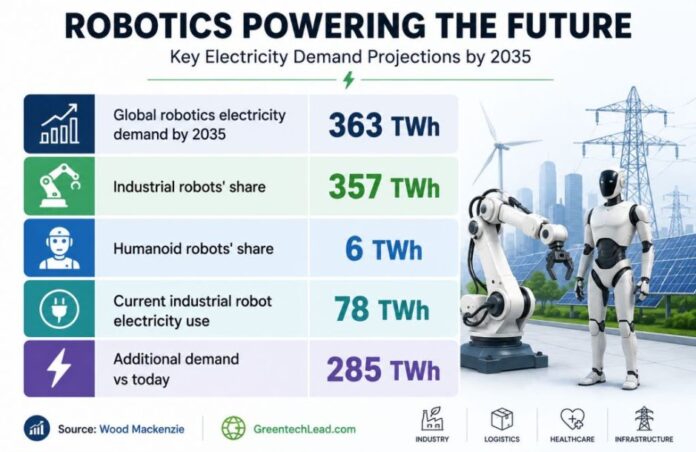
The global robotics industry is set to become a major new source of electricity demand, with Wood Mackenzie forecasting that industrial and humanoid robots will consume 363 TWh of electricity annually by 2035. The projected load would approach France’s 373 TWh of nuclear generation in 2025, highlighting how embodied AI is emerging as a significant electricity consumer alongside AI data centers.
The forecast marks a sharp increase from today’s 78 TWh annual electricity consumption by the world’s 5 million industrial robots. By 2035, robotics would add around 285 TWh of additional annual demand, equivalent to 4.7 times today’s industrial-robot electricity load and enough to power roughly 35 million average US households.
Industrial robots will account for 357 TWh by 2035
The latest Wood Mackenzie report said industrial automation will dominate near-term electricity growth. Wood Mackenzie expects industrial robots to consume 357 TWh annually by 2035, while humanoid robots account for 6 TWh, meaning industrial machines will represent around 98 percent of total robotics electricity demand.
The industrial robot fleet is projected to expand from 5 million units today to 16 million by 2035, supported by approximately 12 percent annual fleet growth.
Annual industrial robot installations have already increased from around 200,000 units in 2015 to 500,000 units, with deployments expected to exceed 1 million units annually by 2032.
ABB, FANUC, KUKA and Yaskawa lead industrial robotics
Established manufacturers including ABB, FANUC, Yaskawa Electric, KUKA, Mitsubishi Electric, Kawasaki Heavy Industries, Denso, Omron, Stäubli, Comau, Universal Robots and Siasun Robot & Automation continue to supply robotic systems for automotive manufacturing, electronics, logistics and industrial automation.
Their expanding production capacity is expected to support the rapid growth from today’s 5 million industrial robots to 16 million over the next decade.
Tesla, Figure AI and Unitree expand humanoid robotics
The humanoid robotics market is evolving rapidly as companies including Tesla, Figure AI, Agility Robotics, Apptronik, 1X, Unitree Robotics and UBTECH move from pilot deployments toward commercial production.
Wood Mackenzie estimates that average humanoid robot prices fell by 93 percent between 2020 and 2025, reducing average prices to about US$58,000.
Unitree Robotics’ G1, priced at approximately US$16,000, illustrates how lower-cost platforms could accelerate commercial adoption.
Operating costs also remain relatively modest. At a global average industrial electricity tariff of US$0.14 per kWh, operating a Unitree G1 for 8 hours daily would cost roughly US$82 annually in electricity.
Major industrial robotics companies are increasing investments in manufacturing capacity, AI-powered automation, R&D and regional operations as demand grows across factories, logistics, semiconductors and infrastructure. FANUC, Yaskawa Electric, ABB and KUKA are among the companies making significant commitments, while Comau is expanding through acquisitions and Universal Robots is strengthening its US operations.
Major investments
FANUC announced in March 2026 that FANUC will invest $90 million, or approximately ¥14.3 billion, to acquire land and construct a new 840,000-square-foot, or approximately 78,000-square-meter, facility in Michigan. The project will create production-ready capacity for potential expansion of FANUC’s US robot manufacturing operations and is expected to create 225 jobs.
Yaskawa Electric announced a $180 million investment for a new campus in Franklin, Wisconsin. Yaskawa has also outlined a broader cumulative investment plan of ¥250 billion.
ABB announced $75 million of investment in India during 2026 to strengthen manufacturing and R&D capabilities serving industrial and infrastructure markets. The program includes $12 million during 2026 for the first phase of a multi-phase laboratory and office development in Hyderabad.
KUKA invested €213 million in research and development during 2025, its highest annual R&D expenditure. Its Automation 2.0 strategy focuses on Physical AI, intelligent software, conventional industrial robots and autonomous mobile robots.
Mitsubishi Electric expanded its manufacturing footprint in India with an investment of ₹2,100 crore in a facility in Tamil Nadu. The company supplies factory-automation technologies including industrial robots, CNC systems, servo systems and programmable controllers.
Kawasaki Heavy Industries was reported in July 2026 to be preparing to raise approximately ¥200 billion, or $1.23 billion, through new shares and convertible bonds to finance capital expenditure.
DENSO announced a $69 million investment in a new manufacturing facility in Lebanon, Tennessee, in January 2026. DENSO has extensive factory-automation capabilities, while DENSO WAVE develops industrial robots. The $69 million project, however, represents a broader manufacturing investment rather than a dedicated robotics factory.
OMRON has established a specialized robotics organization in Europe supported by Automation and Robotics Centers of Excellence in Annecy, Barcelona and Dortmund, along with an Automation Center in Stuttgart and Proof-of-Concept laboratories. In 2026, OMRON Robotics also expanded its autonomous mobile robot portfolio with the LD-150 and LD-300, targeting higher-throughput internal material transportation.
China dominates global robot deployment
China has emerged as the world’s largest robotics market, accounting for more than 70 percent of annual global industrial robot installations and nearly 90 percent of deployed humanoid robots.
The country’s leadership is becoming increasingly important for both manufacturing and electricity planning as automated factories create concentrated local electricity demand.
A major example is China State Grid’s 2026 procurement program worth US$1 billion (approximately 6.8 billion yuan) to purchase 8,500 AI-enabled autonomous robots across more than 600 specialized applications.
The deployment includes:
5,000 quadruped robots
3,000 dual-arm wheeled robots
500 humanoid robots
These robots will perform tasks including substation inspections and live-line maintenance on ultra-high-voltage transmission infrastructure.
Humanoid robots could exceed 10 million units
While humanoids contribute only 6 TWh of projected electricity demand by 2035, their growth trajectory is significantly faster than industrial robots.
Wood Mackenzie forecasts:
More than 90 percent CAGR between 2025 and 2035
Global humanoid stock exceeding 10 million units by 2035
Annual humanoid shipments surpassing 4 million units
The firm also models a longer-term scenario where 1 billion humanoid robots by 2050 could consume electricity equivalent to South Korea’s entire annual electricity generation.
AI and labor shortages accelerate automation
Wood Mackenzie identifies several structural drivers supporting robotics adoption:
Labor shortages
Rising labor costs
Supply-chain resilience
Computer vision advances
Large language models
Reinforcement learning
These factors are improving robot capabilities while reducing deployment costs across manufacturing, logistics, healthcare and infrastructure operations.
Robotics creates a new electricity load beyond AI data centers
Wood Mackenzie emphasizes that the 363 TWh forecast measures only the electricity required to operate physical robots. Electricity used to train robotics-related AI models remains part of existing data-center electricity estimates and is excluded to avoid double counting.
This distinction is becoming increasingly important as AI expands beyond software into physical machines operating across factories, warehouses and critical infrastructure.
Local power grids could become the next bottleneck
Robert Liew, Director of Integrated Energy Research at Wood Mackenzie, warns that local transmission and distribution constraints could slow robotics deployment even where countries have sufficient overall electricity generation.
Industrial clusters with rapidly expanding robot fleets may require significant upgrades to local grid infrastructure to support automation.
SHAFANA FAZAL