
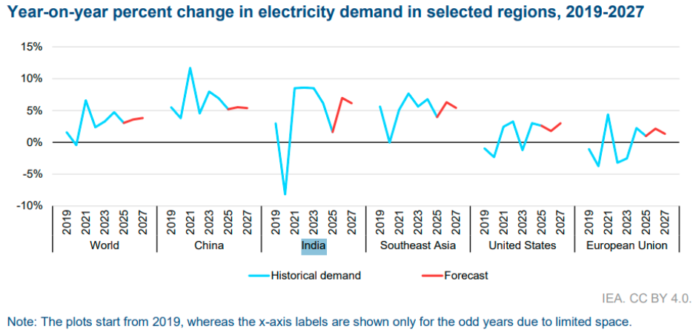
India’s electricity demand is set for a strong recovery in 2026, with the International Energy Agency (IEA) forecasting annual growth of 7 percent, up sharply from 1.6 percent in 2025, as rising industrial activity, electrification, heatwaves and renewable energy investments boost power consumption across the country. The IEA expects another 6 percent growth in 2027, underlining India’s position as one of the world’s fastest-growing electricity markets.
The report said India’s electricity consumption increased by around 6 percent during the first half of 2026, supported by stronger industrial and services sector activity as well as prolonged heatwaves between mid-April and early June. Electricity demand surged 11 percent year-on-year in May, while cooling degree days increased 7 percent, reflecting heavy air-conditioning usage during extreme temperatures.
India recorded its highest-ever electricity demand during the summer, with peak load touching 270.8 GW at 3:45 pm on 21 May, after setting new records for four consecutive days between 18-21 May. Solar photovoltaic generation played a major role in meeting demand, contributing 22 percent of the daytime peak or approximately 60 GW. However, evening demand continued to require rapid ramp-up of coal- and gas-fired power plants, while electricity shortages during January-May 2026 were more than double those of the same period last year. In some northern states, including Punjab, Haryana and Uttarakhand, unmet electricity demand reached 2 percent of monthly demand during April.
The IEA expects weather to remain a critical factor for India’s electricity market. The monsoon arrived on 4 June, three days later than normal, while the India Meteorological Department forecasts the weakest monsoon rainfall in 11 years. Lower rainfall could increase electricity consumption for agricultural irrigation pumps and cooling across the country, supporting continued demand growth.
On the supply side, coal-fired electricity generation increased by around 3 percent during the first half of 2026 after declining in 2025. The Ministry of Power directed imported coal-fired plants to operate at full capacity between April and June to ensure adequate electricity supply during peak summer demand. Renewable energy continued to expand rapidly, with combined solar and wind generation rising by more than 25 percent, increasing their share of India’s electricity mix to 16.5 percent from 14 percent a year earlier. Solar power generation climbed 31 percent, wind generation increased by more than 12 percent, while hydropower output declined by over 2.5 percent because of weak hydrological conditions. Nuclear generation rose by more than 11 percent, supported by the 700 MW Rajasthan Atomic Power Project Unit 7 reaching rated capacity.
The IEA forecasts India’s coal-fired generation to grow 3 percent in 2026 and another 1.5 percent in 2027. Gas-fired generation is expected to decline around 5 percent this year before rebounding by nearly 10 percent in 2027. Nuclear power generation is projected to surge 30 percent in 2026, helped by Rajasthan Atomic Power Project Unit 8 and the restart of two 160 MW reactors at Tarapur, followed by another 22 percent increase in 2027. Solar photovoltaic generation is forecast to jump 39 percent in 2026 and 24 percent in 2027, while wind power is expected to rise 4 percent and 8 percent, respectively.
BABURAJAN KIZHAKEDATH
