India is heading toward another record year for solar energy, with annual installations expected to exceed 50 GWdc in 2026, potentially surpassing the 49 GWdc record in 2025. The country installed 34 GWdc in the first half of 2026, up 38 percent year over year, but a widening gap between module and solar cell manufacturing is emerging as a major constraint.
The implementation of Approved List of Models and Manufacturers Phase II (ALMM-II) in June 2026 requires eligible government-supported projects to use modules incorporating domestically manufactured cells from approved suppliers. The policy is strengthening domestic manufacturing but has also exposed India’s shortage of locally produced cells.
India Could Face 21 GW Solar Cell Supply Gap
The Wood Mackenzie report projects Indian cell production at approximately 29 GW in 2027, compared with average annual module demand of around 50 GW, potentially creating a 21 GW supply gap.
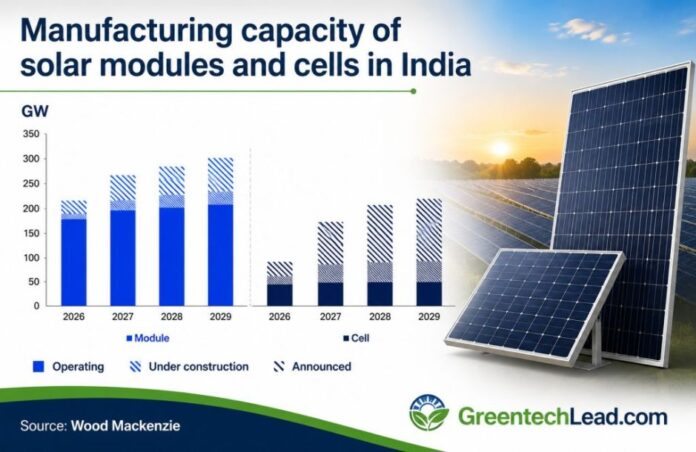
India’s manufacturing expansion has been heavily concentrated on modules. Total module manufacturing capacity reached approximately 210 GW by December 2025, after around 119 GW was added during 2025. Cell manufacturing capacity, in comparison, stood at only around 27 GW.
By March 2026, ALMM-enlisted module capacity reached approximately 173 GW, versus around 30 GW of cell capacity — a module-to-cell ratio of more than 5:1. By May, ALMM-enlisted module capacity had expanded further to approximately 194 GW, while cell capacity remained around 30 GW.
The actual supply situation is even tighter. Effective cell operating capacity was estimated at only 16-18 GW, compared with nominal capacity of around 27-30 GW, as some factories were still being commissioned or operating below full utilization.
Solar Cell Capacity Could Approach 100 GW in 2027
Indian manufacturers are responding with aggressive investment. Cell capacity could exceed 70 GW by March 2027 and approach 100 GW by December 2027, with more than ₹350 billion reportedly being invested in cell-line expansion.
However, the industry remains highly concentrated. The top 10 manufacturers controlled around 44 percent of module capacity but approximately 99.5 percent of cell capacity at the end of 2025.
Around 14 GW of cell capacity is under construction, while another 130 GW is expected by 2029. Against an estimated 88 GW full-build baseline, the expansion requires a compound annual growth rate of approximately 49 percent.
Waaree, Premier Energies, Adani, Vikram Solar Expand Manufacturing
Leading manufacturers are moving toward greater vertical integration. Waaree Energies’ Chikhli facility has received ALMM List-II approval for 5.25 GW of annual cell capacity. Waaree is also planning a 10 GW ingot and 10 GW wafer manufacturing facility in Nagpur, involving investment of approximately ₹6,200 crore.
Premier Energies, Adani Solar, Vikram Solar and Emmvee are also expanding their cell and module manufacturing operations as ALMM-II increases demand for domestic components.
India’s major solar manufacturers are increasingly pursuing backward integration to reduce exposure to imported cells and strengthen their position under ALMM-II.
Waaree Energies is among the most prominent examples. Its Chikhli facility has received ALMM List-II approval for 5.25 GW of annual cell capacity. The company has also announced plans for a 10 GW integrated ingot and 10 GW wafer manufacturing facility in Nagpur, representing an investment of approximately ₹6,200 crore.
Premier Energies, Adani Solar, Vikram Solar and Emmvee are also expanding their cell and module manufacturing footprints. These investments are significant because they demonstrate a shift from India’s earlier module-heavy manufacturing model toward greater vertical integration.
Cell Shortage Could Push Solar Prices Up 20%
The supply deficit is expected to have a significant impact on solar project economics. Wood Mackenzie forecasts that India’s utility-scale solar system prices will rise 20 percent by Q4 2026 because of cell shortages.
Prices are then forecast to decline by only 3 percent between Q4 2026 and Q4 2027, with meaningful stabilization potentially delayed until 2029.
The shortage has already affected smaller manufacturers. Around one-third of small and medium-sized Indian solar panel manufacturers reportedly halted production because of cell shortages, with some waiting as long as eight months for supplies. Approximately $4 billion of investment and 75,000 jobs were reported to be at risk, particularly in Gujarat.
India Imports 20 GW of Solar Cells
Import dependence remains substantial. India imported approximately 20 GW of cells and 5 GW of wafers during the first five months of 2026, while wafer imports jumped 86 percent year over year.
Direct cell imports from China have declined following ALMM-II, while Southeast Asian suppliers have gained ground. Imports of Indonesian cells nearly tripled during the early months of 2026. India also maintains a 20 percent basic customs duty on imported solar cells and modules.
ALMM-III Could Create Next Solar Supply Bottleneck
The next localization challenge will move further upstream. ALMM-III is scheduled for June 2028 and is expected to extend domestic-content requirements to solar wafers.
More than 99 percent of India’s wafer requirements currently depend on imports, raising the risk that rapid cell expansion could simply shift the supply bottleneck from cells to wafers.
Meanwhile, India’s total non-fossil electricity generation capacity reached 300.50 GW as of July 31, 2026, putting the country more than 60 percent of the way toward its 500 GW non-fossil capacity target for 2030.
India therefore faces a critical manufacturing challenge: support solar installations of more than 50 GWdc annually, close the potential 21 GW cell supply gap, expand wafer and ingot manufacturing, and prevent higher domestic-content requirements from undermining project economics.
With cell capacity potentially approaching 100 GW by December 2027 and another 130 GW expected by 2029, India is moving rapidly from a solar deployment boom toward an integrated solar manufacturing race. The success of ALMM-II and future ALMM-III requirements will depend on whether upstream manufacturing can expand fast enough while maintaining competitive prices and sustainable factory utilization.
SHAFANA FAZAL