
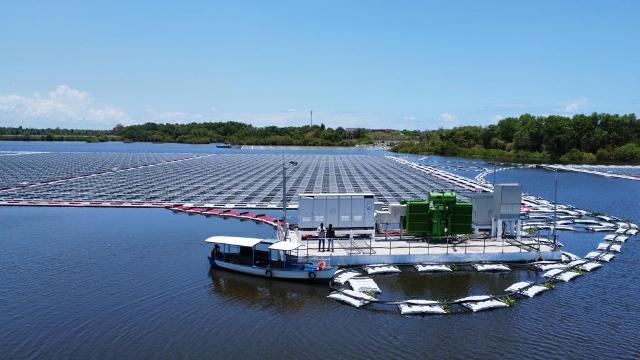
India has approved the Pradhan Mantri Surya Sarovar Yojana (PM-SSY) with a total outlay of Rs 5,070 crore to accelerate the deployment of 5,000 MW of Floating Solar Photovoltaic (FSPV) projects integrated with Energy Storage Systems (ESS) across India.
Under the PM-SSY, India will develop 5,000 MW of floating solar projects with co-located energy storage systems offering a minimum storage duration of two hours, equivalent to 10,000 MWh of storage capacity. Projects will be sanctioned between FY 2026-27 and FY 2030-31, while financial assistance will continue to be disbursed until FY 2032-33.
National Institute of Solar Energy (NISE) estimated India’s floating solar potential at 102.18 GWp across reservoirs and other suitable inland water bodies, highlighting the opportunity for expanding renewable energy generation without increasing pressure on land resources.
India government will provide Central Financial Assistance (CFA) of Rs 1 crore per MW for floating solar projects after commissioning. Additionally, developers can receive up to Rs 50 lakh per project for feasibility studies, including bathymetry, hydrography, environmental assessments, and other preparatory activities that reduce project risks.
The scheme will benefit all States and Union Territories, increasing India’s installed floating solar capacity from around 700 MW to 5,700 MW after full implementation. By utilizing existing reservoirs and industrial ponds, the programme will avoid competition for scarce land while enabling large-scale renewable energy deployment.
The government estimates that the projects will reduce 10 million tonnes of CO₂ emissions annually and create around 16,000 to 17,000 full-time equivalent jobs across the floating solar value chain. The initiative is expected to strengthen domestic manufacturing of floating platforms, photovoltaic cells, solar modules, and energy storage systems.
NTPC Group is India’s largest public-sector renewable energy developer and a key player in floating solar. The company has commissioned multiple floating solar plants, including the 100 MW Ramagundam Floating Solar Project in Telangana. In 2026, THDC India, an NTPC Group company, declared commercial operation of an 11 MW floating solar plant at the Khurja Super Thermal Power Project, while NSPCL commissioned the remaining 5 MW capacity of its Bhilai floating solar station. NTPC Group has crossed 90 GW of installed power capacity, has around 32 GW under construction, and targets 149 GW by 2032, including 60 GW from renewable energy.
NHPC is another major floating solar developer. In March 2026, the company began construction of a 50 MW floating solar project at West Kallada, Kerala, with an investment of more than Rs.260 crore. NHPC has also announced plans to significantly expand its floating solar portfolio across reservoirs in multiple states.
Tata Power Renewable Energy has developed some of India’s landmark floating solar assets, including the 101.6 MWp Kayamkulam Floating Solar Project in Kerala. The company continues to expand its renewable portfolio, which totals 11,638 MW including projects under construction. It currently operates 6,533 MW of renewable capacity, has 5,105 MW under construction, and generated 10.76 billion units of renewable electricity during FY 2025-26.
Adani Green Energy is expanding its utility-scale renewable energy portfolio through large solar, wind, and hybrid projects. While its primary investments are concentrated in the 30 GW Khavda renewable energy park in Gujarat.
ReNew Energy Global continues investing in large renewable energy parks integrating solar, wind, and battery storage. Its development strategy focuses on utility-scale clean energy projects and positions the company as a potential participant in future floating solar tenders supported by the new government scheme.
SJVN Green Energy, NTPC Green Energy, SECI, and several state utilities are also advancing floating solar deployments through competitive tenders and reservoir-based projects.
SHAFANA FAZAL
