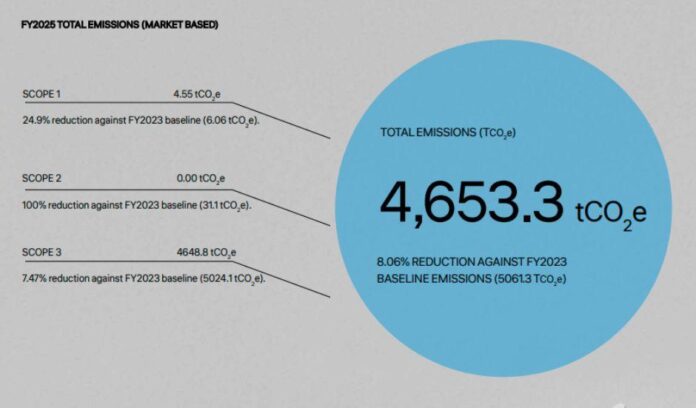
Colebrook Bosson Saunders (CBS) reduced its total greenhouse gas emissions by 8.06 percent against its FY2023 baseline, according to the CBS Sustainability Report 2026. The workplace ergonomics and product-design company also achieved an 87.8 percent reduction in combined Scope 1 and Scope 2 emissions and sourced 100 percent renewable electricity across its operations.
CBS reported FY2025 emissions of 4,653.3 tCO2e, compared with 5,061.3 tCO2e in FY2023 and 6,312.3 tCO2e in FY2024. Total emissions fell approximately 26 percent between FY2024 and FY2025.
CBS targets net-zero emissions
CBS aims to achieve net-zero Scope 1 and Scope 2 emissions by 2030 and net zero across all three emission scopes by 2050.
The company is targeting a 35 percent reduction in Scope 3 emissions by 2030 from the FY2023 baseline. It has completed 21.3 percent of the required reduction, with the FY2030 Scope 3 target set at 3,265 tCO2e. CBS must eliminate another 1,383 tCO2e to reach this goal.
The company plans to begin offsetting residual, hard-to-abate Scope 1 emissions using verified carbon credits from 2030, corresponding to FY2031.
Scope 3 emissions exceed 99 percent of footprint
Combined Scope 1 and Scope 2 emissions declined from 37.16 tCO2e in FY2023 to 4.55 tCO2e in FY2025.
Scope 1 emissions fell 24.9 percent from 6.06 tCO2e to 4.55 tCO2e. Market-based Scope 2 emissions decreased 100 percent from 31.1 tCO2e to zero following the transition to renewable electricity.
Scope 3 remained CBS’s primary decarbonisation challenge, accounting for more than 99 percent of its carbon footprint. These emissions declined 7.47 percent from the FY2023 baseline of 5,024.1 tCO2e to 4,648.8 tCO2e in FY2025.
Purchased products generated 72 percent of Scope 3 emissions, while emissions associated with waste fell 40 percent from the FY2023 baseline.
Product redesign cuts lifecycle emissions
CBS expanded carbon-footprint studies from 74 percent to 97 percent of products sold. The company uses lifecycle assessments to identify reductions through product redesign, material changes and lower product weight.
In FY2025, 30 percent of its top-selling products achieved carbon-footprint reductions exceeding 30 percent. These products represented 71 percent of net sales. CBS defines its wider group of top-selling products as products accounting for 80 percent of FY2025 net sales.
The Flo monitor arm reduced its lifecycle carbon footprint by 33.2 percent, avoiding 402 tCO2e for every 100,000 units. Flo Modular achieved a 32.9 percent reduction and avoided 471 tCO2e per 100,000 units. Ollin delivered an 18.8 percent reduction, equivalent to 253 tCO2e avoided per 100,000 units.
CBS typically targets carbon-footprint reductions of between 25 percent and 35 percent or more when optimising high-volume products.
Recycled aluminium saves over 1,639 tCO2e
Recycled aluminium content at one of CBS’s largest manufacturing sites increased from 87 percent to 96 percent in FY2025. This change reduced emissions by more than 1,639 tCO2e.
Overall, 66.8 percent of products were designed with low-carbon aluminium containing between 92 percent and 96 percent recycled material.
Reported recycled-content levels reached 63.5 percent for Ollin, 61.4 percent for Flo X, 58 percent for Wishbone and 56 percent for Flo. CBS also evaluated more than 30 lower-carbon materials and introduced two new renewable materials.
Solar installation generates 696 MWh annually
CBS sourced 100 percent renewable electricity across its operations in FY2025, using Renewable Energy Certificates to reduce market-based Scope 2 emissions to zero.
The company intends to maintain this position through Renewable Energy Certificates, Power Purchase Agreements and on-site generation. It also began buying renewable gas in FY2026 to reduce Scope 1 emissions.
A rooftop solar installation covering approximately 3,200 square metres at a major CBS production site generates about 696 MWh annually. The installation meets around 55 percent of the facility’s grid-electricity consumption.
Product recyclability reaches 98 percent
Products representing 98 percent of FY2025 net sales were manufactured using fully recyclable materials. All top-selling products were fully recyclable, supporting the company’s 2030 goal of achieving 100 percent product recyclability.
CBS has take-back partners operating across three regions. These partnerships enable products to be reused, refurbished, remanufactured or responsibly recycled at the end of their initial service life.
Plastic-free packaging rises to 99.8 percent
Plastic-free packaging covered 99.8 percent of products sold in FY2025. CBS aims to reach 100 percent plastic-free product packaging by 2027 and transition all packaging globally to Forest Stewardship Council-certified materials by 2030.
Bulk-packaging changes for the Flo Monitor Arm reduced packaging weight from 475 grams to 283 grams per product, a 40.4 percent reduction. The redesigned packaging uses paper-based, renewable and recyclable materials.
PFAS removal and material transparency advance
Every product launched since March 2025 is free from intentionally added PFAS. CBS is phasing out remaining legacy materials and finished-product inventory, targeting global completion by the end of FY2027.
Products shipped to North America are already free from intentionally added PFAS, although certain electrical components remain outside the company’s global commitment.
Declare Labels now provide verified material-ingredient transparency for 94.4 percent of products based on FY2025 net sales. CBS said it achieved its 2026 transparency target for all new and top-selling products ahead of schedule.
The company also developed its first Digital Product Passport pilot in 2026, incorporating information about product materials, carbon footprints and lifecycles.
CBS reports social sustainability progress
Associate participation in volunteering and fundraising increased from 75 percent in FY2025 to 85 percent in FY2026. CBS is targeting 100 percent participation in its Day of Purpose programme by 2030.
The company’s STEM programme delivered 131 volunteer hours through 20 activities, reaching 3,575 students across six schools and organisations.
During its 2025 charity initiative, 20 CBS associates cycled 991 miles and raised £2,596 for mental-health charity Mind.
CBS’s future emissions performance will depend largely on product and supply-chain decarbonisation because Scope 3 represents more than 99 percent of its footprint. Its progress in recycled materials, product redesign, renewable energy, packaging and circularity provides the foundation for achieving its 2030 environmental targets.
SHAFANA FAZAL