Japan’s aim to reduce emissions from coal-fired power plants through ammonia co-firing faces rising costs, limited fuel supplies, technological uncertainty and deployment delays, according to a July 2026 briefing from the Institute for Energy Economics and Financial Analysis (IEEFA).
Ammonia is central to Japan’s Green Transformation strategy. However, its competitiveness is weakening as renewable energy and battery-storage technologies become more commercially attractive, the IEEFA report called Japan’s Ammonia Co-firing Strategy Constrained by Cost, Supply, and Timing.
Japan targets 20 percent ammonia co-firing by 2030
Japan’s Green Transformation roadmap, reaffirmed in April 2026, calls for a 20 percent ammonia co-firing rate across coal-fired power plants by 2030. The country plans to increase the blend to at least 50 percent after 2030 before moving toward fully zero-emission thermal generation using green or blue ammonia and hydrogen by 2050.
The strategy is designed to reduce emissions from existing coal plants while preserving dependable thermal power capacity. However, IEEFA Energy Finance Analyst Walter James warns that costs, supply constraints and delayed commercialisation could prevent ammonia from achieving the expected role.
Japan allocated JPY 586 billion to four hydrogen and ammonia support programmes in fiscal 2025. This included JPY 35.7 billion under the GX Transition Bond Hub Development Program for import infrastructure and supply-chain development.
The Japan Organization for Metals and Energy Security also provides Contract-for-Difference subsidies for periods of up to 15 years, covering part of the cost difference between conventional fuels and low-carbon ammonia.
Blue Point ammonia project cost rises to USD 4 billion
The Blue Point Complex in Louisiana illustrates the growing investment risks surrounding Japan’s ammonia supply strategy. CF Industries is developing the project with JERA and Mitsui & Co. to produce approximately 1.4 million metric tonnes of blue ammonia annually from 2029.
Its estimated capital cost has increased from more than USD 2 billion in 2022 to approximately USD 3 billion in 2023 and around USD 4 billion by 2025 and 2026.
IEEFA attributed the increase to construction inflation, labour shortages, higher equipment costs, tariffs and volatile natural gas prices.
The project also faces technology risks because it will use autothermal reforming combined with Carbon Capture and Storage. According to the briefing, this production method has not yet demonstrated reliable commercial-scale operations with full carbon capture.
Ammonia power could cost 464 percent more than solar
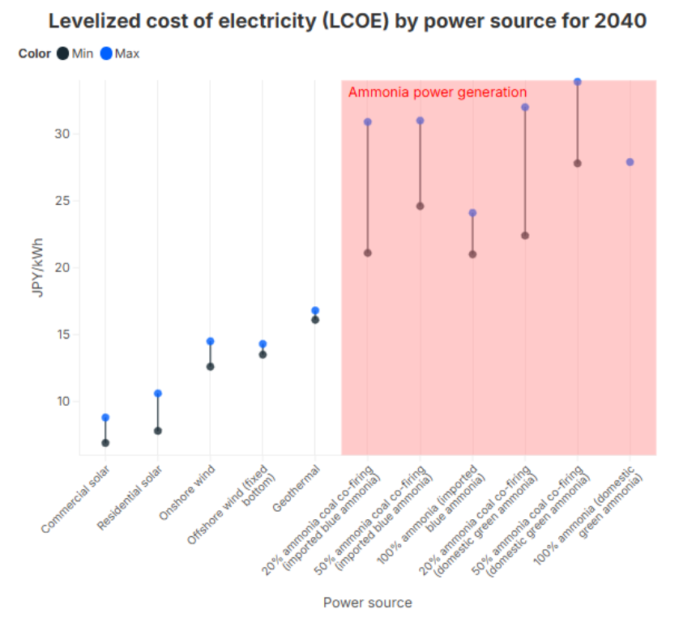
Cost competitiveness represents the biggest barrier to widespread ammonia use. Japan’s Ministry of Economy, Trade and Industry expects commercial solar generation costs to reach JPY 10.9 per kilowatt-hour by 2040, compared with JPY 16.3 per kilowatt-hour for onshore wind.
Electricity generated with a 20 percent ammonia blend could cost between 145 percent and 220 percent more than onshore wind. It could also be between 240 percent and 464 percent more expensive than commercial solar power.
These costs include ammonia production, Carbon Capture and Storage, liquefaction, international transportation, import terminals, storage facilities and modifications to coal-fired power plants.
Japan could require 20 million tonnes of ammonia annually
Japan currently consumes approximately 1.08 million metric tonnes of ammonia annually, mainly for industrial purposes. However, one 1-gigawatt coal-fired generating unit using a 20 percent ammonia blend would consume about 500,000 metric tonnes every year.
Expanding ammonia co-firing nationwide could raise Japan’s annual requirement to approximately 20 million metric tonnes. That volume would be roughly equivalent to the entire global ammonia trade recorded in 2019, highlighting the scale of the supply-chain challenge.
Commercial deployment is also falling behind the country’s ambitions. So far, only JERA’s 1-gigawatt Unit 4 at the 4.1-gigawatt Hekinan Thermal Power Station has demonstrated 20 percent ammonia co-firing at commercial scale.
Just four additional generating units are expected to begin commercial operations between fiscal years 2027 and 2030, making nationwide implementation by 2030 increasingly difficult.
IEEFA recommends more renewable energy and battery investment
JERA, CF Industries, Mitsui & Co. and IHI Corporation continue to invest across the ammonia supply chain. However, IEEFA argues that directing more public funding toward proven clean-energy technologies could deliver quicker and less expensive emissions reductions.
The organisation recommends accelerating utility-scale solar, onshore wind, Battery Energy Storage Systems and electricity transmission infrastructure.
With the Blue Point Complex’s projected cost nearly doubling to USD 4 billion, ammonia-based electricity costing as much as 464 percent more than commercial solar and nationwide demand potentially reaching 20 million metric tonnes annually, Japan faces difficult choices over ammonia’s future role.
Balancing energy security, affordability, technological readiness and emissions reduction will be critical as Japan works toward carbon neutrality by 2050.
SHAFANA FAZAL