The global electric vehicle market could enter a much faster growth phase as oil-price volatility, government policy and advances in battery and manufacturing technology reshape the economics of electric mobility.
Wood Mackenzie’s August 2026 Electric Shock analysis suggests that these forces could push global EV stock approximately 50 percent above its base-case level by 2040, triggering major changes across automotive manufacturing, charging infrastructure, power grids, batteries, critical minerals, oil demand and refining.
Wood Mackenzie defines EVs in the analysis as battery-electric vehicles, excluding plug-in hybrids. Its base case projects EVs rising from 4 percent of the global passenger and commercial vehicle fleet in 2025 to 25 percent by 2040.
Under the Electric Shock scenario, faster adoption could reduce global oil demand to 99 million barrels per day (b/d) in 2040, compared with 104 million b/d in the base case. The 5 million b/d reduction could accelerate the closure of around 40 oil refineries.
China EV Sales Could Reach 29.9 Million by 2040
China is positioned at the center of the potential EV acceleration because of its manufacturing capacity, battery supply chain and growing export strength.
China’s EV market share increased from 33 percent in Q2 2025 to 42 percent in Q2 2026. Wood Mackenzie estimates Chinese EV production exceeded domestic sales by approximately 50 percent in 2025, creating capacity that can increasingly support exports.
Under the Electric Shock scenario, China’s annual EV sales could rise from 8.9 million to 29.9 million by 2040, while Chinese EV manufacturing capacity could expand another 50 percent by 2035.
Wood Mackenzie models additional gasoline-consumption restrictions, full purchase-tax exemptions and larger upfront sales credits. Combined, these measures could reduce EV total cost of ownership in China by approximately 30 percent.
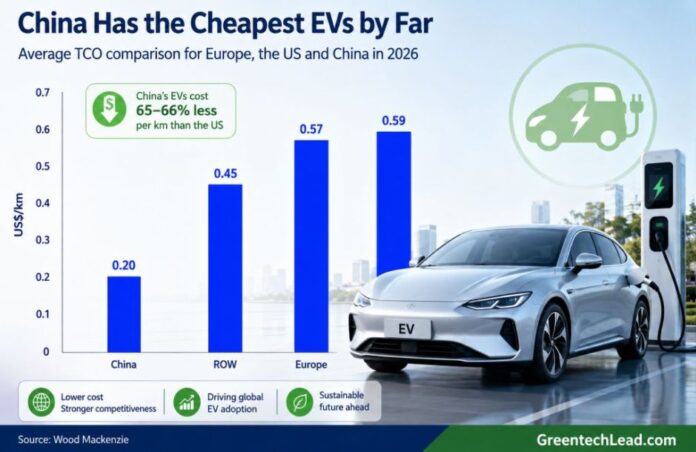
China had already achieved purchase-price parity on a total-cost-of-ownership basis in 2026, giving the market an important advantage over Europe and the US.
BYD Overseas EV Sales Jump 124.3 Percent
BYD illustrates the increasing international reach of Chinese EV manufacturers. The company sold 419,211 new-energy vehicles in July 2026.
BYD’s overseas passenger-vehicle and pickup sales reached a record 179,841 units, increasing 124.3 percent and accounting for approximately 43 percent of its monthly sales.
Geely Sales Reach 1.42 Million as Overseas NEV Business Surges 585 Percent
Geely Auto sold 1,422,958 vehicles globally during the first half of 2026, including 474,228 vehicles overseas, representing growth of 158 percent.
Geely’s overseas new-energy vehicle sales surged 585 percent to 277,189 units, representing 59 percent of overseas sales.
Geely reported first-half revenue of RMB 173.6 billion, up 15 percent, on August 17, while core profit increased 46 percent.
The company is targeting two-thirds of its sales outside China over the longer term. Geely has formed a partnership with Ford to manufacture electric SUVs at Ford’s plant in Spain and is targeting European sales of 600,000 vehicles annually within two to three years.
SAIC and Chery are expanding the competitive pressure from China. SAIC’s partnership with General Motors (GM) has been extended for another 20 years, with the companies positioning China-developed electrified vehicles for international markets.
Together, BYD, Geely, SAIC and Chery demonstrate how Chinese automakers are increasingly competing through manufacturing scale, battery integration, pricing and international expansion.
Emerging-Market EV Stock Could Be 85 Percent Higher
Emerging markets could become one of the largest beneficiaries of cheaper Chinese EV exports.
Wood Mackenzie estimates Chinese EV imports could reduce emerging-market EV costs by 28 percent under the Electric Shock scenario. Chinese manufacturers could capture nearly 30 percent of emerging-market EV sales by 2040, approximately twice their base-case market share.
Combined with investment in charging infrastructure and declining fossil-fuel subsidies, these factors could make emerging-market EV stock 85 percent higher than the base case by 2040.
Mexico demonstrates the potential scale of the shift. Chinese EV sales increased from approximately 3,000 vehicles in 2023 to nearly 80,000 in 2025, giving Chinese EV brands around 6 percent of Mexican car sales.
Europe EV Stock Could Rise 53 Percent Above Base Case
Europe is also experiencing rapid EV adoption, although automakers face significant cost and employment pressures.
European EV sales increased 30 percent during the first five months of 2026, while EVs represented approximately 3 percent of the European vehicle fleet in 2025.
Wood Mackenzie’s base case projects EV penetration reaching 35 percent by 2040. Under the Electric Shock scenario, European EV stock could be 53 percent higher than the base case.
The automotive industry is already restructuring, with approximately 60,000 European auto-sector layoffs announced in 2026.
Wood Mackenzie models a potential industrial “grand bargain” involving tariff relief in exchange for Chinese investment in European manufacturing. Chinese-backed factories, lower tariffs and purchase incentives financed through fuel taxes could reduce EV total cost of ownership by 23 percent by 2040.
Europe is expected to achieve total-cost-of-ownership parity between EVs and gasoline or diesel vehicles by 2030 under Wood Mackenzie’s base case.
Hyundai Plans KRW 125.2 Trillion Investment Through 2030
Hyundai plans to invest KRW 125.2 trillion in South Korea between 2026 and 2030, comprising KRW 50.5 trillion for future businesses, KRW 38.5 trillion for research and development and KRW 36.2 trillion for capital expenditure. The strategy covers EVs, AI, software-defined vehicles, robotics, hydrogen and other future technologies. Hyundai plans to increase electrified-vehicle exports from 690,000 units in 2024 to 1.76 million by 2030.
Tesla, GM, Ford and Rivian Face US EV Cost Challenge
The US market is following a different trajectory. Passenger EV sales dropped 33 percent year over year during the first five months of 2026 following the withdrawal of tax incentives.
EVs represent approximately 3 percent of the US vehicle fleet. Wood Mackenzie’s base case projects EV penetration reaching 20 percent by 2040.
Without accelerated changes, EVs are expected to reach total-cost-of-ownership parity with gasoline and diesel vehicles in the US in 2033.
Under the Electric Shock scenario, however, targeted government support, foreign investment and new greenfield factories using modular EV manufacturing technologies could reduce production costs by as much as 50 percent.
Combined with technological improvements, EV total cost of ownership could decline 25 percent, bringing parity with gasoline vehicles forward to 2031, or two years earlier than the base case.
The resulting US EV fleet could be 51 percent larger than the base case by 2040.
Tesla, GM, Ford and Rivian therefore face an intensifying battle over vehicle costs, battery technology, manufacturing efficiency and supply-chain resilience. GM is also leveraging its extended 20-year SAIC partnership, while Ford is combining its internal EV strategy with its manufacturing partnership with Geely.
China and Europe May Need US$308 Billion in Additional EV Charging Investment
A faster EV transition would require enormous investment in charging infrastructure.
Around 7 million public charging ports were operating worldwide at the end of 2025. Average utilization across major markets was only about 15 percent, partly because charger deployment initially ran ahead of EV adoption.
Under Wood Mackenzie’s Electric Shock scenario, China would require an additional 4 million public charging ports by 2040, representing a 25 percent increase over the base case and requiring approximately US$200 billion of extra investment.
Europe would need another 2.7 million public charging ports and approximately US$108 billion of additional investment.
The US would require another 500,000 charging ports above the base case.
China and Europe alone could therefore generate approximately US$308 billion in additional EV charging investment.
Managed EV Charging Could Limit Pressure on Power Grids
Electricity consumption will increase substantially as EV fleets expand, but managed charging could prevent equivalent growth in peak power demand.
In Western Europe, around 50 percent of EV charging was managed in 2025. Wood Mackenzie expects managed charging to reach 85 percent across Europe by 2040 under the Electric Shock scenario.
Europe’s annual electricity consumption could increase 44 percent by 2040, with EVs accounting for approximately one-third of the increase. Despite this growth, only 28 GW of additional generation capacity could be required over the following 14 years if charging flexibility is maintained.
The US has substantially lower managed-charging participation. No more than 5 percent of charging sessions were managed in 2025.
If participation rises to 50 percent, Wood Mackenzie estimates peak daily EV electricity demand on the largest US grids in 2040 could remain unchanged from the base case despite EV electricity consumption being 46 percent higher.
Battery Innovation Could Reshape Global EV Competition
Battery technology will play a decisive role in determining future EV cost, range, charging performance and critical-mineral requirements.
Wood Mackenzie identifies lithium-manganese-rich batteries as one of the strongest opportunities for Western-led battery technology through 2040. Advanced lithium iron phosphate (LFP) and sodium-ion batteries could provide additional alternatives.
China, however, is already investing heavily across these battery technologies and maintains strong positions in mineral processing, refining, cell manufacturing and EV production.
Western automakers and governments may consequently need deeper partnerships with Japanese and South Korean battery manufacturers to commercialize new battery technologies at competitive scale.
US$45 Billion Metals Investment Needed for Faster EV Growth
Critical-mineral supply would also need to accelerate.
Wood Mackenzie estimates that approximately US$45 billion in additional greenfield metals investment over the next decade could support the Electric Shock scenario.
Copper represents the largest potential constraint. Annual copper mine-capacity additions would need to increase from the long-term average of approximately 850 ktpa to 960 ktpa between 2025 and 2040.
That acceleration could require approximately US$25 billion of additional copper investment, on top of roughly US$250 billion already forecast in Wood Mackenzie’s base case.
Future projects could increasingly involve higher-risk mining jurisdictions including Argentina, the Democratic Republic of Congo and Pakistan. Established copper-producing countries including Chile, Peru and the US will need competitive fiscal policies and faster permitting to retain investment.
Otherwise, Wood Mackenzie sees the potential for a larger share of new supply to be controlled by state-backed Chinese companies.
EV Boom Could Cut Oil Demand by 5 Million b/d and Shut 40 Refineries
The Electric Shock scenario could have major consequences for the global petroleum industry.
Wood Mackenzie’s base case puts global oil demand at 104 million b/d in 2040. Faster EV adoption could lower this to 99 million b/d, creating a 5 million b/d demand reduction.
With an average oil refinery processing approximately 200,000 b/d, Wood Mackenzie estimates the transportation-fuel demand shock could accelerate the closure of around 40 refineries.
OECD refineries could face particularly strong pressure because of comparatively high energy expenses and carbon costs.
Global EV Race Expands Beyond Cars to Batteries, Software, Charging and Minerals
Wood Mackenzie’s Electric Shock scenario illustrates how the EV transition could become a much broader industrial transformation by 2040.
Global EV stock could be approximately 50 percent higher than the base case, while China could reach 29.9 million annual EV sales. Emerging-market EV stock could be 85 percent higher, European EV stock 53 percent higher and the US EV fleet 51 percent larger than their respective base cases.
The transition would create equally significant investment requirements. China and Europe could require US$308 billion in additional charging investment, while approximately US$45 billion could be needed for new metals capacity. Copper alone could require another US$25 billion, with annual mine-capacity additions rising from approximately 850 ktpa to 960 ktpa.
At the same time, global oil demand could fall 5 million b/d below the base case by 2040, potentially accelerating the closure of around 40 refineries.
Companies including BYD, Geely Auto, SAIC, Chery, Hyundai Motor Group, Volkswagen, BMW, Mercedes-Benz, Tesla, General Motors, Ford and Rivian are therefore competing in a market increasingly defined by far more than EV sales.
SHAFANA FAZAL