
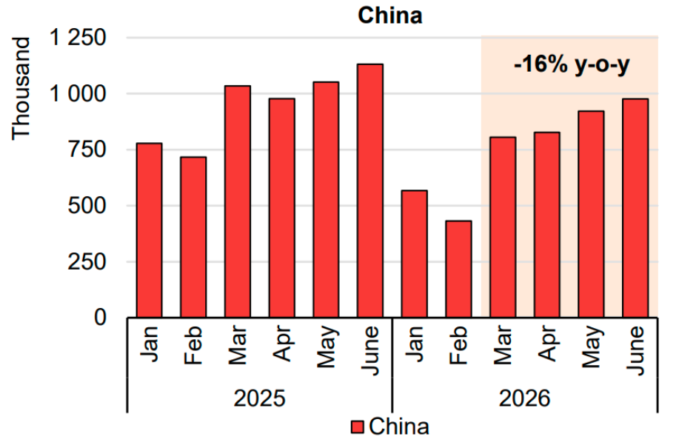
China’s electric vehicle market is entering a new phase in 2026, marked by weaker domestic demand but an increasingly dominant EV sales share and a significant growth in exports. According to the International Energy Agency’s latest update to the Global EV Outlook 2026, China remains central to the global EV industry despite significant pressure on its overall automotive market.
China’s total car sales dropped by more than 20 percent year-on-year during the first half of 2026, representing around 2.5 million fewer vehicles sold. The decline was considerably steeper for conventional cars, where sales fell about 30 percent, while electric car sales declined by less than 20 percent, IEA report said.
Despite the decline in volumes, EVs are strengthening their position within China’s automotive market. Electric cars represented more than 60 percent of total car sales in China during the second quarter of 2026, compared with less than 55 percent across 2025.
The IEA expects electric car sales in China to reach approximately 13.2 million units in 2026, broadly similar to 2025 levels, while EVs are projected to account for more than 60 percent of all Chinese car sales for the full year, setting a new record.
China’s weaker domestic market is also one of the biggest factors limiting global EV growth. Worldwide electric car sales are forecast to rise around 10 percent to 23 million units in 2026, representing 29 percent of global car sales. China alone would therefore account for roughly 57 percent of expected worldwide EV sales volumes.
China EV Exports Jump More Than 120%
Chinese automakers are turning to overseas markets to offset falling domestic demand. Total vehicle exports from China surged 65 percent year-on-year in H1 2026, reaching more than 5 million vehicles, compared with closer to 3 million during the corresponding period of 2025.
Electric car exports expanded even faster, jumping more than 120 percent year-on-year during the first six months of 2026. This export growth fully compensated for the decline in domestic electric car sales and helped limit the fall in overall Chinese vehicle production to around 6 percent, despite domestic vehicle sales dropping more than 20 percent.
The EV share of China’s automobile exports consequently climbed from more than 35 percent in 2025 to over 45 percent in H1 2026. In contrast, ICE vehicle wholesale sales fell roughly 15 percent during the first half.
The scale of China’s EV export expansion is now running ahead of actual overseas registrations. Chinese electric car exports increased more than 120 percent in H1 2026, compared with approximately 75 percent growth in overseas sales of these vehicles. The IEA estimates that more than 1 million EVs exported from China during the past 18 months had not yet been registered as sales in destination countries, pointing to potentially significant inventory accumulation in some markets.
China Controls More Than One-Third of Global Car Production
China’s EV strength is supported by an enormous domestic manufacturing base. Chinese vehicle production reached around 30 million units in 2025, increasing 10 percent from 2024 and reaching more than 2.5 times its 2010 level.
China accounted for more than 35 percent of global automobile production in 2025, compared with less than 20 percent in 2010. China has been the only major automotive manufacturing region to record substantial export growth this decade, with production increasing around 50 percent while domestic sales grew approximately 25 percent.
The country was responsible for 30 percent of global car sales in 2025, up dramatically from just 2 percent in 2000. Chinese automakers have meanwhile expanded to capture approximately 25 percent of worldwide new-car sales.
Chinese EV Makers Gain Ground as Foreign Brands Lose Share
The rise of domestic EV manufacturers is reshaping competitive positions inside China. Electric car sales now exceed conventional car sales in the country, strengthening Chinese manufacturers that have built their businesses around EVs.
Japanese automakers’ share of China’s car market dropped from more than 20 percent in 2019 to 12 percent in 2025. European manufacturers experienced a similarly sharp decline, with their share falling from approximately 25 percent to 15 percent over the same period.
Chinese EV manufacturers are also building significant positions overseas. Chinese OEMs accounted for close to 25 percent of overseas electric car sales in 2025, compared with only around 5 percent of overseas conventional vehicle sales.
Outside Europe and the United States, vehicles imported from China represented 55 percent of total electric car sales in H1 2026. In Australia and New Zealand, Chinese EV imports represented around 80 percent of electric car sales, up from approximately 70 percent in H1 2025, while import volumes increased 140 percent year-on-year.
China’s influence is particularly pronounced across emerging markets. Chinese manufacturers account for around 60 percent of EV sales across emerging and developing economies excluding China, compared with only 10 percent of conventional vehicle sales.
China EV Manufacturing Has a 35% Cost Advantage
China’s EV competitiveness extends beyond vehicle volumes. The IEA estimates that Chinese manufacturers have production costs around 35 percent lower than manufacturers in advanced economies, supported by manufacturing scale, integrated supply chains and strong battery capabilities.
Batteries are especially important because approximately one-quarter of an electric car’s value comes from the battery. China occupies a leading position across battery cells and upstream components, giving its EV manufacturers an important cost and supply-chain advantage.
China has built this position through more than two decades of industrial policy. EVs appeared in national industrial development plans as early as 2001, while subsequent measures included consumer subsidies, purchase-tax exemptions, public procurement, charging infrastructure, low-cost financing, manufacturing incentives and battery R&D. China had previously established a target of 5 million new energy vehicles by 2020, helping stimulate investment and manufacturing capacity.
China Begins Reducing EV Tax Support
The Chinese EV industry is now moving from aggressive market expansion toward what policymakers describe as higher-quality development. In 2026, the previous NEV purchase-tax exemption was replaced by a 50 percent exemption, accompanied by tighter technical eligibility requirements.
From the beginning of 2028, NEVs will no longer receive a purchase-tax exemption. Plug-in hybrids, including extended-range electric vehicles, will also become subject to annual vehicle ownership taxes beginning in 2027, estimated at CNY 360-660 ($50-$90).
At the same time, China continues to expand electrification beyond passenger cars. The Ministry of Transport has established a 2030 target for electric trucks to reach 40 percent of heavy-truck sales.
The figures underline a structural shift in the China EV market. Domestic EV volumes may be broadly flat at around 13.2 million units in 2026, but an EV sales share exceeding 60 percent, export growth above 120 percent, more than 5 million total vehicle exports in six months and a roughly 35 percent manufacturing cost advantage demonstrate that China’s influence on the global electric vehicle industry continues to expand even as its domestic automotive market contracts.
BABURAJAN KIZHAKEDATH
