
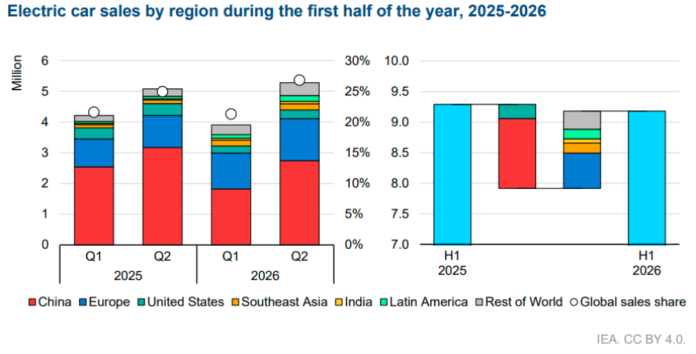
The global electric vehicle market is proving more resilient than the wider automotive industry in 2026, with electric car sales recovering strongly in the second quarter despite economic uncertainty, weaker overall car demand and significant pressure in China. The International Energy Agency (IEA) expects global electric car sales to increase around 10 percent in 2026 to 23 million vehicles, lifting EVs to a record 29 percent of worldwide car sales.
More than 9 million electric cars were sold worldwide during H1 2026, including over 5 million in Q2 alone. Second-quarter EV sales jumped 35 percent from Q1 2026 and 4 percent year-on-year. H1 sales were still around 1 percent below H1 2025, largely because electric car sales in China fell almost 20 percent. EVs nevertheless represented 24 percent of global car sales, one percentage point above the corresponding period of 2025, IEA report said.
The EV performance stands out against a weaker automotive market. Overall global car sales declined around 5 percent in H1 2026, while the IEA expects full-year car sales to finish approximately 2 percent below 2025 levels. The shift toward electrification is therefore continuing even as consumers reduce overall vehicle purchases.
Europe EV Sales Jump 30 Percent
Europe emerged as the strongest-performing major EV market in H1 2026, with electric car sales increasing 30 percent year-on-year. Germany sold 140,000 more EVs than during H1 2025, while the UK added 100,000, France 95,000, Italy 75,000 and Spain 40,000.
EVs accounted for more than 30 percent of total EU car sales, compared with 27 percent in 2025, while the UK’s EV share reached 38 percent.
Growth was even faster in several emerging EV markets. Electric car sales outside the major markets increased around 75 percent in H1 2026. India recorded growth of more than 90 percent, Southeast Asia expanded 75 percent, and Latin American sales more than doubled.
Australia, Brazil, India, Korea and Viet Nam each recorded more than 100,000 EV sales during H1 2026, with sales roughly doubling during March-June compared with the same four months of 2025.
Colombia recorded growth of 300 percent, New Zealand 180 percent, Uruguay 170 percent and Singapore 110 percent during March-June. African EV sales more than doubled to over 30,000 vehicles, including more than fivefold growth in South Africa and more than threefold growth in Egypt.
China EV Market Heads Toward 13.2 Million Sales
China remains by far the world’s largest EV market despite its 2026 slowdown. The IEA expects Chinese electric car sales to reach approximately 13.2 million vehicles in 2026, broadly matching 2025, while EV penetration rises above 60 percent of total car sales.
China’s domestic weakness is increasingly being offset by exports. Total Chinese car exports jumped 65 percent year-on-year in H1 2026, exceeding 5 million vehicles, compared with close to 3 million a year earlier.
Electric car exports surged by more than 120 percent, pushing EVs from over 35 percent of Chinese car exports in 2025 to more than 45 percent in H1 2026. More than 1 million EVs exported from China over the past 18 months had not yet been registered as overseas sales, suggesting significant inventories may be accumulating in destination markets.
Chinese EVs are also taking exceptionally high shares of emerging markets. Chinese imports represented 55 percent of EV sales outside Europe and the United States. In South Africa they accounted for 90 percent of new electric cars, while BYD imports represented close to 90 percent of Argentina’s EV sales. Argentina sold around 9,000 EVs in H1 2026, versus fewer than 2,200 during all of 2025.
EV Revenue Pressure Intensifies for Global Carmakers
The rapid EV transition is reshaping automotive revenue and profitability. Inflation-adjusted revenues of the world’s 26 largest automakers have declined from their 2018 levels, while total automaker revenue fell 2 percent in 2025 following four consecutive years of growth. Industry profits plunged 65 percent, with European and North American manufacturers bearing much of the decline.
EV-focused manufacturers are simultaneously gaining a larger share of industry revenue opportunities. Traditional manufacturers focused primarily on combustion-engine vehicles still control close to 90 percent of total global car sales, but accounted for only around 55 percent of EV sales in 2025. EV-focused newer entrants captured approximately 45 percent, up from less than 35 percent in 2019.
China’s manufacturers have become particularly influential. Chinese OEMs now represent around 25 percent of global new-car sales and almost 90 percent of Latin America’s EV market, compared with less than 10 percent of its conventional-car market.
The IEA expects EVs to account for around 50 percent of global car sales by 2035, meaning an increasing proportion of automotive revenue is likely to shift toward EV manufacturers and EV-related batteries, electronics and software.
EV Investment Shifts Toward Batteries, Manufacturing and Government Support
Investment requirements are also moving deeper into the EV supply chain. Around one-quarter of an electric car’s value comes from its battery, making batteries one of the most important areas for future automotive investment.
EV-specific components represented only 10 percent of the automotive supplier market in 2024, but their share had expanded almost sevenfold since 2019. The transition is directing capital away from engines, gearboxes and other combustion technologies toward batteries, critical minerals, electronics, semiconductors, sensors and software-defined vehicles.
Governments are reinforcing this transition with new financial commitments. France plans to increase annual public funding for electrification from €5.5 billion to €10 billion by 2030. Thailand has announced a THB 5 billion soft-loan programme that includes financing for EV purchases, while California approved a new zero-emission vehicle rebate programme as part of a broader $600 million clean-transportation investment.
Ireland’s ICE2EV programme provides €5,000 each to 2,000 eligible applicants scrapping older combustion vehicles to purchase new battery-electric cars. Kenya has announced import-duty waivers covering 100,000 EVs, while Rwanda requires at least 30 percent of newly procured vehicles by public institutions to be electric.
EV Charging Investment Gains Momentum
Charging infrastructure is becoming another major focus of EV investment as governments seek to support rising vehicle penetration.
Australia’s fuel-resilience package includes funding for the rollout of kerbside fast chargers, alongside EV tax incentives and accelerated electrification of the country’s postal delivery fleet. Cambodia has reduced customs tariffs and import-export duties on EVs and charging equipment.
Europe is also expanding charging support. The European Commission’s Electrification Action Plan includes measures designed to accelerate charging infrastructure deployment and enable vehicle-to-grid charging. Hungary’s revised Recovery Plan includes financing for EV charging stations, while Spain extended income-tax deductions covering both EV purchases and the installation of charging points until December 31, 2026.
The UK plans legislation requiring increased EV charging provision in new buildings and properties undergoing major renovations, while also making it easier for renters and leaseholders to request and install chargers.
The combination of 23 million expected EV sales in 2026, a 29 percent global sales share, more than 60 percent EV penetration in China, accelerating government investment and expanding charging networks indicates that electrification is increasingly becoming a structural transformation of the global automotive industry rather than simply a vehicle-sales trend. Batteries, charging infrastructure, software and electronics are becoming central to where future automotive investment and revenue are created.
BABURAJAN KIZHAKEDATH
