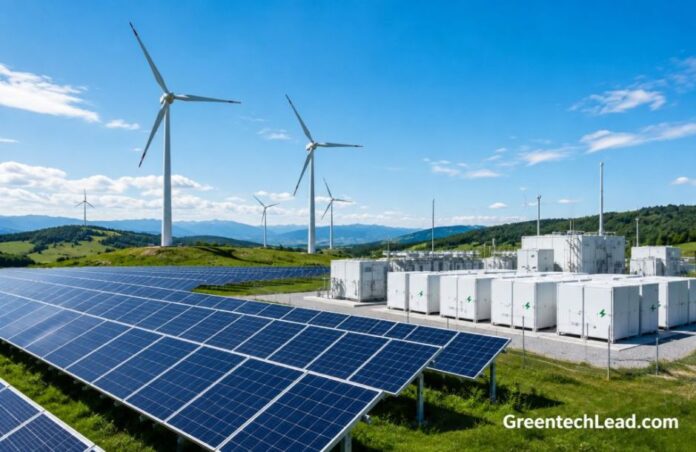
India’s renewable energy investment market is expanding beyond solar and wind into battery storage, firm and dispatchable renewable energy, pumped hydro, domestic manufacturing and transmission. With renewable capacity reaching 295.55 GW by August 2026, major investments such as Tata Power’s ₹5,750 crore wind-solar project and ReNew’s ₹4,200 crore solar manufacturing facility highlight the scale of the next clean-energy investment cycle.
India had 168.04 GW of solar capacity and 58.52 GW of wind capacity as of August 31, 2026. Total renewable capacity, including large hydro, reached 295.55 GW, while renewables excluding large hydro stood at 243.49 GW. Between April and August alone, India added 17.78 GW of solar and 2.43 GW of wind.
Investment is accelerating alongside capacity. JMK Research estimates approximately $1.76 billion was invested in India’s renewable sector during August 2026, comprising $1.15 billion in debt financing, $515 million in acquisitions and $100 million in equity.
The emerging investment opportunity is therefore much larger than building more solar farms. India increasingly needs an integrated system of renewable generation, energy storage, transmission and domestic manufacturing.
Solar Leads India Renewable Energy Investment
Solar remains India’s largest renewable technology.
Of the country’s 168.04 GW of installed solar capacity, 123.99 GW was ground-mounted, while grid-connected rooftop solar reached 32.59 GW. Hybrid projects contributed another 4.83 GW and off-grid solar 6.63 GW.
Rajasthan, Gujarat and Madhya Pradesh remain particularly important investment destinations. Together, the three states contributed 1,456 MW, or 84 percent, of the 1,737 MW of utility-scale solar installed during July 2026.
But India’s solar investment model is changing.
Developers increasingly need to evaluate land, substations, transmission availability, storage and curtailment alongside module and EPC costs. As solar penetration rises, the commercial value of electricity increasingly depends on when and where it can be delivered, rather than simply how cheaply it can be generated.
The latest MNRE renewable energy capacity data provides a useful benchmark for tracking India’s rapid solar, wind and broader clean-energy expansion.
Tata Power Invests ₹5,750 Crore in 800 MW Wind-Solar Project
Hybrid renewable projects are becoming an important part of the next investment phase because they combine different generation profiles and can improve transmission utilization.
Tata Power Renewable Energy’s project in Andhra Pradesh provides a strong example.
The development combines 400 MW of solar and 400 MW of wind, creating an 800 MW hybrid portfolio backed by approximately ₹5,750 crore of investment. It has secured 800 MW of interstate transmission connectivity and is expected to generate around 4,000 local employment opportunities.
Wind capacity across India reached 58.52 GW by August 2026, with another 2.43 GW installed between April and August.
Hybrid projects can create better generation profiles because wind output can complement daytime solar production. They can also share transmission infrastructure, potentially improving the economics of grid connectivity.
For investors, this represents an important shift from maximizing installed MW toward maximizing the quality, utilization and value of renewable electricity.
BESS Investment Moves Into Gigawatt Scale
Battery storage is becoming one of India’s fastest-growing clean-energy investment segments.
During August 2026 alone, India floated tenders covering 3,255 MW/12,105 MWh of standalone battery energy storage systems.
Rajasthan Urja Vikas Nigam accounted for 1,500 MW/6,000 MWh, while 950 MW/2,900 MWh of standalone BESS was awarded during the month.
These figures demonstrate why storage projects should be evaluated using both MW and MWh.
MW determines how much power a battery can deliver at a particular moment. MWh determines how long that output can be maintained.
A 200 MW/400 MWh battery provides two hours of storage, whereas 200 MW/800 MWh provides four hours.
As India’s daytime solar generation grows, longer-duration storage can shift surplus electricity into evening demand periods, potentially improving both grid stability and renewable-project economics.
Major developers are already building significant portfolios. ReNew has approximately 1.7 GW/6.2 GWh of storage, while JSW Energy has 29.6 GWh of locked-in storage capacity, including pumped hydro. Adani Green is also deploying BESS at its massive Khavda renewable-energy development.
FDRE Projects Create Higher-Value Renewable Power
Firm and Dispatchable Renewable Energy, or FDRE, could become one of India’s most important renewable investment models.
Traditional solar and wind projects supply electricity according to weather conditions. FDRE combines renewable generation and storage to deliver power according to contracted schedules.
The difference is visible in tariffs.
In August 2026, SECI awarded 1,500 MW/6,000 MWh of renewable energy with storage at a lowest discovered tariff of ₹5.99/kWh. A separate 1,000 MW round-the-clock renewable tender achieved a lowest tariff of ₹5.25/kWh.
These prices should not be compared directly with standalone solar tariffs because FDRE provides a fundamentally different electricity product.
The MNRE framework for firm and dispatchable renewable energy reflects the policy shift toward renewable electricity that can better match power-system requirements.
For developers, FDRE means higher capex but potentially greater revenue certainty and a more valuable power product.
Pumped Hydro Emerges as Long-Duration Storage Opportunity
Batteries are not the only storage investment opportunity.
India had approximately 7.43 GW of pumped-storage capacity by August 2026.
Pumped-storage projects require large upfront investment in reservoirs, tunnels, turbines, pumping equipment and transmission infrastructure. Their construction periods are also substantially longer than battery projects.
But they offer an important advantage: the ability to shift large quantities of electricity over longer periods and operate for decades.
JSW Energy’s storage strategy illustrates the opportunity. Of its 29.6 GWh locked-in storage portfolio, 26.4 GWh comes from pumped storage.
India’s future storage system is consequently likely to use batteries for rapid response and short-to-medium duration requirements, while pumped hydro handles larger and longer-duration energy shifting.
ReNew Invests ₹4,200 Crore in Solar Manufacturing
One of the biggest changes in India’s renewable investment story is the rapid movement of capital upstream into manufacturing.
ReNew is investing approximately ₹4,200 crore in a 6.5 GW solar ingot and wafer manufacturing facility in Andhra Pradesh. The company already has 6.4 GW of solar module manufacturing capacity and 2.5 GW of solar-cell capacity.
India’s broader manufacturing expansion is even larger.
Solar module manufacturing capacity reached approximately 233 GW by June 2026, while solar-cell manufacturing capacity stood at around 42 GW. Around 24 GW of module capacity and 2.6 GW of cell capacity were added in Q2 2026 alone.
The expansion represents a second renewable investment cycle alongside power generation.
Factories create demand for equipment, industrial land, engineering, logistics and skilled employment while supporting India’s effort to build a deeper domestic solar supply chain.
The ReNew manufacturing expansion illustrates how renewable developers are increasingly integrating generation with manufacturing.
Transmission Becomes a Critical Renewable Investment
India’s renewable investment challenge increasingly involves getting electricity from where it is generated to where it is needed.
Rajasthan and Gujarat have excellent renewable resources but are far from several large electricity-demand centers.
That creates investment requirements for interstate transmission lines, substations, transformers and grid-management technologies.
The financial impact is already visible in curtailment. India recorded 667.76 million units of variable renewable-energy curtailment during August 2026, equivalent to 1.89 percent of renewable generation. That was an improvement from 3.3 percent in July but remains economically significant.
A solar farm with extremely low generation costs can still produce weak returns if transmission constraints prevent electricity from reaching buyers.
Grid connectivity should therefore increasingly be treated as part of the renewable investment decision rather than infrastructure that follows project construction.
Andhra Pradesh, Gujarat and Rajasthan Emerge as Investment Hubs
Three states illustrate different parts of India’s renewable opportunity.
Rajasthan combines large-scale solar resources with an emerging storage market, highlighted by the 1,500 MW/6,000 MWh BESS tender.
Gujarat is developing an integrated renewable ecosystem around large-scale solar, wind and storage, led by developments such as Khavda.
Andhra Pradesh is attracting both generation and manufacturing investment, including Tata Power’s ₹5,750 crore wind-solar project and ReNew’s ₹4,200 crore manufacturing development.
Karnataka, Tamil Nadu, Maharashtra and Madhya Pradesh also remain significant markets for renewable generation and supporting infrastructure.
India’s Renewable Investment Race Through 2030
Corporate expansion targets illustrate how much additional capital could enter the sector.
Adani Green Energy is targeting 50 GW of renewable capacity by 2030. JSW Energy is targeting 30 GW of generation and 40 GWh of storage by 2030, while NTPC has a 60 GW renewable target for 2032.
These targets should not be confused with commissioned capacity. For investors, more meaningful indicators include financial closure, construction progress, PPAs, transmission connectivity and commissioning schedules.
India’s renewable investment race is ultimately moving from one metric — installed GW — toward several interconnected measures: GW of generation, GWh of storage, manufacturing capacity, transmission readiness, tariffs and project returns.
With 295.55 GW of renewable capacity already installed, billions of dollars entering the sector and storage tenders now reaching gigawatt scale, India’s next renewable-energy boom will be about much more than building solar and wind farms.
The larger investment opportunity is the creation of an integrated clean-power ecosystem combining solar, wind, BESS, pumped hydro, domestic manufacturing and transmission infrastructure.
SHAFANA FAZAL