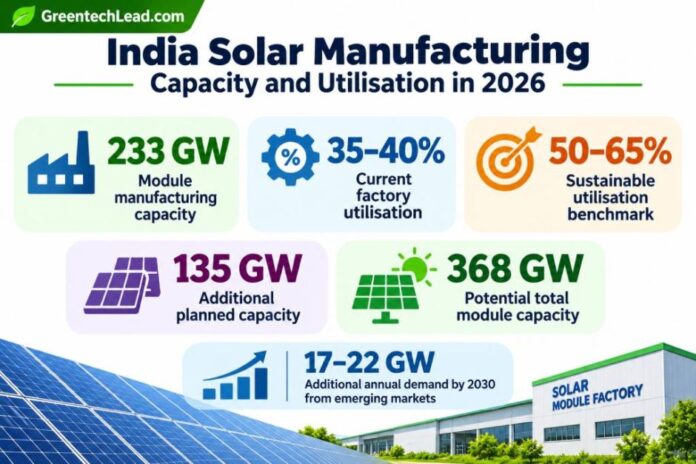
India’s solar photovoltaic (PV) manufacturing industry is facing growing financial pressure as module production capacity reaches approximately 233 GW while factory utilisation remains at just 35–40 percent, according to an analysis by the Institute for Energy Economics and Financial Analysis (IEEFA).
India has emerged as the world’s second-largest solar module manufacturing base, supported by investments from companies including Waaree Energies, Adani Solar, Vikram Solar, Premier Energies, Tata Power Solar, RenewSys, Emmvee, Goldi Solar and Saatvik Green Energy.
However, the rapid expansion of manufacturing capacity has outpaced demand, creating risks of declining module prices, lower profit margins, underutilised factories and delayed investment returns.
IEEFA estimates that approximately 135 GW of additional module manufacturing capacity is planned or under construction, potentially pushing India’s total capacity toward 368 GW if all projects are completed.
The IEEFA assessment of India’s solar PV manufacturing market indicates that manufacturers need utilisation rates of approximately 50–65 percent for sustainable operations, significantly above current industry levels.
At 35–40 percent utilisation, India’s existing 233 GW manufacturing base would produce approximately 82–93 GW of modules annually if the reported utilisation range were applied across the entire nameplate capacity.
At 50–65 percent utilisation, the same manufacturing base would need annual production of approximately 117–151 GW.
These calculations illustrate the scale of the demand challenge. Actual output depends on operational capacity, production yields, equipment availability and product mix.
Solar Cell, Wafer and Ingot Capacity Remains a Major Weakness
India’s solar manufacturing expansion is concentrated in module assembly rather than the complete photovoltaic supply chain.
IEEFA estimates that module capacity is nearly seven times domestic solar cell manufacturing capacity and approximately 116 times ingot and wafer manufacturing capacity.
This imbalance leaves module producers dependent on imported cells and other upstream materials.
Companies investing in integrated manufacturing could benefit from greater control over input costs, product quality and supply-chain reliability.
However, cell, wafer and ingot investments require substantial CAPEX, advanced manufacturing technology, reliable electricity and sufficient utilisation to generate acceptable returns.
Major Solar Manufacturing Projects and Vendors in India
India’s manufacturing expansion includes large integrated projects as well as standalone module factories.
Waaree Energies: Waaree is expanding its solar module and cell manufacturing operations in India and overseas. Its manufacturing strategy includes advanced solar cells, modules and upstream integration to reduce dependence on imported components.
Adani Solar: Adani Solar, part of Adani New Industries, has developed integrated solar manufacturing operations at Mundra, Gujarat. Its expansion covers modules, cells and upstream manufacturing technologies, positioning the company to serve domestic utility-scale projects and export markets.
Tata Power Solar: Tata Power Renewable Energy operates a 4.3 GW solar cell and module manufacturing facility in Tirunelveli, Tamil Nadu. The investment strengthens domestic cell manufacturing capacity and supports Tata Power’s solar project development and rooftop businesses.
Premier Energies: Premier Energies is expanding solar cell and module manufacturing in Telangana. Its projects include TOPCon cell technology, targeting higher conversion efficiency and increased domestic content.
Vikram Solar: Vikram Solar is developing additional manufacturing capacity while pursuing higher-efficiency module technologies. Its growth strategy includes domestic project supplies and international customers.
Emmvee: Bengaluru-based Emmvee is investing in integrated solar cell and module manufacturing, including TOPCon technology, to strengthen its position in India’s domestic solar supply chain.
Goldi Solar: Gujarat-based Goldi Solar is expanding solar module manufacturing and investing in solar cell production, seeking to reduce reliance on imported cells.
RenewSys: RenewSys manufactures solar modules and key components including encapsulants and backsheets, supporting domestic supply-chain development beyond module assembly.
Saatvik Green Energy: Saatvik is expanding solar module manufacturing and developing cell manufacturing capabilities to serve utility-scale, commercial and industrial customers.
Insolation Energy: Rajasthan-based Insolation Energy is expanding module production and pursuing solar cell manufacturing, reflecting the broader shift among Indian manufacturers toward upstream integration.
These are examples of manufacturing operations and expansion initiatives, not evidence that every announced production line is fully commissioned or operating at high utilisation.
Solar Manufacturing Oversupply Could Reduce Profit Margins
Low utilisation increases fixed manufacturing costs per watt because factories must recover equipment depreciation, labour expenses, financing costs and maintenance across fewer modules.
IEEFA’s analysis indicates that prolonged overcapacity could create particular difficulties for smaller standalone module manufacturers and companies operating older PERC production lines.
Manufacturers with integrated cell production, modern TOPCon technology, stronger balance sheets and long-term customer contracts may be better positioned to manage pricing pressure.
The research also identifies the possibility of consolidation, acquisitions and factory closures as the industry adjusts to excess capacity.
Solar Exports Face US Tariffs and Market Concentration Risks
Exports are important for improving factory utilisation, but India’s solar manufacturers face increasing trade barriers.
According to IEEFA and JMK Research, the United States accounted for approximately 97 percent of India’s solar module export volume in FY2026.
The report says US trade duties exceeding 200 percent for many Indian manufacturers contributed to export volumes falling approximately 44–47 percent from their FY2024 peak.
This concentration creates risks for manufacturers that have invested in capacity primarily to serve overseas customers.
Europe could offer alternative opportunities, although Indian manufacturers must compete with established Chinese suppliers on price, technology, efficiency and product certification.
Data Centres, Green Hydrogen and Solar Projects Could Boost Demand
IEEFA estimates that data centres, green hydrogen and exports could create an additional 17–22 GW of annual solar module demand by 2030.
Green hydrogen projects represent a particularly important opportunity because electrolysers require substantial renewable electricity supplies.
Data-centre investments from cloud providers and digital infrastructure companies could also support additional solar capacity through renewable power purchase agreements.
India’s domestic project pipeline provides another source of demand. According to JMK Research data cited in industry reporting, approximately 149 GW of renewable generation projects, including solar, wind, hybrid and storage, were in the pipeline as of June 2026, with another 48 GW in the bidding stage.
However, renewable project capacity cannot be treated as equivalent solar module demand because the pipeline includes non-solar technologies and projects with different commissioning schedules.
Solar Manufacturing Investment Outlook Through 2030
India’s solar manufacturing industry faces a transition from capacity expansion to improving factory utilisation, supply-chain integration and investment returns.
The IEEFA and JMK Research findings on solar manufacturing overcapacity suggest that additional module capacity alone will not address the industry’s structural weaknesses.
For Waaree Energies, Adani Solar, Tata Power Solar, Premier Energies, Vikram Solar, Emmvee, Goldi Solar and other manufacturers, future competitiveness will depend on production costs, cell availability, technology upgrades, export access and contracted demand.
Investors should evaluate operational capacity, factory utilisation, manufacturing cost per watt, EBITDA margins, CAPEX commitments, debt obligations and order-book quality rather than relying exclusively on announced capacity.
With 233 GW of existing module capacity and another 135 GW planned, India’s immediate challenge is to convert manufacturing scale into sustainable production, stronger margins and competitive exports.
SHAFANA FAZAL