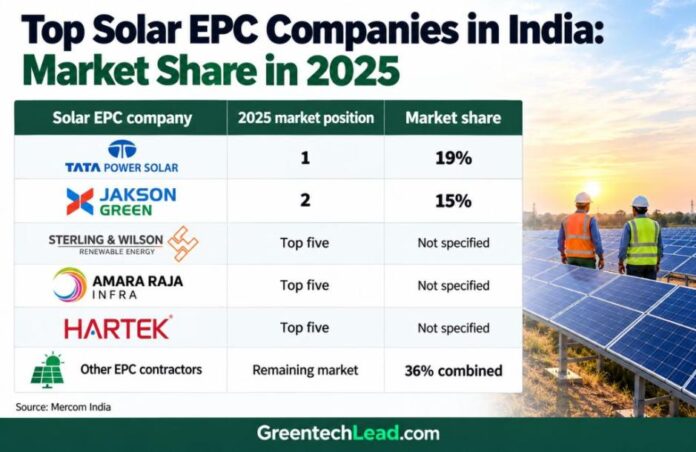
India’s solar engineering, procurement and construction (EPC) industry is expanding as utilities, commercial businesses and renewable energy developers invest in large-scale solar projects. Tata Power Solar, Jakson Green, Sterling & Wilson Renewable Energy, Amara Raja Infra and HARTEK are among the leading EPC contractors, while L&T, Waaree Renewable Technologies, KPI Green Energy, Mahindra Susten and Rays Power Infra compete for projects.
For solar EPC companies, growth depends on project execution, order-book conversion, profitability, customer contracts and working-capital management rather than contract announcements alone.
Top Solar EPC Companies in India: Market Share in 2025
| According to the Mercom India Solar Market Leaderboard 2026, five companies accounted for approximately 64 percent of utility-scale solar EPC installations during 2025. | ||
These rankings measure solar capacity installed during 2025, not cumulative installations, revenue or order-book value.
Major Solar EPC Companies Operating in India
India’s solar EPC industry includes diversified engineering companies, renewable energy specialists and integrated solar manufacturers.
| Company | Major solar EPC capabilities |
| Tata Power Solar | Utility-scale solar, rooftop solar, renewable EPC |
| Jakson Green | Solar EPC, renewable energy, hybrid projects |
| Sterling & Wilson Renewable Energy | Utility-scale solar, international EPC, battery storage |
| Amara Raja Infra | Solar EPC, substations, transmission infrastructure |
| HARTEK | Solar EPC, substations, grid connectivity |
| Larsen & Toubro (L&T) | Large solar parks, renewable EPC, electrical infrastructure |
| Waaree Renewable Technologies | Ground-mounted solar, industrial solar EPC |
| KPI Green Energy | Captive solar, independent power projects, EPC |
| Mahindra Susten | Utility-scale solar, renewable infrastructure |
| Rays Power Infra | Solar parks, utility-scale EPC, renewable development |
| Vikram Solar | Solar modules, EPC and integrated solar solutions |
| Gensol Engineering | Solar EPC and renewable engineering |
| Oriana Power | Industrial solar EPC, renewable development |
| Solex Energy | Solar manufacturing and EPC services |
| Prozeal Green Energy | Utility-scale solar, industrial solar, hybrid projects |
| SJVN Green Energy | Renewable project development and procurement |
| NTPC Renewable Energy | Large renewable projects and EPC procurement |
Important distinction: SJVN Green Energy and NTPC Renewable Energy are primarily project developers and procurers, rather than independent third-party EPC contractors. Their projects create business opportunities for EPC suppliers.
Tata Power Solar: Leading Solar EPC Contractor
Tata Power Solar ranked first in India’s utility-scale solar EPC market during 2025 with a 19 percent installation share.
In January 2026, Tata Power Renewable Energy reported cumulative EPC execution exceeding 10 GW, comprising:
Solar EPC execution: 9.7 GW
Wind EPC execution: 290 MW
In-house projects: 4.2 GW
Third-party customer projects: 5.8 GW
During the first nine months of FY2026, renewable capacity commissioning reached 1.88 GW, increasing 33 percent year over year.
The company’s 10 GW EPC execution milestone highlights its experience in delivering projects for both internal businesses and external customers.
Tata Power’s advantage includes engineering capabilities, procurement scale and experience across utility-scale and distributed solar installations.
Jakson Green: Second-Largest Solar EPC Provider
Jakson Green secured approximately 15 percent of India’s utility-scale solar EPC installations in 2025, making it the second-largest contractor by annual installations.
The company competes in utility-scale solar EPC, renewable energy infrastructure, hybrid power projects and emerging clean-energy technologies.
Its competitive position depends on converting project awards into commissioned capacity while maintaining procurement discipline.
For customers, Jakson Green’s installation share demonstrates recent execution capability, although project-specific delivery performance and financial terms require separate assessment.
Sterling & Wilson Renewable Energy: ₹12,481 Crore Order Book
Sterling & Wilson Renewable Energy is among India’s most prominent international solar EPC contractors.
As of September 30, 2026, the company reported an order book of approximately ₹12,481 crore, representing around 34 percent year-over-year growth.
| Financial indicator | Reported figure |
| Total order book | ₹12,481 crore |
| Domestic order book | ₹6,943 crore |
| International order book | ₹5,538 crore |
| H1 FY2027 order inflows | ₹3,626 crore |
| Q2 FY2027 revenue | ₹1,527.50 crore |
| Q2 FY2027 net profit | ₹16.82 crore |
| H1 FY2027 operating cash flow | ₹77.75 crore |
International contracts represented nearly 90 percent of first-half order inflows.
The company’s investor presentations and financial disclosures provide additional information about its order book, revenue and execution pipeline.
Sterling & Wilson’s major challenge is converting its growing backlog into profitable revenue while controlling project costs and payment cycles.
L&T, Waaree, KPI Green and Other Solar EPC Competitors
Larsen & Toubro: L&T’s Renewables business benefits from engineering expertise, large-project execution capabilities and electrical infrastructure experience. Its activities extend beyond solar installations into grid connectivity and renewable power infrastructure.
Waaree Renewable Technologies: Waaree competes for utility-scale and industrial solar EPC contracts. Its business benefits from growing demand for domestic solar installations and industrial decarbonization.
KPI Green Energy: KPI Green develops solar projects and provides EPC services, particularly for captive and industrial customers seeking lower electricity costs.
Amara Raja Infra: The company combines solar EPC capabilities with substations, transmission systems and electrical infrastructure.
HARTEK: HARTEK operates across solar EPC, substations and power-system integration, making grid connectivity an important competitive strength.
Mahindra Susten: The company has experience in utility-scale solar development, engineering and project execution.
Rays Power Infra: Rays Power Infra participates in utility-scale solar EPC and renewable project development.
Oriana Power and Prozeal Green Energy: These companies compete in industrial solar, renewable EPC and hybrid project development.
Gensol Engineering: Gensol has participated in solar EPC projects, although customers and investors should evaluate its current financial, regulatory and execution position before treating historical capabilities as evidence of current delivery capacity.
Solar EPC Order Books: What Investors Should Compare
Order books indicate potential future revenue, but not every awarded contract immediately enters execution.
Investors should examine contract value, project readiness, customer creditworthiness, execution timelines and expected profitability.
For example, an EPC contractor with a ₹5,000 crore backlog may generate stronger returns than a competitor with ₹10,000 crore if it completes projects faster, earns better margins and collects payments promptly.
Customer contracts should clearly define equipment costs, payment milestones, commissioning deadlines, performance guarantees and penalties.
Solar EPC Profitability: Why Project Costs Matter
Solar EPC profitability depends heavily on module prices, inverters, cables, steel, labour and financing costs.
Consider a hypothetical ₹350 crore solar EPC contract with estimated execution costs of ₹325 crore.
The expected project contribution is ₹25 crore, representing a 7.1 percent margin before overheads and financing expenses.
If execution costs increase by 5 percent, the contribution falls to ₹8.75 crore, reducing the margin to 2.5 percent.
This illustrates why procurement efficiency and contract escalation provisions are critical.
Solar-Plus-Storage Creates New EPC Opportunities
India’s renewable energy market is increasingly adopting battery energy storage systems, hybrid projects and grid-connected renewable infrastructure.
Solar EPC companies capable of integrating batteries, power conversion equipment, substations and energy-management systems may gain additional opportunities.
However, storage projects introduce new requirements involving battery safety, performance warranties, degradation and commissioning.
The IEA World Energy Investment 2026 report provides context for investment in renewable energy and electricity infrastructure.
Outlook: Which Solar EPC Companies Are Best Positioned?
Tata Power Solar and Jakson Green demonstrated strong installation performance during 2025, while Sterling & Wilson Renewable Energy reported a substantial order book in September 2026.
L&T, Waaree Renewable Technologies, KPI Green Energy, Amara Raja Infra, HARTEK, Mahindra Susten and Rays Power Infra add competition across utility-scale, industrial and grid-connected solar projects.
The strongest solar EPC companies through 2030 will be those that convert orders into commissioned megawatts, protect project margins, collect customer payments and expand into solar-plus-storage infrastructure.
For investors, order-book growth must be assessed alongside revenue, profit, cash flow and execution performance. For customers, project delivery records, financial stability and contract quality remain the most important selection criteria.
SHAFANA FAZAL