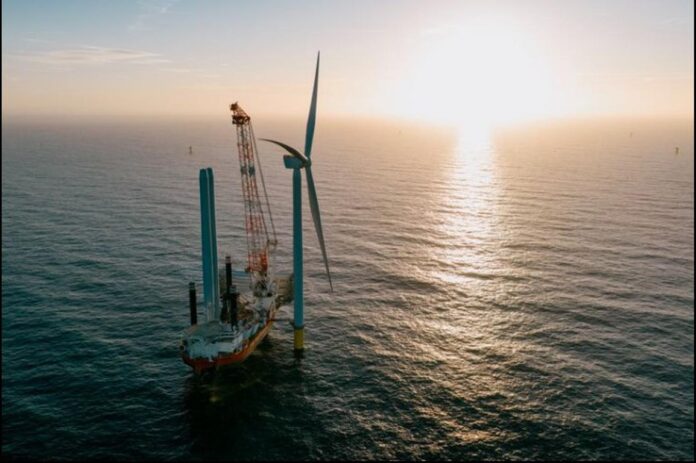
The world’s biggest offshore wind projects are moving into a new investment phase in 2026, driven by multi-gigawatt capacity, 14–15 MW turbines, long-term power contracts and billions of dollars of institutional capital. Dogger Bank at 3.6 GW, Hornsea 3 at around 2.9 GW and Coastal Virginia Offshore Wind at 2.64 GW illustrate how offshore wind is evolving from a renewable generation business into a major infrastructure industry.
The investment opportunity now extends beyond turbines into foundations, ports, vessels, subsea cables, offshore substations, grid connections and long-term operations. The UK’s 2026 Allocation Round 7 alone secured 8.4 GW of offshore wind capacity, supporting an estimated £22 billion of private investment.
Here are 20 offshore wind projects that highlight the investment, technology and financing trends shaping the global market.
1. Dogger Bank — 3.6 GW, UK
Dogger Bank remains one of the world’s largest offshore wind developments. Its three phases — Dogger Bank A, B and C — each have 1.2 GW of capacity, creating a combined 3.6 GW project approximately 130–190 km off northeast England.
Total investment is around £9 billion, while A and B secured approximately £5.5 billion of financing from 29 banks and three export credit agencies.
GE Vernova is supplying 277 Haliade-X turbines. Dogger Bank’s distance from shore also requires substantial investment in HVDC transmission, offshore substations and export cables.
The Dogger Bank Wind Farm provides a benchmark for financing and constructing multi-gigawatt offshore infrastructure.
2. Hornsea 3 — 2.9 GW, UK
Ørsted’s Hornsea 3 will have approximately 2.9 GW of capacity and is designed to generate electricity equivalent to the consumption of more than three million UK homes.
The project is deploying Siemens Gamesa’s SG 14-236 DD turbines at 15 MW. The first 115-meter UK-made blades are being produced at Siemens Gamesa’s Hull facility.
Hornsea 3 is also attracting infrastructure capital. Mubadala committed $325 million alongside an Apollo-led consortium, while Ørsted retains a 50 percent interest and remains responsible for development, construction and operations.
3. Coastal Virginia Offshore Wind — 2.64 GW, US
Dominion Energy’s Coastal Virginia Offshore Wind, or CVOW, has approximately 2.64 GW of capacity from 176 Siemens Gamesa turbines.
Stonepeak committed $2.6 billion for a noncontrolling equity interest representing approximately half of project-to-date capital investment.
CVOW demonstrates why US offshore wind investment extends far beyond turbine procurement. Ports, installation vessels, foundations, cables, substations and transmission all contribute to project CAPEX.
4. Hornsea 2 — 1.32 GW, UK
The operational 1.32 GW Hornsea 2 uses 165 Siemens Gamesa 8 MW turbines.
The project provides an important comparison with the new generation of 15 MW machines. Developers can now achieve comparable or greater capacity with substantially fewer turbine positions, potentially reducing foundations and array connections.
For mature projects such as Hornsea 2, investment is shifting toward O&M, refinancing and long-term asset management.
5. Baltic Power — 1.14 GW, Poland
Baltic Power is among Europe’s most important projects entering operation in 2026.
The 1.14 GW project uses 76 Vestas V236-15.0 MW turbines and delivered first electricity to Poland’s grid in July 2026. It is expected to generate approximately 4 TWh annually, equivalent to about 3 percent of Poland’s current electricity demand.
More than 100 vessels and 5,300 workers and contractors have participated in construction.
The Baltic Power offshore wind development also supports Poland’s domestic manufacturing supply chain.
6. Seagreen — 1.075 GW, UK
Scotland’s Seagreen represents approximately £3 billion of investment and has 1.075 GW of capacity from 114 MHI Vestas V164-10 MW turbines.
Annual generation can reach approximately 5 TWh.
Its foundations extend to around 59 meters, demonstrating how water depth and foundation requirements can materially affect offshore wind investment.
7. Hai Long — 1.044 GW, Taiwan
Taiwan’s Hai Long development combines three projects totaling approximately 1.044 GW.
It uses 73 Siemens Gamesa SG 14-222 DD turbines and has supported investment around Taichung Harbor covering turbines, foundations, cables and marine engineering.
Hai Long demonstrates how the offshore wind supply chain is expanding beyond Europe into Asia.
8. Moray East — 950 MW, UK
Moray East uses 100 Vestas V164-9.5 MW turbines and three offshore substations.
Its UK Contract for Difference at £57.50/MWh in 2012 prices illustrates the importance of long-term revenue certainty in financing capital-intensive offshore assets.
9. Triton Knoll — 857 MW, UK
Triton Knoll required approximately £2 billion of investment and uses 90 V164-9.5 MW turbines.
One of its most interesting investment events occurred after construction: transmission assets were sold to an OFTO consortium for approximately £572.7 million.
The transaction shows how offshore transmission can become a separate infrastructure asset, allowing developers to recycle capital.
10. Empire Wind 1 — 810 MW, US
Empire Wind 1 will deploy 54 Vestas V236-15 MW turbines to deliver 810 MW.
The development is closely connected with redevelopment of the South Brooklyn Marine Terminal, highlighting why ports have become a critical component of offshore wind investment.
Larger turbines reduce turbine count but require heavier cranes, specialized vessels and larger port staging areas.
11. Vineyard Wind 1 — 806 MW, US
Vineyard Wind represents approximately $4.5 billion of investment and uses 62 GE Vernova Haliade-X turbines.
The project began initial operations in February 2026. In September, GE Vernova and Vineyard Wind settled outstanding litigation following earlier disputes involving turbine performance and payments.
The development has generated nearly 4,000 jobs and $1.94 billion of economic output, according to GE Vernova.
The Vineyard Wind settlement highlights the importance of turbine reliability, warranties and contractual risk.
12. East Anglia ONE — 714 MW, UK
East Anglia ONE was developed with approximately £2.5 billion of investment and uses 102 Siemens 7 MW turbines.
Its importance extends beyond the 714 MW project because it helped establish a regional offshore wind ecosystem encompassing ports, engineering, marine contractors and long-term operations.
13. Revolution Wind — 704 MW, US
The 704 MW Revolution Wind project demonstrates the importance of state procurement in US offshore wind.
Its long-term electricity contracts are priced in the high-$90/MWh range, providing revenue visibility needed to support construction financing.
14. Walney Extension — 659 MW, UK
Walney Extension uses 87 turbines across 7 MW and 8 MW platforms.
The project illustrates the speed of technology change: today’s 15 MW offshore turbines have roughly twice the capacity of machines deployed at Walney Extension.
15. London Array — 630 MW, UK
London Array uses 175 Siemens 3.6 MW turbines to provide 630 MW.
Its technology provides a striking comparison with Baltic Power, which delivers nearly twice as much capacity using only 76 turbines.
London Array also links two important offshore investors, RWE and Masdar. Their latest cooperation could extend to Germany’s 2027 offshore auctions with potential investment exceeding €3 billion.
16. Beatrice — 588 MW, UK
Beatrice represents approximately £2.5–£2.6 billion of investment and uses 84 Siemens Gamesa 7 MW turbines.
The project generated substantial supply-chain activity across foundations, cables, engineering and marine services.
17. Race Bank — 573 MW, UK
Race Bank’s importance goes beyond its 573 MW capacity.
The development is part of the UK’s East Coast offshore cluster, where multiple projects share access to ports, operations bases, marine contractors and skilled workers.
Such clusters can lower infrastructure duplication and improve utilization of specialized offshore resources.
18. Greater Gabbard — 504 MW, UK
Greater Gabbard represents approximately £1.6 billion of investment and uses 140 Siemens 3.6 MW turbines.
Its turbine fleet provides another clear illustration of technology evolution: a modern 15 MW turbine has more than four times the nameplate capacity of each Greater Gabbard machine.
19. Neart na Gaoithe — 448 MW, UK
EDF Renewables’ Neart na Gaoithe uses 54 Siemens Gamesa SG 8.0-167 DD turbines.
The project demonstrates the intermediate technology step between earlier 3–7 MW machines and today’s 14–15 MW platforms.
20. Dudgeon — 402 MW, UK
Dudgeon highlights another important part of offshore wind investing: capital recycling.
Its initial investment decision was approximately £1.5 billion, actual construction costs were around £1.25 billion, and the project later completed approximately £1.4 billion of hybrid refinancing.
Offshore wind investment therefore continues well beyond project commissioning through refinancing, stake sales and transmission transactions.
15 MW Turbines Are Transforming Offshore Wind Economics
One of the clearest trends across these projects is turbine scaling.
Early commercial projects such as London Array and Greater Gabbard used 3.6 MW turbines. Baltic Power and Empire Wind now deploy 15 MW Vestas turbines, while Hornsea 3 uses Siemens Gamesa’s 14 MW platform at 15 MW.
Larger turbines can reduce the number of foundations, array cables and offshore installation positions required for each GW.
But larger machines introduce new investment requirements for ports, heavy-lift cranes, specialized vessels, foundations and maintenance infrastructure. Turbine reliability, warranty terms and component availability are consequently becoming as important as headline MW ratings.
PPAs and CfDs Unlock Billions in Offshore Investment
Offshore projects typically require billions in investment years before commercial electricity production begins. Long-term revenue visibility is therefore essential.
The UK’s Allocation Round 7 offshore wind results secured 8.4 GW of offshore capacity and are expected to support approximately £22 billion in private-sector investment.
The UK primarily uses Contracts for Difference, while US projects commonly depend on state procurements and utility PPAs.
As financing costs increase, auction prices need to reflect turbine prices, inflation, construction risk and supply-chain costs.
Dogger Bank South Shows the Next Investment Wave
The next offshore investment cycle is already taking shape.
Dogger Bank South East and West are planned at 1.5 GW each, creating another 3 GW offshore development. RWE owns 51 percent and Masdar 49 percent.
Both secured UK CfDs in 2026 and received development consent in May. A final investment decision is targeted for 2027. The projects could supply electricity equivalent to the annual requirements of approximately three million UK homes.
This model — multi-GW capacity + long-term contracts + institutional capital + large transmission investment — increasingly defines the next generation of offshore wind.
Offshore Wind Investment Outlook to 2030
The Top 20 offshore wind projects show how dramatically the industry has changed.
Dogger Bank demonstrates the financing requirements of a 3.6 GW mega-project. Hornsea 3 and Baltic Power demonstrate the transition toward 15 MW turbines. CVOW and Vineyard Wind illustrate both the opportunity and execution risks in the US, while Triton Knoll shows how transmission infrastructure can become a separate investment asset.
The industry’s biggest opportunities through 2030 will therefore extend beyond turbine manufacturers and developers. Capital will increasingly flow into subsea cables, foundations, substations, transmission, ports, vessels, manufacturing, O&M and refinancing.
For investors, project capacity alone is no longer enough to assess offshore wind opportunities. The critical metrics are CAPEX per MW, turbine reliability, capacity factor, financing cost, PPA or CfD revenue, construction schedule, grid connection and supply-chain availability.
Offshore wind has become a multi-billion-dollar infrastructure business — and the projects that control costs while securing reliable technology, financing and grid access are likely to define the industry’s next growth cycle.
SHAFANA FAZAL