
Latin America’s wind-energy market is moving into a new investment cycle led by Brazil, Chile and Peru, with projects exceeding 800 MW, multi-billion-real investments and a regional onshore wind market expected to surpass 120 GW by 2035.
Latin America is emerging as an important wind-energy investment market as developers combine high-quality wind resources with larger turbines, industrial power demand and new transmission infrastructure.
The Global Wind Energy Council expects Latin America and the Caribbean to more than double onshore wind capacity to above 120 GW by 2035.
Offshore wind could create another growth engine. GWEC projects regional offshore capacity of 6 GW by 2035, 19.6 GW by 2040 and 40.6 GW by 2045.
But installed MW alone will not determine the most valuable projects.
The region’s leading developments show that capacity factor, annual generation, transmission access, industrial PPAs, turbine productivity and financing can matter more to investment returns than headline capacity.
Lagoa dos Ventos: 1,063 MW Sets the Scale Benchmark
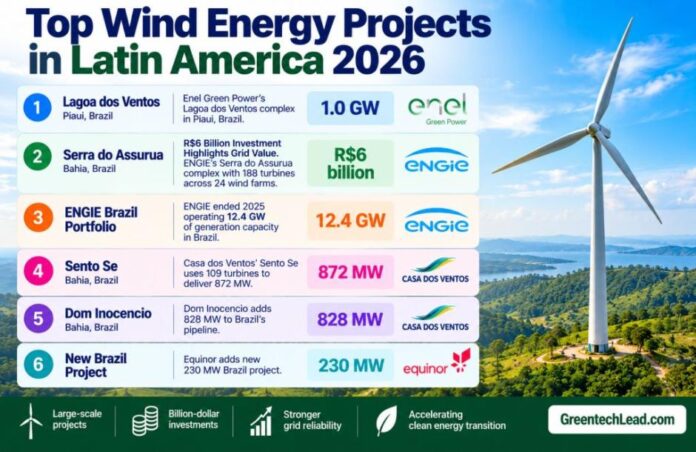
Enel Green Power’s Lagoa dos Ventos complex in Piauí, Brazil, is one of Latin America’s largest operating wind assets.
The expanded complex has 1,063.05 MW of installed capacity across 230 turbines and can generate more than 3.3 TWh of electricity annually.
The original 716 MW phase involved approximately R$3 billion of investment.
Lagoa dos Ventos demonstrates why annual energy production is more important than MW alone.
Its 3.3 TWh annual output is sufficient to demonstrate the enormous generation potential of Brazil’s northeastern wind corridor, where strong and relatively consistent winds support high turbine productivity.
The Lagoa dos Ventos wind complex shows how scale, resource quality and infrastructure can be combined in a single renewable-energy platform.
Serra do Assuruá: R$6 Billion Investment Highlights Grid Value
ENGIE’s Serra do Assuruá complex in Bahia provides another model.
Fully commissioned in December 2025, the project consists of 188 turbines across 24 wind farms with 846 MW of installed capacity.
Investment reached approximately R$6 billion.
Importantly, the project includes 28 kilometers of transmission lines connecting the wind complex to Brazil’s electricity grid.
ENGIE ended 2025 operating 12.4 GW of generation capacity in Brazil, with Serra do Assuruá among its major new renewable assets.
The project demonstrates a crucial investment principle: a wind farm without adequate transmission is not a complete infrastructure asset.
Developers must assess turbine economics and grid-access economics together.
Sento Sé Uses 109 Turbines to Deliver 872 MW
Casa dos Ventos’ Sento Sé project in Bahia demonstrates how larger turbines are changing wind-farm design.
The 872 MW project is expected to use 109 Goldwind GWH182-8.0 MW turbines and generate approximately 4.5 million MWh annually.
Using 8 MW-class turbines allows Sento Sé to approach 1 GW of capacity with only 109 machines.
That can potentially reduce the number of foundations, internal roads, electrical connections and maintenance points compared with projects built around smaller turbines.
However, bigger turbines also require stronger roads, larger cranes and more sophisticated logistics.
The relevant investor metric is therefore MWh generated over the turbine’s lifetime relative to total project CAPEX and OPEX, rather than turbine size itself.
Dom Inocêncio Adds 828 MW to Brazil’s Pipeline
Another Casa dos Ventos project demonstrates a different turbine strategy.
The 828 MW Dom Inocêncio wind complex in Piauí will use 184 Vestas V150-4.5 MW turbines.
Construction is expected to begin in 2026, with final commissioning scheduled for 2028.
Vestas will also provide 25 years of operations and maintenance services under its AOM 5000 agreement.
That long-term service contract is economically important.
Modern wind projects generate revenue opportunities not only for turbine manufacturers but also through decades of maintenance, digital monitoring, spare parts and performance optimization.
Equinor Adds a New 230 MW Brazil Project
Another 2026 development demonstrates continuing international investment in Brazilian wind.
In March, Equinor, through Rio Energy, acquired the 230 MW Esquina do Vento project from Vestas in Rio Grande do Norte.
The project will use 51 Vestas V163-4.5 MW turbines.
Installation is scheduled to start in March 2027, with all turbines expected to be installed by the end of that year.
Vestas will provide operations and maintenance services for an unusually long 30-year period.
The project demonstrates the attractiveness of Brazil’s northeast to international energy companies seeking long-duration renewable assets.
Brazil Targets Another 12.5 GW Through 2030
The individual projects sit within a much larger Brazilian wind investment cycle.
Industry expectations indicate that Brazil could install another 12.5 GW of wind capacity between 2026 and 2030.
For perspective, Brazil ended 2024 with 33.7 GW of installed wind capacity, after adding approximately 3.3 GW during the year. The country had 1,103 wind farms at that point.
The expected 12.5 GW expansion therefore represents a significant addition to an already large installed fleet.
The pipeline creates opportunities for Vestas, Goldwind, Nordex and other turbine suppliers, as well as developers, transmission companies, engineering contractors and long-term service providers.
Horizonte Links 816 MW of Wind to Chilean Mining
Chile provides a different investment model.
Colbún’s Horizonte wind farm in the Antofagasta region has 816 MW of capacity from 140 turbines and is expected to generate approximately 2,450 GWh annually.
Investment is around $900 million, equivalent to approximately $1.1 million per MW.
Its economics are strengthened by industrial demand.
Colbún has a 15-year agreement with copper producer Codelco covering 1,100 GWh of renewable electricity annually.
That represents roughly 45 percent of Horizonte’s expected annual generation.
The Horizonte wind project and Codelco power model demonstrates why mining can become an important anchor customer for renewable-energy projects.
Copper, lithium, data centers and green hydrogen could create similar long-term demand.
Peru Shows Why Capacity Factor Can Beat Project Size
Statkraft’s 72 MW Emma wind project in Piura, Peru, is much smaller than Brazil’s giant projects.
But it demonstrates why MW alone can be misleading.
Emma is expected to produce around 325 GWh annually, supported by a capacity factor above 50 percent.
Consider two hypothetical 500 MW projects.
At a 30 percent capacity factor, annual generation would be around 1.31 TWh.
At 50 percent, generation rises to approximately 2.19 TWh.
The same 500 MW asset therefore produces around 876 GWh more electricity every year simply because of superior wind resources and turbine utilization.
This is why investors should compare MWh/MW, capacity factor and LCOE, rather than ranking wind projects only by nameplate capacity.
Curtailment Can Cost Millions of Dollars
Latin America’s excellent wind resources frequently exist far from major electricity-demand centers.
That makes transmission one of the industry’s largest risks.
A 500 MW wind farm operating at a 50 percent capacity factor could theoretically generate approximately 2.19 TWh annually.
If grid constraints cause 10 percent curtailment, around 219 GWh would be lost.
At an illustrative electricity value of $40/MWh, that represents approximately $8.8 million of annual gross revenue exposure.
At 20 percent curtailment, the figure rises to approximately $17.5 million.
Actual losses depend on PPAs, market prices and curtailment compensation, but the calculation demonstrates why transmission investment can materially influence project returns.
Battery Storage Could Unlock More Wind Value
Battery energy storage is becoming relevant to Latin American wind economics.
A BESS can store electricity when transmission is constrained or electricity prices are weak and release it during more valuable periods.
Hybrid wind + solar + battery developments can also improve utilization of expensive grid connections because solar and wind generation profiles frequently differ.
This is particularly relevant in Chile, where renewable curtailment has increased the value of storage.
The next generation of Latin American wind developments could therefore be designed as integrated renewable-energy platforms rather than standalone wind farms.
Brazil Moves Closer to Offshore Wind
The region’s biggest longer-term opportunity may be offshore.
Brazil established a federal offshore-wind framework through Law 15,097/2025, providing rules for allocating offshore areas for electricity generation.
Regulatory implementation advanced further in 2026.
In April, Brazil’s National Energy Policy Council established guidelines for implementing the offshore-wind framework.
In July, the government published its methodology for selecting potential offshore-wind areas, incorporating technical, environmental, social and economic criteria.
In August, Brazil’s EPE published a new assessment of offshore wind resources along the country’s coastline.
These steps do not mean large offshore projects will be operating immediately, but they are building the regulatory and technical foundations required for future auctions and investment.
The Brazil offshore wind regulatory framework could eventually create demand for ports, foundations, subsea cables, transmission infrastructure and specialized vessels.
Offshore Wind Could Reach 40.6 GW by 2045
GWEC forecasts Latin America and the Caribbean could develop approximately 6 GW of offshore wind by 2035, rising to 19.6 GW by 2040 and 40.6 GW by 2045.
Brazil is particularly well positioned because it combines a large offshore resource with an established onshore wind supply chain and experience from its offshore oil and gas industry.
However, offshore wind will require a much broader industrial ecosystem.
Ports must handle large turbines and foundations. Developers need specialized installation vessels. Submarine cables and offshore substations require new supply chains, while transmission must move large volumes of electricity from coastal projects to demand centers.
Latin America Wind Market Could Exceed 120 GW by 2035
The region’s onshore wind capacity is expected to surpass 120 GW by 2035, creating opportunities across turbines, transmission, O&M, engineering, financing and energy storage.
Brazil should remain the regional volume leader, supported by projects such as Lagoa dos Ventos at 1,063 MW, Sento Sé at 872 MW, Serra do Assuruá at 846 MW and Dom Inocêncio at 828 MW.
Chile demonstrates another route through Horizonte’s 816 MW project and 15-year industrial power agreement, while Peru’s Emma project shows how a capacity factor above 50 percent can make smaller assets economically attractive.
The Latin American wind supply-chain opportunity will consequently extend far beyond turbine manufacturing.
Transmission, battery storage, ports, grid equipment, O&M, financing and industrial PPAs will determine which projects create the greatest value.
The key question for investors is therefore shifting from “Which is Latin America’s largest wind farm?” to “Which project converts each MW into the most reliable and valuable MWh?”
By 2035, the winners are likely to be projects combining strong wind resources, high capacity factors, efficient turbines, reliable transmission, low curtailment, contracted demand and disciplined financing.
Those factors — rather than headline MW alone — will determine which Latin American wind projects become the region’s most valuable long-term renewable infrastructure assets.
SHAFANA FAZAL
