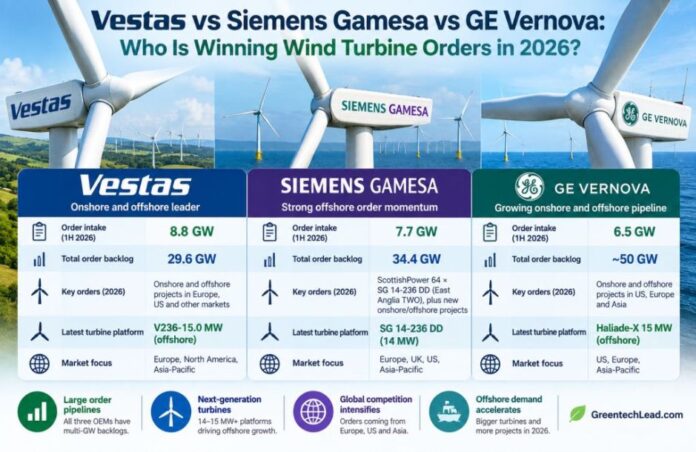
The global wind turbine market is becoming a battle for profitable orders, reliable execution and long-term service revenue, rather than simply installed megawatts.
Among the three major Western wind turbine manufacturers, Vestas has the strongest publicly disclosed order momentum in 2026. The company booked 7.85 GW during the first half and had announced another approximately 1.3 GW of Q3 orders by September 29.
Siemens Gamesa is pursuing a different objective: restoring profitability while leveraging its position in offshore wind. GE Vernova Wind, meanwhile, is emphasizing selective contracting and established turbine platforms rather than maximizing order volume.
The result is a three-way contest in which order quality, turbine reliability, margins and service contracts increasingly matter as much as GW won.
Vestas Wind Orders Reach 7.85 GW in First Half
Vestas recorded 4.50 GW of firm and unconditional turbine orders in Q1 2026 and another 3.35 GW in Q2, taking first-half order intake to 7.85 GW.
Its publicly announced Q3 orders had reached approximately 1.3 GW by September 29, although final Q3 intake will include unannounced orders disclosed with financial results.
Vestas’ 2026 wind turbine order portfolio demonstrates significant geographic diversification across Europe, Latin America and Asia-Pacific.
Its biggest wins are offshore.
Vestas Wins 2.76 GW from Vanguard Offshore Projects
Two UK projects illustrate the scale of Vestas’ offshore strategy.
In February, RWE placed a firm 1.38 GW order for Vanguard West, covering 92 V236-15.0 MW turbines.
In March, Vestas secured another 1.38 GW order for Vanguard East, again involving 92 V236-15.0 MW turbines.
Together, the two developments represent 2.76 GW and 184 offshore turbines.
Vestas will supply, deliver and commission the machines and provide five-year comprehensive service agreements followed by longer-term operational support.
The projects show why offshore orders have strategic value beyond initial turbine sales: a multi-billion-dollar installed fleet can create service opportunities extending for decades.
Brazil Adds 230 MW and 30-Year Service Deal
Vestas’ onshore business provides another example.
Equinor and Rio Energy ordered turbines for the 230 MW Esquina do Vento wind project in Brazil. The project will use 51 V163-4.5 MW turbines.
More importantly for lifetime economics, the contract includes a 30-year service agreement.
Long-term agreements can generate maintenance, spare-parts, monitoring and performance-optimization revenue well after the initial turbine installation.
Vestas is also introducing its new V182-7.2 MW turbine, securing its first order for the platform in Sweden in September.
These projects support the view that Vestas is competing simultaneously on turbine technology, geographic reach and service attachment.
Siemens Gamesa’s 2026 Priority Is Profitable Offshore Execution
Siemens Gamesa enters the competition from a different position.
Its immediate priority is not necessarily winning the largest volume of new orders, but demonstrating that its existing backlog and technology portfolio can produce sustainable profits.
Siemens Energy reported a positive quarterly result for Siemens Gamesa in fiscal Q3 2026 and maintained its objective of reaching break-even during fiscal 2026.
The turnaround is particularly important because Siemens Gamesa remains a major offshore wind technology supplier.
Its SG 14-236 DD platform offers a 14 MW rating, with power-boost capability reaching 15 MW and a 236-metre rotor.
Large offshore turbines can increase output while reducing the number of foundations and turbine positions required, but they also increase manufacturing, installation and reliability risks.
For Siemens Gamesa, successful execution of major offshore projects is therefore more important than headline order volume.
East Anglia TWO Shows Siemens Gamesa’s Offshore Scale
The 960 MW East Anglia TWO project in the UK provides a good example.
ScottishPower selected Siemens Gamesa to supply 64 SG 14-236 DD offshore wind turbines for the 960 MW East Anglia TWO project under a turbine contract worth more than £1 billion.
The wider project represents investment of around £4 billion.
East Anglia TWO demonstrates why offshore wind contracts are strategically important. Turbine manufacturing represents only one component of the overall project, while successful installation and long-term reliability can strengthen the OEM’s position for future multi-GW developments.
Siemens Gamesa’s profitability recovery will therefore depend heavily on delivering large projects without the cost overruns and quality problems that previously affected the business.
GE Vernova Focuses on Selective Wind Orders
GE Vernova is following a third strategy.
Its Wind segment recorded $2.2 billion of orders in Q2 2026 and 1.8 GW of turbine orders, including repowering.
The company has emphasized contract selectivity, pricing discipline and execution rather than pursuing maximum volume.
That strategy is particularly visible in India, where GE Vernova is expanding around its 3.8 MW-154m onshore turbine.
GE Vernova Wins 100 MW Powerica Project in India
Powerica ordered 28 GE Vernova 3.8 MW-154m turbines for the 100 MW Botad Wind Farm in Gujarat.
The order is important because it represents the Indian market debut of GE Vernova’s 3.8 MW platform.
Turbines will be supplied from the company’s Pune facility, which can support up to 1.5 GW of annual production capacity.
The platform has also been included on India’s Approved List of Models and Manufacturers.
GE Vernova’s 3.8 MW turbine expansion in India demonstrates how localization is becoming central to OEM strategy.
Enfinity Adds Another 163 MW GE Vernova Order
GE Vernova followed the Powerica contract with a larger Indian win in August.
Enfinity Global ordered 43 of the 3.8 MW-154m turbines for the 163.4 MW Fatehgarh Wind Farm in Rajasthan.
Deliveries are expected to begin in Q4 2026.
Together, Powerica and Enfinity represent more than 263 MW of disclosed orders for GE Vernova’s new Indian 3.8 MW platform.
GE Vernova also surpassed 5 GW of installed wind capacity in India in 2025, providing an established operating base for its next stage of expansion.
Scotland Adds 96 MW to GE Vernova Pipeline
Europe remains another important market.
In September, ESB selected GE Vernova to supply 16 6.1 MW-158m turbines for the 96 MW Chleansaid Wind Farm in the Scottish Highlands.
The contract demonstrates that GE Vernova’s strategy extends beyond its established 3 MW platform into higher-capacity European onshore turbines.
For GE Vernova, the challenge is converting selective orders into higher margins while controlling warranty, logistics and execution risks.
Wind Order Quality Is Becoming More Important Than GW
Comparing wind OEMs purely by megawatts can be misleading.
A 1 GW offshore contract has very different economics from 1 GW of onshore projects. Turbine specifications, logistics, warranties, delivery schedules, local-content requirements and service agreements all influence profitability.
The strongest orders can generate revenue from several sources:
turbine manufacturing and supply;
construction and commissioning;
long-term service agreements;
spare parts and component replacement;
software and performance optimization; and
eventual repowering.
This explains why manufacturers increasingly focus on lifetime customer value rather than turbine price alone.
Chinese OEMs Increase Pressure on Western Turbine Makers
Vestas, Siemens Gamesa and GE Vernova are also facing unprecedented competition from Chinese manufacturers.
Global firm turbine order intake reached 215 GW in 2025, according to Wood Mackenzie’s wind turbine order analysis.
Chinese OEMs dominate their domestic market and are expanding internationally, particularly across emerging economies.
Western OEMs still benefit from established service networks, lender familiarity, large international installed fleets and long-standing relationships with major developers.
But Chinese competition makes cost control and technology execution increasingly important.
Vestas vs Siemens Gamesa vs GE Vernova: Who Is Winning?
Vestas has the clearest publicly visible wind turbine order momentum in 2026.
Its 7.85 GW first-half order intake, approximately 1.3 GW of announced Q3 orders through September 29 and major 2.76 GW Vanguard offshore portfolio give it the strongest disclosed order trajectory among the three Western OEMs.
Siemens Gamesa’s key metric is different. Progress toward break-even and successful delivery of major offshore developments such as East Anglia TWO could strengthen its competitive position significantly.
GE Vernova is pursuing selective growth, illustrated by new projects including 100 MW Botad, 163.4 MW Fatehgarh and 96 MW Chleansaid.
The 2026 wind turbine race is therefore no longer simply about who wins the most GW.
The eventual winner will be the OEM that converts orders into profitable deliveries, reliable turbines and recurring service revenue while managing increasingly complex offshore projects, localization requirements and competition from Chinese manufacturers.
SHAFANA FAZAL