India’s accelerating wind-energy market is intensifying the competition between Suzlon Energy and Inox Wind, the two major domestic wind turbine manufacturers competing for orders from utilities, renewable developers, PSUs and commercial and industrial customers.
India had 58.52 GW of installed wind capacity by August 31, 2026, after adding 2.43 GW during April-August 2026. The expansion is creating opportunities across wind turbines, EPC, operations and maintenance (O&M), repowering and wind-solar hybrid projects.
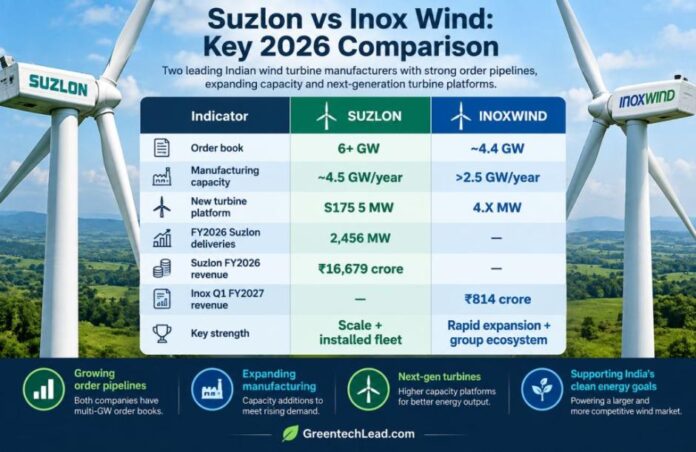
Suzlon currently leads the comparison in order-book scale, manufacturing capacity, deliveries and installed fleet. Inox Wind, however, is expanding through its 4.X MW turbine platform, approximately 4.4 GW order book and potential demand from the wider INOXGFL ecosystem.
The real battle is therefore shifting from simply winning turbine orders to converting backlog into commissioned MW, improving turbine energy yield and building recurring lifecycle revenue.
India Wind Capacity Reaches 58.52 GW
India’s wind market has moved into another expansion cycle.
Wind capacity reached 58,520 MW at the end of August 2026, according to MNRE’s latest renewable-energy capacity data. India added 2,425 MW during the first five months of FY2027 alone.
The long-term opportunity is considerably larger. Taller towers and larger rotors are improving generation at low- and medium-wind sites, while corporate renewable procurement, green open access, hybrid projects and round-the-clock renewable power are creating additional demand.
For Suzlon and Inox Wind, this means the addressable market is no longer dominated by traditional utility-scale wind auctions. C&I, captive and hybrid renewable projects are increasingly important growth engines.
Suzlon Leads Inox Wind in Wind Turbine Order Book
Suzlon’s order book stood above 6 GW in 2026, giving it a clear scale advantage over Inox Wind.
Inox Wind reported an approximately 4.4 GW order book, covering IPPs, PSUs, C&I customers and group-related renewable projects.
The difference is not only the number of megawatts but the composition of the backlog.
Suzlon has built a diversified customer base spanning independent power producers, industrial companies, renewable developers and public-sector customers. Inox Wind combines external orders with potential demand generated by the INOXGFL ecosystem.
Backlog quality matters because an MoU, equipment-supply contract, turnkey EPC project and firm turbine order offer different levels of revenue visibility and execution responsibility.
Suzlon’s 2026 Projects Show Strong Customer Diversification
Suzlon has secured several significant projects during 2026, demonstrating how rapidly India’s wind project sizes are increasing.
Tata Power Renewable Energy – 400 MW: Suzlon secured a 400 MW EPC order in June, taking its relationship with Tata Power beyond 1 GW.
Torrent Green Energy – 250 MW: The August order increased cumulative Suzlon-Torrent wind capacity to more than 1.3 GW.
Waaree Group – 201.6 MW: Suzlon won its first wind order from Waaree in July for a 201.6 MW project.
Ayana Renewable Power – 200 MW: In September, Suzlon announced its first order from Ayana for a 200 MW wind project.
ArcelorMittal – 248.5 MW: Suzlon secured its first wind order from ArcelorMittal in January 2026, demonstrating the growing importance of renewable power for energy-intensive industries.
Sunsure Energy – 195 MW: Suzlon also expanded its relationship with Sunsure through a 195 MW order involving its established 3 MW platform.
These awards show the breadth of Suzlon’s current project pipeline. Suzlon’s 2026 project announcements include orders across C&I customers, IPPs and large renewable developers.
S175 Gives Suzlon a New 5 MW Growth Platform
Technology is becoming an increasingly important competitive differentiator.
Suzlon’s S175 has a 5 MW rating and 175-metre rotor, positioning the machine for lower- and medium-wind locations. The turbine supports hub heights reaching 160 metres.
Its first commercial order came from Sunsure Energy for 105 MW, providing an important reference project for the new platform.
Suzlon is also developing the S163 6.3 MW turbine as part of its BlueSky platform for international markets. The company’s established S144 remains its primary Indian platform.
The strategy is important because larger turbines can generate more electricity from fewer positions. That potentially reduces foundations, roads, electrical infrastructure and balance-of-plant requirements per MW.
Inox Wind Bets on 4.X MW Turbine Technology
Inox Wind is following a similar technology path.
The company is transitioning from its existing 2 MW and 3 MW turbine platforms toward a 4.X MW machine, while expanding manufacturing capabilities to support larger turbines.
Its approximately 4.4 GW backlog provides a substantial pipeline for future execution.
Inox Wind has also secured repeat business from customers including NLC India, strengthening its position in the PSU segment. Its relationship with Inox Clean Energy provides another potential source of projects as renewable development within the group expands.
For Inox, successful commercialization of the 4.X MW platform could be critical to narrowing the technology and manufacturing-scale gap with Suzlon.
Manufacturing: Suzlon Has the Bigger Industrial Base
Manufacturing capacity remains one of Suzlon’s strongest competitive advantages.
Suzlon has approximately 4.5 GW of annual manufacturing capacity, compared with more than 2.5 GW across five facilities for Inox Wind.
That gives Suzlon roughly 1.8 times Inox Wind’s disclosed manufacturing capacity.
But installed factory capacity alone does not determine market leadership. Manufacturing utilization, blade production, supply-chain availability, turbine deliveries and project execution ultimately determine how much revenue the factories generate.
India’s domestic wind supply chain also provides both companies with a strategic advantage as turbine demand expands.
Suzlon Delivered 2.46 GW in FY2026
Execution provides another useful comparison.
Suzlon delivered 2,456 MW during FY2026, representing growth of 58 percent. Revenue from operations reached approximately ₹16,679 crore, while EBITDA was around ₹3,022 crore.
The company entered FY2027 with continued momentum, reporting its highest-ever first-quarter deliveries.
The performance matters because large order books only create value when manufacturers can convert orders into turbines, commissioned projects and cash flow.
Inox Wind is expanding from a smaller revenue base. It reported ₹814 crore revenue from operations in Q1 FY2027, adjusted EBITDA of ₹237 crore and net profit of ₹64.1 crore.
Its execution rate will therefore be one of the most important indicators to watch as it converts the 4.4 GW backlog.
Suzlon’s Installed Fleet Creates an O&M Advantage
Suzlon has another advantage that cannot be measured through new orders alone: its large installed turbine fleet.
Its historically installed Indian capacity gives Suzlon a significant addressable market for operations and maintenance, spare parts, turbine upgrades and repowering.
O&M revenue can be particularly valuable because wind turbines operate for decades and require continuous monitoring, maintenance and component replacement.
Repowering could become another major opportunity. Older wind farms developed with smaller turbines occupy some attractive wind locations with existing grid connections. Replacing ageing machines with modern higher-capacity turbines can potentially increase electricity production without developing entirely new sites.
Inox Wind is building its own recurring service opportunity as its installed fleet expands, supported by its relationship with Inox Green.
Who Is Winning India’s Wind Market in 2026?
Suzlon currently holds the stronger overall competitive position.
It has the larger order book, approximately 4.5 GW of manufacturing capacity, 2.46 GW of FY2026 deliveries, a large operating fleet and an increasingly diversified portfolio of C&I, IPP and utility customers.
Its 2026 projects with Tata Power, Torrent, Waaree, Ayana, ArcelorMittal and Sunsure also demonstrate repeat business and customer diversification.
Inox Wind, however, should not be underestimated. Its 4.4 GW backlog, new 4.X MW turbine, expanding manufacturing capacity and connection to the INOXGFL renewable-energy ecosystem provide a credible route to faster growth.
The next phase of the Suzlon vs Inox Wind competition will consequently be determined by more than orders. Investors and renewable developers should watch annual turbine deliveries, backlog conversion, energy yield, manufacturing utilization, EBITDA margins, O&M growth, repowering projects and repeat orders.
Suzlon enters the second half of 2026 with the scale advantage. Inox Wind’s challenge is to translate its expanding pipeline into commissioned capacity quickly enough to close that gap.
With India’s wind capacity already above 58 GW and deployment accelerating, the market may ultimately be large enough for both companies to grow rapidly. The more important contest is becoming which manufacturer can convert India’s wind expansion into the strongest combination of turbine sales, project execution and long-term recurring revenue.
SHAFANA FAZAL