
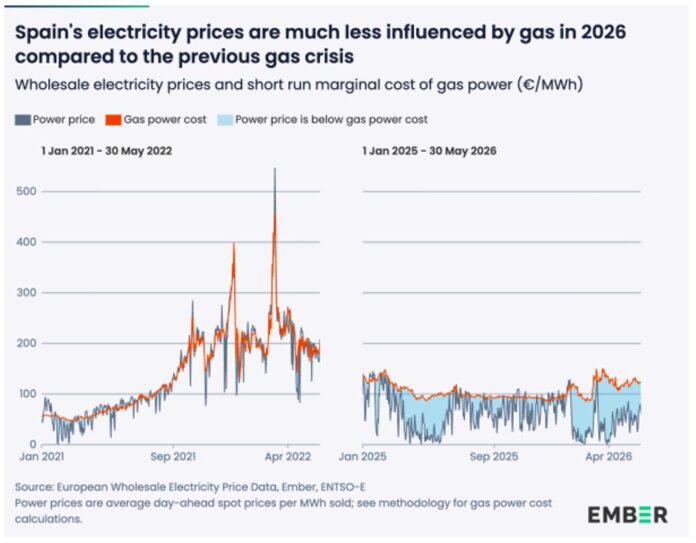
Spain’s investment in renewable energy is delivering significant savings for consumers, with households avoiding an average of €10 per month in electricity costs since March 2026 as wind and solar power reduce the impact of volatile gas prices on the electricity market.
According to a new report from Ember, Spain’s renewable energy strategy has helped shield consumers from the latest energy crisis while maintaining some of the lowest power prices in Europe.
The report authored by Chris Rosslowe highlights that the influence of gas on Spain’s electricity pricing has fallen dramatically from 52 percent of hours in 2021 to just 9 percent of hours during the first five months of 2026. This shift has been driven by a 37 percent increase in wind and solar generation between 2021 and 2025, significantly weakening the link between gas prices and electricity costs.
Spain’s renewable energy growth has proven especially valuable as European gas markets face renewed volatility. Following the escalation of conflict involving Iran, European gas prices surged by approximately 75 percent, remaining around 60 percent above pre-war levels in early June 2026. Despite this, Spain’s electricity market remained largely insulated from the shock due to its lower dependence on gas-fired generation.
The difference is evident when comparing Spain with more gas-dependent markets. In March 2026, wholesale electricity prices averaged €42 per MWh in Spain, compared with €143 per MWh in Italy, making Italian power prices more than three times higher.
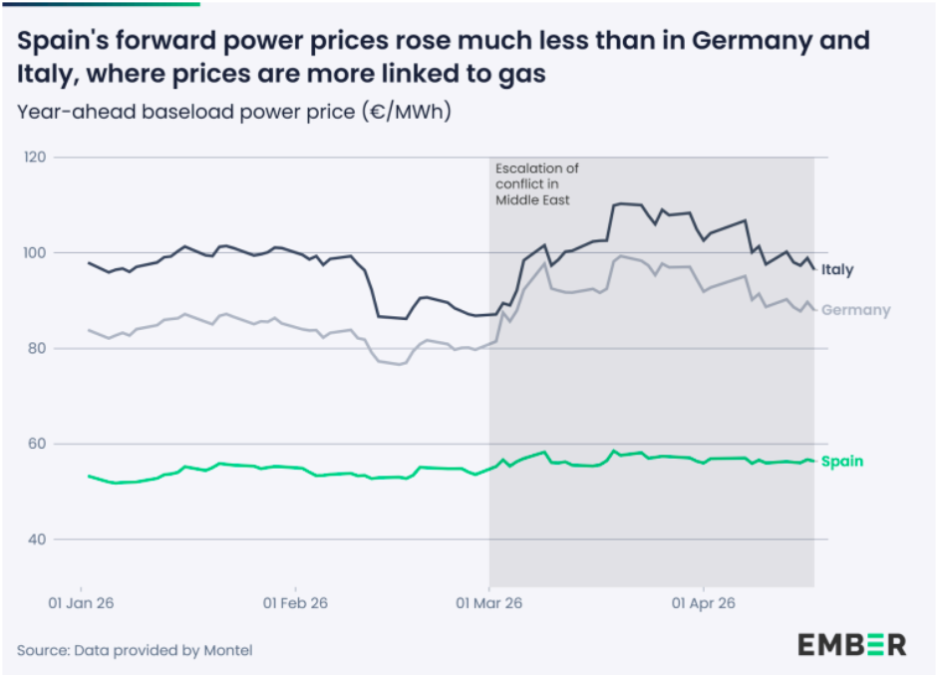
Gas influenced electricity prices in Italy during 75 percent of hours in the first five months of 2026, compared with just 9 percent in Spain. Spain and Portugal ranked among the three cheapest electricity markets in the European Union during each of the first four months of 2026.
The benefits are flowing directly to consumers. Ember estimates that a typical Spanish household on the regulated tariff would be paying €10 more per month, or 19 percent higher electricity bills, if power prices were still linked to gas as strongly as they were in 2021. The average household electricity bill under the regulated tariff was estimated at €60.22 per month, based on monthly consumption of 250 kWh and a 4.6 kW connection.
Wholesale electricity market costs account for roughly 20-30 percent of a typical household electricity bill. During March and April 2026, avoided wholesale energy costs generated savings of approximately €15 per month. These savings were partially offset by an increase in grid balancing costs of around €6 per month, resulting in a net consumer benefit of €10 per month after taxes.
Grid balancing costs have risen alongside renewable energy growth, with annual balancing expenditures increasing from €1.3 billion in 2021 to €3.8 billion in 2025, while renewable energy curtailment expanded from 0.1 TWh to 4.6 TWh during the same period.
Spain has continued accelerating renewable energy deployment despite the Iberian blackout of April 2025. Between May 2025 and February 2026, the country added an average of 1.3 GW of wind and solar capacity per month, slightly higher than the 1.2 GW monthly average recorded during the previous twelve months. The government has also introduced reforms to improve renewable integration and expand energy storage. Installed large-scale battery capacity already quadrupled in 2025, and another fourfold increase is expected in 2026. As of May 2026, approximately 6 GW of renewable energy capacity was already providing voltage-control services to support grid stability.
Spain’s response to the 2026 energy crisis has also included tax reductions aimed at lowering consumer costs and encouraging electrification. The government temporarily reduced electricity VAT from 21 percent to 10 percent, cut the electricity tax from 5.1 percent to 0.5 percent, and suspended the electricity generation tax.
These measures removed approximately €8 per month from the typical household electricity bill and up to €20 per month for larger households and businesses. Combined with low wholesale electricity prices, these tax reductions pushed regulated household electricity prices in April 2026 to some of their lowest levels since before the 2021-2024 gas crisis.
Despite progress in renewable energy, Spain remains dependent on imported fossil fuels, with import reliance standing at 71 percent, higher than the European Union average of 57 percent. Ember believes continued investment in renewable energy, battery storage, and electrification will further reduce exposure to fossil fuel price shocks while strengthening Spain’s long-term energy security and consumer affordability.
BABURAJAN KIZHAKEDATH
