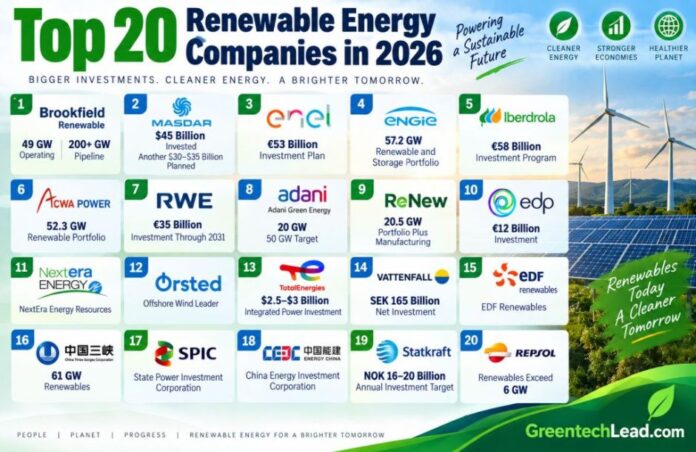
The world’s largest renewable energy companies are entering a new investment cycle in 2026 as billions of dollars flow into solar, wind, battery storage, electricity networks and flexible power infrastructure.
Installed capacity remains important, but capital expenditure, development pipelines, storage, grid access and geographic diversification increasingly determine which renewable companies can sustain growth through 2030.
Here are 20 leading renewable energy companies in 2026 based on operating capacity, pipelines, investment commitments and expansion strategies.
1. Brookfield Renewable — 49 GW Operating, 200+ GW Pipeline
Brookfield Renewable operates approximately 49 GW and has a development pipeline exceeding 200 GW across hydro, solar, wind and storage.
The company manages about $147 billion of assets and expects its annual renewable development rate to approach 10 GW by 2027.
Its expansion includes Geronimo Power, adding around 3.2 GW of operating and development assets plus a pipeline exceeding 30 GW. Brookfield’s access to large pools of institutional capital gives it significant flexibility to finance acquisitions and new projects.
2. Masdar — $45 Billion Invested, Another $30-$35 Billion Planned
UAE-based Masdar has become one of the industry’s most aggressive global investors.
Its renewable portfolio reached 65 GW in 2026, including 45 GW operational, under construction or committed and another 20 GW in advanced development.
Masdar’s 65 GW portfolio and investment strategy indicated that it has invested $45 billion and intends to deploy another $30-$35 billion by 2030 while targeting 100 GW.
Its Abu Dhabi round-the-clock clean-energy project alone combines 5.2 GW of solar with 19 GWh of batteries and represents approximately $6.1 billion of investment.
3. Enel — €53 Billion Investment Plan
Enel’s 2026-2028 strategy calls for approximately €53 billion of total investment, including more than €26 billion in integrated businesses and over €26 billion in electricity networks.
Around €20 billion will go into renewables, supporting roughly 15 GW of additions and taking renewable capacity above 80 GW by 2028. More than 75 percent of additions will come from wind and battery storage or other dispatchable technologies.
4. ENGIE — 57.2 GW Renewable and Storage Portfolio
ENGIE ended 2025 with approximately 57.2 GW of renewable and battery capacity and added 6.2 GW during the year.
Its broader project portfolio reached around 121 GW, with nearly 8 GW under construction. The company is targeting 95 GW of renewable and storage capacity by 2030, implying average annual additions of roughly 7 GW.
ENGIE’s 4.8 GW of corporate PPAs signed during 2025 also provides long-term demand support for investment.
5. Iberdrola — €58 Billion Investment Program
Iberdrola has one of the industry’s biggest investment programs: €58 billion through 2028.
Iberdrola’s €58 billion investment strategy indicated that it earmarked around €37 billion for electricity networks and €21 billion for renewable generation and customers. The renewable/customer allocation includes roughly €8 billion for offshore wind, €5 billion for onshore wind, €2 billion for storage and €2 billion for solar.
Geographically, investment includes €20 billion in the UK, €16 billion in the U.S., €9 billion in Iberia and €7 billion in Brazil.
6. ACWA Power — 52.3 GW Renewable Portfolio
Saudi Arabia-based ACWA Power has approximately 98.2 GW of total power-generation capacity across 16 countries, including around 52.3 GW of renewables.
Its 111 assets across operations, construction and advanced development give ACWA exposure to billions of dollars of investment in Saudi Arabia, the wider Middle East, Africa and Central Asia.
Its strategy increasingly combines solar, wind, storage, desalination and long-term power contracts.
7. RWE — €35 Billion Investment Through 2031
RWE plans €35 billion of net investment between 2026 and 2031, adding around 25 GW of renewable, battery and flexible-generation capacity and taking its portfolio toward 65 GW.
RWE’s €35 billion global investment plan shows that the United States will receive €17 billion, supporting 9 GW of additions and increasing RWE’s U.S. capacity from around 13 GW to 22 GW. Another €7 billion is allocated to European wind and solar, €2 billion to offshore wind and €9 billion to flexible generation.
8. Adani Green Energy — 20 GW and 50 GW Target
Adani Green Energy exceeded 20 GW of operational renewable capacity in 2026, after adding 5.051 GW during FY2026.
Its Khavda renewable-energy development in Gujarat is planned at 30 GW, while operational battery storage has reached approximately 3.55 GWh.
Adani Green aims to reach 50 GW of renewable capacity by 2030 and more than 10 GWh of BESS in FY2027, making storage a major part of its next investment cycle.
9. ReNew — 20.5 GW Portfolio Plus Manufacturing
ReNew entered FY2027 with a 20.5 GW renewable portfolio, including 1.7 GW/6.2 GWh of battery storage.
Its manufacturing strategy includes 6.4 GW of module and 2.5 GW of cell capacity, with another 4 GW of cells and a 6.5 GW ingot-wafer facility under development.
ReNew also has a 15 GW pumped-hydro pipeline, making it increasingly an integrated energy rather than purely renewable-generation company.
10. EDP/EDPR — €12 Billion Investment
EDP plans approximately €12 billion of gross investment during 2026-2028, including around €7.5 billion for EDPR’s wind, solar and battery expansion.
Approximately 60 percent of EDPR investment is targeted at the United States, while around 70 percent of EDP’s overall investment will be concentrated in Europe.
The company also plans about €5 billion of asset-rotation proceeds, allowing it to recycle capital into new projects.
11. NextEra Energy Resources
NextEra Energy Resources operates approximately 28 GW of wind and solar generation plus around 4 GW of battery storage.
Its biggest opportunity is the accelerating U.S. electricity-demand cycle, particularly from AI data centers, semiconductor plants and manufacturing.
Solar-plus-storage and long-term supply contracts with large customers are becoming increasingly important components of its investment strategy.
12. Orsted — Offshore Wind Leader
Orsted had approximately 18.8 GW of installed renewable capacity in Q1 2026, including more than 10 GW of offshore wind.
Another 8.6 GW had reached final investment decision, with offshore projects accounting for most of that capacity.
The company’s investment strategy has become more selective as higher financing costs force offshore developers to prioritize projects with strong PPAs, CfDs and acceptable returns.
13. TotalEnergies — $2.5-$3 Billion Integrated Power Investment
TotalEnergies ended 2025 with approximately 34 GW of gross renewable capacity.
The company plans to invest around $2.5-$3 billion in Integrated Power during 2026, supporting solar, wind, batteries and electricity businesses.
Partnerships and joint ventures allow TotalEnergies to expand while recycling capital and limiting the amount tied up permanently in individual renewable assets.
14. Vattenfall — SEK 165 Billion Net Investment
Vattenfall’s 2026-2030 plan includes approximately SEK 165 billion of net investment and SEK 239 billion gross.
Wind alone receives approximately SEK 62 billion of net Capex, including SEK59 billion for growth.
Major investments include the 980 MW Nordlicht I and 630 MW Nordlicht II offshore wind projects in Germany.
15. EDF Renewables
EDF’s renewable business operates across Europe, North America, the Middle East and other markets.
Its North American operations alone have developed more than 26 GW of wind, solar and storage, while partnerships include seven U.S. projects with Masdar totaling around 1.1 GW.
EDF is also participating in Saudi Arabia’s expanding utility-scale renewable investment market.
16. China Three Gorges — 61 GW Renewables
China Three Gorges has approximately 61.04 GW of renewable capacity, including around 7.05 GW of offshore wind.
Its renewable operations are complemented by enormous hydroelectric assets including the 22.5 GW Three Gorges project and 16 GW Baihetan project, providing flexible generation capable of supporting China’s rapidly growing solar and wind fleet.
17. SPIC
State Power Investment Corporation is one of China’s largest integrated power companies, with major solar, wind and hydro operations.
Its investment strength comes from access to China’s manufacturing ecosystem, project financing and large-scale engineering resources.
SPIC is also expanding internationally, particularly in emerging markets seeking large utility-scale renewable projects.
18. China Energy Investment Corporation
China Energy Investment Corporation is another major beneficiary of China’s enormous renewable infrastructure buildout.
Its scale across generation, engineering and infrastructure allows it to integrate wind and solar with transmission and storage — increasingly important as China adds hundreds of gigawatts of renewable capacity.
19. Statkraft — NOK16-20 Billion Annual Investment Target
Norway’s Statkraft combines hydroelectric generation with wind and solar investments.
The company has targeted approximately NOK16-20 billion of annual investment across core technologies and markets.
During H1 2026, Statkraft made investment decisions covering more than 600 MW of new renewable capacity, including projects in Peru and Europe.
20. Repsol — Renewables Exceed 6 GW
Repsol’s installed renewable capacity exceeded 6 GW in 2026, with Spain and the United States among its priority investment markets.
Major developments include the 825 MW Pinnington solar project in Texas.
Repsol is also using asset rotation to sell stakes in mature renewable projects and recycle capital into new developments, reducing the capital intensity of expansion.
Renewable Investment Race Is Moving Beyond Capacity
The biggest renewable companies are increasingly differentiated by how much capital they can deploy and how efficiently they can convert development pipelines into operating assets.
Masdar plans another $30-$35 billion through 2030. Enel’s 2026-2028 investment program totals about €53 billion, while Iberdrola plans €58 billion through 2028 across networks, renewables and customers. RWE is targeting €35 billion through 2031.
India is producing another group of fast-growing players, with Adani Green targeting 50 GW and ReNew combining renewable generation with storage and solar manufacturing.
Outlook to 2030
The renewable-energy leaders of 2030 may therefore look different from a ranking based purely on today’s installed GW.
The strongest companies will combine renewable capacity, multibillion-dollar investment programs, storage, electricity networks, long-term PPAs and access to fast-growing power markets.
AI data centers, electrification and industrial expansion are also creating new sources of electricity demand. This gives developers with strong balance sheets, grid connections and storage portfolios an advantage in converting renewable pipelines into commercially viable projects.
Capacity still matters. But in the next phase of the renewable-energy race, capital deployment and the ability to finance, connect and sell clean electricity may matter just as much as the number of gigawatts installed.
SHAFANA FAZAL