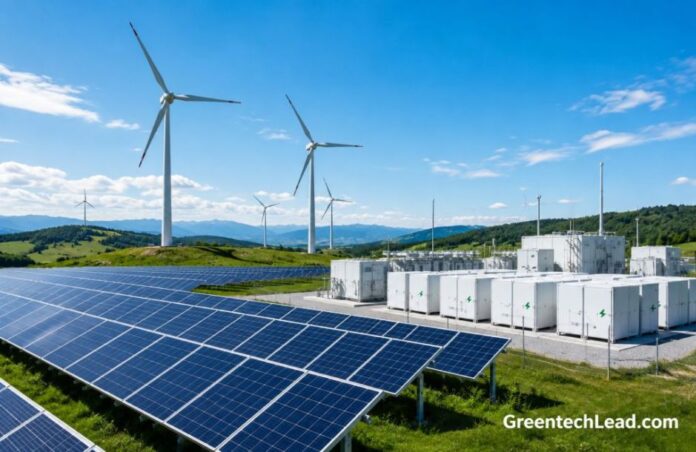
The global renewable energy industry is approaching a massive replacement and repowering cycle as the first generations of wind turbines and solar projects reach the later stages of their operating lives. More than 3.5 terawatts (TW) of wind and solar capacity is already operational worldwide, while another 2.5 TW of projects will eventually face decisions over decommissioning, lifetime extension or complete repowering by the 2040s, according to Wood Mackenzie.
The transition could create a major second wave of investment in wind turbines, solar modules, grid infrastructure and renewable project redevelopment. Wood Mackenzie estimates that replacement demand will account for 44 percent of global wind installations and 23 percent of solar installations during the 2040s.
Equipment manufacturers could be among the biggest beneficiaries. Despite an expected slowdown in the growth rate of net renewable capacity additions, the volume of equipment sold globally in 2050 is projected to be more than 60 percent higher than in 2026 as ageing projects require replacement.
The findings indicate that the energy transition is moving beyond a model dominated by adding new renewable capacity. The next phase will increasingly involve maintaining, upgrading and replacing the enormous fleet of wind and solar assets already operating around the world.
Wind Decommissioning Has Already Started
Wind power is at the front of this renewable replacement cycle because large-scale wind deployment started earlier than the solar boom.
Wood Mackenzie expects more than 30 GW of wind capacity to have been decommissioned globally by the end of 2026. Around two-thirds of that capacity was taken offline between 2022 and 2026, demonstrating how quickly retirement volumes are beginning to accelerate.
Solar deployment expanded rapidly later than wind, meaning widespread solar retirement remains further away. However, the much larger scale of recent solar installations means the ageing solar fleet is expected to overtake wind before 2040.
The replacement market will therefore develop in phases: wind repowering is already becoming an important investment opportunity, while solar repowering and replacement could become significantly larger during the 2030s and 2040s.
The trend comes as global renewable capacity continues to expand rapidly. IRENA data show that global wind capacity reached about 1.29 TW at the end of 2025, up from 1.13 TW in 2024. Solar and wind are now responsible for most additions to the world’s renewable electricity fleet.
IRENA has also found that renewables remain highly competitive economically. More than 90 percent of utility-scale renewable projects commissioned during 2025 produced electricity at a lower cost than the cheapest new fossil-fuel alternative available in their respective markets.
Why Repowering Can Beat Greenfield Renewable Projects
For renewable asset owners, reaching the end of the original project’s operating life does not necessarily mean abandoning the site.
Repowering can offer important advantages over developing an entirely new wind or solar project because an established renewable site may already have a grid connection, planning approval, roads, electrical infrastructure and community acceptance.
These assets are becoming increasingly valuable as renewable developers encounter grid-connection queues, permitting delays and competition for high-quality sites.
While capital and operating expenditure for a fully repowered project can be broadly comparable with greenfield development, an existing site can potentially reach commercial operation faster while reducing development risks.
The economic case becomes even stronger when the existing project occupies a particularly attractive renewable resource location.
Germany Shows the Economics of Better Wind Sites
Wood Mackenzie’s analysis of Germany demonstrates the value hidden in established renewable locations.
Average wind speeds at German sites decommissioned during the current decade are around 4 percent higher than those available to new greenfield projects entering operation, while the difference between individual locations can reach as much as 30 percent.
Even a relatively small wind-speed advantage can have a substantial financial impact.
Wood Mackenzie estimates that a 4 percent increase in wind speed can produce roughly a 7 percent increase in capacity factor and a 7 percent reduction in levelised cost of energy (LCOE), assuming other factors remain unchanged.
That creates an incentive for developers and investors to acquire ageing operational projects located in high-quality wind areas, remove older equipment and redevelop the same location using larger and more efficient turbines.
The opportunity is particularly relevant as manufacturers introduce turbines capable of generating substantially more electricity from individual sites. The latest generation of turbines is increasingly designed around higher annual energy production, larger rotor diameters and improved performance at sites with moderate wind resources.
Recent developments such as the Vestas V182-7.2 MW turbine illustrate how turbine technology continues to evolve as developers seek higher output and stronger project economics from available sites.
Repowering Creates a New Renewable Investment Cycle
Repowering could consequently emerge as an important investment category alongside conventional greenfield renewable development.
Opportunities will extend beyond wind turbine and solar module manufacturers. Engineering, procurement and construction companies, transmission equipment suppliers, developers, asset managers, recycling companies and renewable financing providers could all participate in the replacement cycle.
For project owners, the decision is likely to involve three main options: continue operating existing equipment through lifetime extensions, partially upgrade the project, or completely repower the site.
The economics will depend on equipment condition, electricity prices, financing costs, grid availability, government policy and the potential increase in generation from newer technology.
The declining cost of renewable generation strengthens the case for modernisation. According to IRENA’s renewable power generation cost analysis, the global average LCOE of utility-scale solar PV was about $44 per MWh in 2025, while onshore wind fell to around $33 per MWh and offshore wind averaged approximately $78 per MWh.
Repowering an established high-quality site with modern equipment could therefore combine today’s lower-cost renewable technology with infrastructure and resource advantages secured years earlier.
EU Wind Target Faces Hidden Decommissioning Challenge
The replacement cycle also has significant implications for government renewable-energy targets.
Many targets concentrate on installed capacity without fully reflecting the capacity that will disappear as older projects are decommissioned.
The European Union provides an important example.
The European Commission’s Wind Power Action Plan envisages wind capacity increasing from 204 GW in 2022 to more than 500 GW by 2030 as Europe works toward its renewable-energy objectives.
Wood Mackenzie estimates that reaching approximately 500 GW would require roughly 37 GW of annual wind additions between 2023 and 2030.
However, around 17 GW of wind capacity is expected to be decommissioned during the same period.
Europe therefore needs roughly another 2 GW of annual installations simply to compensate for retired wind farms, in addition to the already challenging construction rate required to expand total capacity.
This distinction between gross renewable additions and net capacity growth will become increasingly important.
If a country installs 10 GW of renewable capacity while simultaneously retiring 3 GW, its generating fleet expands by only 7 GW. As retirement volumes increase, governments may need to revise renewable targets to explicitly incorporate replacement capacity.
Repowering Could Cut German Power Prices 12–19%
Large-scale repowering could also affect wholesale electricity markets.
Wood Mackenzie estimates that additional electricity generation from repowered German renewable sites could reduce power prices by approximately 12 percent to 19 percent during the 2040s.
Lower electricity prices would benefit consumers and electricity-intensive industries, but they could create a more complicated revenue environment for renewable investors.
Many older projects will have moved beyond their original government support mechanisms and long-term contracts by then. Their revenues may depend increasingly on wholesale electricity markets or corporate power purchase agreements.
Repowering could therefore produce an interesting market effect: replacing older equipment with higher-output turbines and solar modules improves individual project productivity, but widespread repowering could increase renewable electricity supply sufficiently to place downward pressure on market prices.
Asset owners evaluating repowering will consequently need to model both higher electricity production and potentially lower future power prices.
Equipment Sales Could Be 60% Higher by 2050
For renewable equipment suppliers, the replacement cycle creates a different market dynamic.
Net additions alone may increasingly underestimate the size of the addressable equipment market because manufacturers will supply technology both for new renewable capacity and for replacing ageing installations.
Wood Mackenzie expects total equipment sales in 2050 to be more than 60 percent higher than in 2026.
The impact becomes particularly significant during the 2040s, when replacement of decommissioned projects is expected to account for 44 percent of global wind installations and 23 percent of global solar installations.
In some mature European renewable markets, replacement projects could represent more than 70 percent of installations.
The implications are important for companies planning turbine factories, solar manufacturing facilities and renewable supply chains. Future demand will increasingly depend not only on electricity-demand growth and new renewable targets but also on the age profile of existing assets.
The emerging replacement cycle comes as the renewable industry is already investing heavily in manufacturing capacity, including expansion across the global solar manufacturing supply chain, where manufacturers are competing on module efficiency, production costs and technology.
Renewable Energy Enters the Build-and-Renew Era
The first decades of the global energy transition were dominated by one objective: build as much renewable capacity as possible.
The next phase will be more complicated.
Developers will simultaneously need to construct greenfield projects, extend the operating lives of viable assets, repower high-quality sites and decommission equipment that can no longer operate economically.
For governments, this means renewable targets will increasingly need to account for retiring capacity. For developers, access to existing grid connections and prime wind and solar locations could become strategically valuable. For equipment manufacturers, the ageing renewable fleet represents a potentially enormous source of replacement demand.
And for investors, the 2.5 TW of wind and solar capacity approaching future renewal decisions could develop into one of the largest infrastructure reinvestment opportunities of the energy transition.
The 2040s may appear distant, but wind decommissioning has already started. Decisions being made today about project ownership, lifetime extensions, grid rights and repowering strategies will determine which companies are best positioned when the global renewable replacement cycle reaches full scale.
SHAFANA FAZAL