
India could develop 15–25 gigawatt-hours (GWh) of residential battery storage capacity through a proposed ₹28,000 crore subsidy programme, creating a major growth opportunity for battery manufacturers, solar installers and energy storage companies.
A new analysis by Ember, titled Plugging Storage into India’s Rooftop Solar Revolution, estimates that extending battery incentives to 5 million households under the PM Surya Ghar: Muft Bijli Yojana framework could transform residential solar installations into distributed energy storage resources.
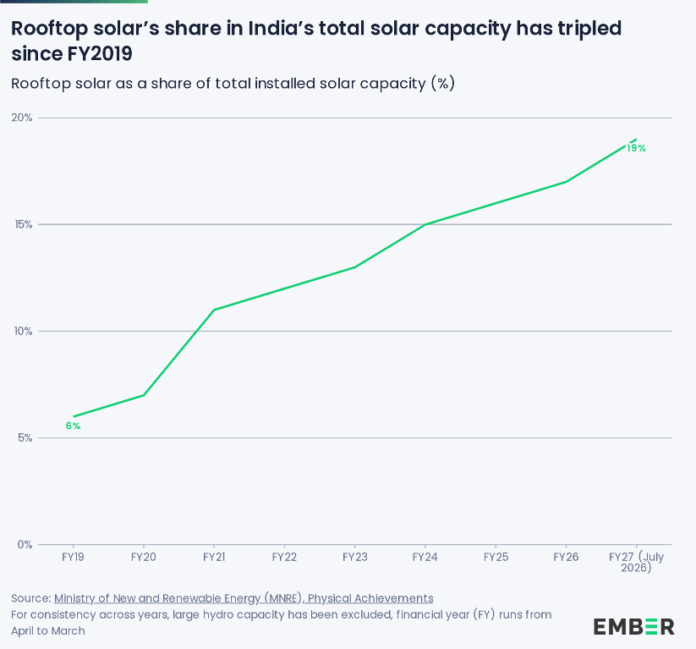
India’s rooftop solar capacity reached 30.7 GW in July 2026, accounting for nearly 19 percent of the country’s 164.6 GW installed solar capacity. Residential installations under PM Surya Ghar contributed 14.9 GW across approximately 5 million households.
“With more than 5 million households already adopting rooftop solar under PM Surya Ghar, we should be building storage alongside that capacity, not years later,” Ruchita Shah, Energy Analyst, Asia, Ember, said.
The report identifies significant opportunities for battery energy storage systems, solar equipment suppliers and electricity distribution companies as rooftop solar penetration increases.
India Rooftop Solar and Battery Storage: 10 Key Findings
1. Rooftop Solar Capacity Reaches 30.7 GW, Representing 19% of India’s Solar Market
India’s installed rooftop solar capacity increased to 30.7 GW by July 2026, compared with approximately 6 percent of total solar capacity in FY2019.
Rooftop installations now represent 19 percent of India’s 164.6 GW solar portfolio, reflecting a threefold increase in their share of total installed solar capacity since 2019.
The expansion is supported by residential subsidies, improving installation economics and increasing consumer interest in reducing electricity bills.
2. Five Million Households Install 14.9 GW Under PM Surya Ghar
Residential rooftop solar installations under the PM Surya Ghar: Muft Bijli Yojana reached 14.9 GW across approximately 5 million households by July 2026.
The programme targets 10 million households and offers capital subsidies of:
₹30,000 per kW for the first 2 kW.
₹18,000 for the additional capacity up to 3 kW.
Maximum subsidy of ₹78,000 per household.
Residential systems now account for nearly half of India’s rooftop solar capacity, making households increasingly important to electricity grid management.
3. Gujarat and Maharashtra Account for Nearly 45% of Rooftop Solar Capacity
Gujarat leads India’s rooftop solar market with 7,518 MW, followed by Maharashtra with 5,975.8 MW.
Together, these states represent approximately 44 percent of national rooftop solar installations.
More than 85 percent of India’s rooftop solar capacity is concentrated in ten states, including Uttar Pradesh, Rajasthan, Kerala, Tamil Nadu, Haryana, Madhya Pradesh, Karnataka and Andhra Pradesh.
In the residential PM Surya Ghar segment, Gujarat accounts for 19.6 percent, Maharashtra 17.5 percent and Uttar Pradesh 16.5 percent of installed capacity.
4. Kerala’s Rooftop Solar Capacity Equals 35% of Peak Electricity Demand
Kerala has emerged as a significant market for rooftop solar and battery storage integration.
Its rooftop solar capacity reached approximately 2.3 GW in July 2026, equivalent to 35 percent of its recorded peak electricity demand of 6.48 GW during April–July 2026.
Gujarat follows with a rooftop solar-to-peak-demand ratio of 26 percent, while Maharashtra records 18 percent, compared with the national average of 11 percent.
These figures do not mean rooftop solar supplies those percentages of peak demand. Kerala’s peak occurs during evening hours, when solar generation is unavailable.
Battery storage could help address this mismatch by transferring daytime solar generation to evening consumption.
5. A 5 kWh Battery Can Reduce Daytime Solar Exports by 85–90%
Ember’s modelling indicates that adding a 5 kWh battery to a 3 kW residential rooftop solar system could reduce daytime electricity exports by 85–90 percent.
The battery could shift approximately 1,600–1,800 units of electricity annually from daytime generation to evening consumption.
This would increase household self-consumption while reducing pressure on distribution networks during periods of high solar generation.
The finding creates a potential business opportunity for residential lithium-ion battery suppliers, hybrid inverter manufacturers and solar installation companies.
6. Solar-Only System Costs ₹87,000 After Subsidy, With 3.3-Year Payback
Ember evaluated a representative household consuming approximately 350 electricity units per month.
The financial comparison shows how adding battery storage affects investment requirements.
| Financial indicator | 3 kW solar only | 3 kW solar + 5 kWh battery |
| Modelled system cost | ₹1,65,000 | ₹2,27,000 |
| Existing solar subsidy | ₹78,000 | ₹78,000 |
| Payback without battery subsidy | 3.3 years | Around 9 years |
| Payback with 50% battery subsidy | Not applicable | 6.3 years |
The figures illustrate a major challenge for India’s residential storage market: battery integration improves grid flexibility but increases household investment and extends payback under existing net metering rules.
These are modelled economics, not guaranteed prices or returns for every household.
7. A 50% Battery Subsidy Can Reduce Payback to 6.3 Years
A proposed subsidy covering 50 percent of battery capital expenditure could reduce the payback period for a solar-plus-storage installation from approximately nine years to 6.3 years.
Under a separate scenario involving restrictions on using banked solar electricity during evening peak hours and a 20 percent peak tariff surcharge, the payback could decline to 5.7 years with the same battery subsidy.
The results indicate that storage incentives and electricity tariff reforms could substantially improve the economics of residential batteries.
However, the report presents these as policy scenarios rather than incentives already approved under PM Surya Ghar.
8. ₹28,000 Crore Battery Incentive Could Create 15–25 GWh of Storage
Ember proposes extending battery incentives through the existing rooftop solar subsidy framework.
If incentives reach 5 million households, equivalent to half the current PM Surya Ghar target, India could develop 15–25 GWh of distributed battery storage capacity.
The estimated government financial support would total approximately ₹28,000 crore.
This would represent a significant potential market for energy storage technologies, battery management systems, hybrid inverters, residential energy management platforms and installation services.
The estimated storage capacity and expenditure depend on policy adoption and household participation.
9. Daytime and Evening Electricity Prices Differ by Nearly Six Times
India’s existing net metering arrangements allow households to offset electricity exported during daytime against electricity consumed during evening hours.
However, wholesale electricity prices can differ substantially between these periods.
Ember reports that representative day-ahead market prices fell to approximately ₹1.56 per unit during high-solar-generation hours in July 2026, while evening prices approached ₹10 per unit.
This difference creates financial challenges for electricity distribution companies because low-value daytime exports can offset consumption during more expensive evening periods.
The Central Electricity Authority has proposed differentiated tariff structures for net metering consumers, including time-of-day pricing and separate fixed and variable charges.
Battery storage could reduce the imbalance by allowing households to consume stored solar electricity during peak hours.
10. Battery Storage Could Prepare Households for New Net Metering Rules
Ember examined two potential changes to India’s rooftop solar settlement arrangements.
Under a proposed 40 percent cap on banked solar exports, with remaining exports compensated at ₹2 per kWh, the modelled solar-plus-battery payback would be 9.4 years without additional subsidy and 6.5 years with a 50 percent battery subsidy.
Under a separate scenario restricting withdrawals of banked solar between 6 pm and 10 pm, combined with a 20 percent peak-hour surcharge, the payback could decline to 5.7 years with the battery subsidy.
Such reforms could increase demand for rooftop solar and battery storage solutions as households seek to maximise the value of electricity generated on-site.
India Rooftop Solar and Battery Storage 2026: Key Figures
| Indicator | Figure |
| India’s total solar capacity | 164.6 GW |
| Installed rooftop solar capacity | 30.7 GW |
| Rooftop share of total solar capacity | 19% |
| Residential capacity under PM Surya Ghar | 14.9 GW |
| Households covered | 5 million |
| Gujarat rooftop solar capacity | 7,518 MW |
| Maharashtra rooftop solar capacity | 5,975.8 MW |
| Reduction in daytime exports with battery | 85–90% |
| Proposed battery subsidy programme | ₹28,000 crore |
| Potential distributed battery storage | 15–25 GWh |
Business Opportunities for Solar and Battery Companies
The proposed residential battery incentive could expand India’s addressable market beyond conventional rooftop solar installations.
Battery manufacturers could benefit from demand for residential storage systems, while inverter suppliers would have opportunities to supply hybrid inverters supporting solar generation, battery charging and grid interaction.
Solar EPC companies and installers could expand their services into battery integration, system maintenance and energy management.
Distribution companies could potentially benefit from lower daytime solar exports and reduced evening electricity procurement requirements.
For the Indian renewable energy industry, the central opportunity is to move from rooftop solar installations focused primarily on electricity generation towards integrated systems combining solar panels, batteries and intelligent energy management.
The scale of this opportunity will depend on battery prices, financing availability, state electricity regulations and whether the government introduces targeted storage subsidies.
BABURAJAN KIZHAKEDATH
