Corporate renewable energy power purchase agreements (PPAs) are emerging as a major investment driver for solar, wind, battery storage and low-carbon electricity infrastructure. Amazon, Google, Microsoft and Meta are expanding clean energy procurement as artificial intelligence (AI), cloud computing and data centres increase electricity demand.
However, the global corporate renewable energy market is becoming more selective. Companies are evaluating electricity reliability, grid connectivity, project financing and long-term returns alongside renewable energy capacity.
According to BloombergNEF’s corporate clean energy market outlook, companies contracted 55.9 gigawatts (GW) of off-site clean electricity through PPAs in 2025, down 10 percent from 2024. Amazon, Google, Microsoft and Meta collectively accounted for 49 percent of global procurement.
The concentration highlights how large technology companies are influencing renewable energy investment decisions, while smaller corporate buyers face greater challenges from electricity prices, financing costs and regulatory uncertainty.
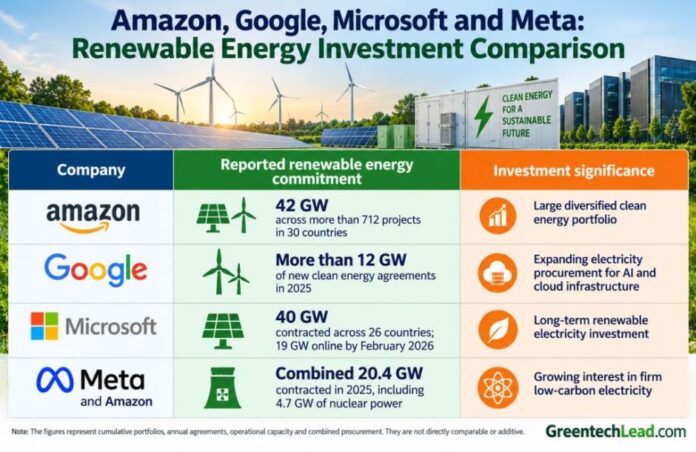
Amazon, Google, Microsoft and Meta: Renewable Energy Investment Comparison
The four technology companies have established substantial renewable energy portfolios, although their reported capacity figures represent different measures.
1. Amazon: 42 GW Clean Energy Portfolio
Amazon’s 2025 Sustainability Report identifies more than 712 carbon-free energy projects across 30 countries, representing 42 GW of capacity.
Its investment strategy extends beyond conventional solar and wind projects to nuclear energy, geothermal power and long-duration electricity storage.
For renewable energy developers, Amazon’s procurement scale creates opportunities to secure long-term electricity contracts supporting project financing.
However, the 42 GW figure represents portfolio capacity rather than electricity generation already delivered to Amazon’s operations.
2. Google: More Than 12 GW of New Clean Energy Agreements
Google signed agreements covering more than 12 GW of net-new clean energy in 2025, its largest annual procurement total.
According to Google’s 2026 Environmental Report, the agreements include electricity procurement, storage and environmental attribute certificates.
Google’s strategy focuses on matching clean electricity availability with the requirements of its data centres.
This creates opportunities for solar-plus-storage projects, advanced geothermal systems and renewable electricity facilities located close to major computing infrastructure.
Importantly, the 12 GW commitment should not be interpreted as 12 GW of newly commissioned generating capacity.
3. Microsoft: 40 GW Contracted, 19 GW Operational
Microsoft has contracted 40 GW of new renewable energy supply across 26 countries following its 2020 carbon-negative commitment.
By February 2026, 19 GW had become operational, while the remaining contracted capacity was expected to enter service over the following five years.
This distinction between contracted and operational capacity is important for investors.
Projects under development may still require construction financing, grid approvals, transmission infrastructure and equipment procurement.
Microsoft’s expansion demonstrates how long-term corporate electricity commitments can support renewable energy developers while also creating substantial opportunities for grid equipment suppliers.
4. Meta: Expanding Renewable and Nuclear Procurement
Meta remains one of the largest corporate clean electricity buyers, with investment linked to electricity-intensive AI infrastructure.
BloombergNEF reported that Meta and Amazon collectively contracted 20.4 GW of clean power in 2025, including 4.7 GW of nuclear electricity.
Nuclear procurement reflects growing interest in electricity sources capable of supplying continuous power, complementing variable solar and wind generation.
For investors, this signals opportunities beyond renewable generation, including firm low-carbon electricity, storage and grid infrastructure.
How Corporate PPAs Create Renewable Energy Investment Opportunities
A corporate PPA provides an electricity producer with a contractual revenue arrangement, often extending over several years.
Such agreements can help developers obtain project debt, attract equity investment and reduce uncertainty over future electricity sales.
Three procurement models are particularly important:
Physical PPA: Electricity is supplied under an agreed delivery arrangement.
Virtual PPA: A financial contract settles differences between agreed and market electricity prices.
On-site PPA: A developer installs and operates renewable generation at a customer’s premises.
A financially strong corporate buyer can improve project bankability, but a signed PPA does not automatically guarantee financing or profitability.
Investors must evaluate construction costs, interest rates, contract duration, electricity prices, grid connectivity and buyer creditworthiness.
AI Data Centres Are Creating New Demand for Solar, Storage and Grid Infrastructure
AI data centres require substantial electricity throughout the day, creating a challenge for solar and wind projects whose generation varies with weather conditions.
This is encouraging investment in hybrid renewable projects, battery energy storage systems (BESS), transmission networks and firm low-carbon electricity.
The opportunity extends beyond electricity generation.
Transformers, substations, high-voltage cables, grid-management technologies and power electronics are becoming important components of the corporate clean energy investment ecosystem.
For example, a solar project supplying a data centre may require battery storage to shift part of its generation into evening hours.
However, storage adds capital expenditure, conversion losses and replacement costs. Investors must determine whether the additional electricity value justifies the investment.
Corporate PPA Economics: What Returns Can Investors Expect?
Consider an illustrative 100 MW solar project with an initial investment of $100 million and annual electricity generation of 200,000 megawatt-hours (MWh).
At an electricity selling price of $50/MWh, the project generates $10 million in annual revenue.
Assuming $1.5 million in annual operating expenditure, $8.5 million remains before financing costs, taxes and other expenses.
| PPA electricity price | Annual revenue | Amount after operating costs |
| $40/MWh | $8 million | $6.5 million |
| $50/MWh | $10 million | $8.5 million |
| $60/MWh | $12 million | $10.5 million |
These figures demonstrate how electricity pricing influences project economics.
The $8.5 million operating surplus at $50/MWh represents 8.5 percent of initial investment, but it is not the project’s internal rate of return (IRR).
Actual investment returns depend on debt servicing, taxes, equipment degradation, replacement costs and electricity sales after the PPA expires.
India Corporate Renewable PPAs: Open Access Solar Reaches 36 GW
India is becoming an important market for corporate renewable electricity procurement through open access, captive and group-captive arrangements.
According to Mercom India’s solar open access market analysis, the country added nearly 6 GW of solar open access capacity during the first half of 2026, an increase of 42 percent year over year.
Cumulative solar open access capacity reached approximately 36 GW by June 2026.
Manufacturing companies, data centres and commercial electricity consumers are potential beneficiaries of these arrangements.
Indicative September 2026 project-level PPA prices included:
| Renewable energy technology | Indicative tariff |
| Standalone solar | ₹3–₹4.50/kWh |
| Wind-solar hybrid | ₹4.50–₹5.50/kWh |
| Solar with battery storage | ₹5–₹7/kWh |
These indicative 15-year ex-busbar prices relate to projects exceeding 100 MW and should not be treated as nationwide delivered electricity tariffs.
The S&P Global Energy analysis of India’s PPA market highlights how storage requirements and grid constraints are influencing renewable procurement.
For example, a manufacturer purchasing solar electricity at ₹3.50/kWh could face a landed cost of ₹5/kWh after assuming ₹1.50/kWh in applicable delivery charges.
Compared with an avoidable grid energy charge of ₹8/kWh, the illustrative saving would be ₹3 per unit, subject to actual consumption and regulatory conditions.
Five Renewable Energy Investment Opportunities Through 2030
Corporate renewable PPAs are creating opportunities across several infrastructure segments.
Solar and wind projects: Long-term contracts with creditworthy corporate buyers can improve revenue predictability.
Hybrid renewable projects: Combining solar and wind can improve the generation profile and support larger electricity consumers.
Battery energy storage: Storage can increase the value of renewable generation by shifting supply toward high-demand periods.
Grid infrastructure: Transformers, substations, transmission lines and power-management equipment benefit from expanding electricity demand.
Firm low-carbon electricity: Nuclear and geothermal projects may attract buyers requiring dependable power, although development and financing risks can be substantial.
These opportunities differ in capital intensity, project maturity, contract risk and potential investment returns.
Outlook: Corporate Renewable PPAs Will Depend on Electricity Delivery, Not Announced Capacity
Amazon, Google, Microsoft and Meta are reshaping renewable energy investment through large electricity procurement commitments associated with AI, cloud computing and data centre expansion.
However, the 10 percent decline in global corporate PPA activity during 2025 shows that renewable electricity demand does not automatically translate into continuously rising contract volumes.
Through 2030, projects with competitive electricity costs, strong corporate buyers, reliable grid connections and realistic commissioning schedules are likely to be better positioned.
For renewable energy investors, the most important measures are not announced gigawatts alone, but operational capacity, electricity delivered, financing costs and sustainable long-term returns.
SHAFANA FAZAL