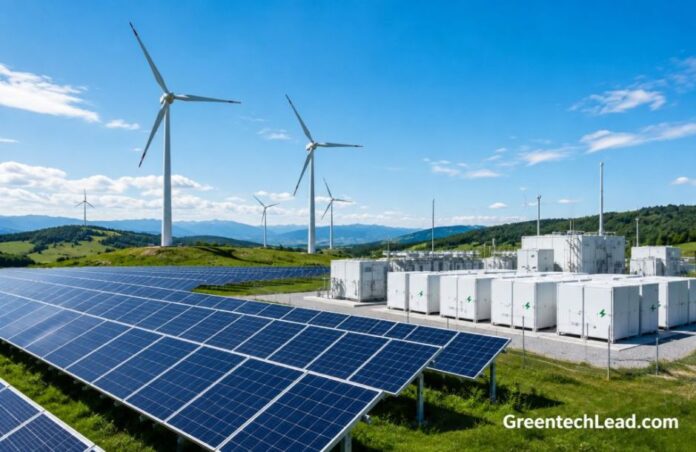
Renewable energy generation in the United States increased 10.2 percent during the first eight months of 2026, with solar and wind emerging as the primary drivers of electricity growth. The country is also projected to add nearly 83 gigawatts (GW) of renewable energy and battery storage capacity by August 2027, according to data from the U.S. Energy Information Administration (EIA) analyzed by the SUN DAY Campaign.
The expansion is strengthening renewable energy’s position in the American electricity market. Renewables accounted for 28.1 percent of total US electricity generation between January and August 2026, compared with 26.2 percent during the corresponding period in 2025.
The latest figures highlight three major developments: accelerating solar electricity production, declining coal generation and substantial investment in battery storage infrastructure.
US Renewable Electricity Generation Rises 10.2% in 2026
According to the U.S. Energy Information Administration, renewable electricity generation increased 10.2 percent during January–August 2026, nearly four times the 2.6 percent growth recorded in overall US electricity production.
Utility-scale solar registered the fastest growth among major renewable technologies, increasing 20 percent year over year.
Small-scale solar electricity generation expanded 12 percent, followed by wind power at 7.8 percent, hydropower at 4.2 percent and geothermal energy at 3.8 percent.
US Electricity Generation Growth: January–August 2026
| Energy source | Year-on-year generation growth |
| Utility-scale solar | +20.0% |
| Small-scale solar | +12.0% |
| Wind power | +7.8% |
| Hydropower | +4.2% |
| Geothermal | +3.8% |
| Natural gas | +2.6% |
| Nuclear power | +1.3% |
| Coal | -8.7% |
| Total US electricity generation | +2.6% |
| All renewable sources | +10.2% |
The figures demonstrate that renewable energy is capturing an increasing share of electricity demand growth.
While natural gas generation increased moderately, coal-fired electricity production declined 8.7 percent, reflecting the changing composition of US power generation.
Solar and Wind Supply 21.1% of US Electricity
Solar and wind together generated approximately 21.1 percent of US electricity during the first eight months of 2026.
Wind contributed 10.6 percent of national electricity generation, while utility-scale and small-scale solar together accounted for nearly 10.5 percent.
The combined electricity production from solar and wind exceeded coal generation by 44.4 percent and nuclear generation by 24.8 percent.
This represents an important development for the American electricity industry because solar and wind are becoming major contributors to national electricity supply rather than supplementary sources.
The increasing contribution of renewable electricity also highlights the importance of grid modernization, transmission investment and energy storage systems to support higher levels of variable power generation.
US Adds 43.5 GW of Renewable Energy Capacity in 12 Months
Renewable energy capacity expanded by approximately 43.5 GW between September 2025 and August 2026.
Utility-scale solar accounted for the largest increase, adding 27.14 GW of generating capacity.
Wind capacity increased by 9.98 GW, including 800 MW of offshore wind installations.
Small-scale solar added another 6.53 GW.
US Power Capacity Changes: September 2025–August 2026
| Technology | Net capacity change |
| Utility-scale solar | +27.14 GW |
| Wind power | +9.98 GW |
| Small-scale solar | +6.53 GW |
| All renewable energy | +43.50 GW |
| Utility-scale battery storage | +17.59 GW |
| Natural gas | +5.32 GW |
| Coal | -2.70 GW |
| Nuclear power | No change |
| Fossil fuels and nuclear combined | +2.61 GW |
Renewable capacity additions were nearly 17 times the net increase in fossil fuel and nuclear generating capacity.
Battery storage capacity also expanded substantially, increasing by 17.59 GW during the same period.
The expansion demonstrates the growing importance of solar installations and energy storage investments in US electricity infrastructure development.
US Solar Capacity to Expand by 44.6 GW by August 2027
The EIA’s latest capacity projections indicate that utility-scale renewable energy installations could increase by another 53.12 GW between September 2026 and August 2027.
Solar will dominate the expansion.
Utility-scale solar capacity is projected to increase by 44.60 GW, raising its share of US utility-scale generating capacity from 13.4 percent to 16.5 percent.
Wind capacity is expected to expand by 8.31 GW, including 3.36 GW of offshore wind capacity.
Hydropower, geothermal and biomass together are projected to contribute approximately 202 MW.
Projected US Renewable Capacity Additions: September 2026–August 2027
| Technology | Projected capacity addition |
| Utility-scale solar | 44.60 GW |
| Wind power | 8.31 GW |
| Other renewable sources | 0.20 GW |
| Total utility-scale renewables | 53.12 GW |
| Small-scale solar | Approximately 6 GW* |
| Battery energy storage | 23.66 GW |
| Combined renewables and battery storage | Approximately 82.8 GW* |
Small-scale solar is an estimate by the SUN DAY Campaign rather than an EIA forecast.
The projected 53.12 GW expansion in utility-scale renewable capacity would represent approximately 44 percent more capacity than the 36.97 GW added during the preceding 12 months.
According to the EIA’s Short-Term Energy Outlook, electricity demand, generation trends and capacity additions remain important indicators of the changing US power market.
Renewable Energy Capacity Could Overtake Natural Gas in 2027
Renewable energy could become the largest category of installed electricity-generating capacity in the United States by summer 2027 when small-scale solar installations are included.
As of September 2026, renewable sources represented approximately 34.5 percent of US utility-scale generating capacity.
The EIA projects that share will increase to 37.3 percent by August 2027.
Including small-scale solar installations, renewables’ share of total generating capacity is projected to rise from approximately 37.7 percent to 40.4 percent.
The SUN DAY Campaign estimates that renewable energy capacity could reach approximately 550 GW by September 2027.
Natural gas generating capacity is projected at approximately 518.3 GW.
This would place renewable energy capacity more than 31 GW above natural gas.
Solar alone could account for approximately 20.7 percent of total US generating capacity.
However, installed generating capacity should not be confused with electricity production. Solar and wind output varies with weather conditions, while natural gas plants can generally operate on demand.
US Battery Storage Capacity to Reach 77.8 GW
Battery energy storage represents another major growth opportunity in the US electricity sector.
The EIA projects that utility-scale battery storage capacity will increase by 23.66 GW over the 12 months ending August 2027.
This represents growth of approximately 43.7 percent.
Total utility-scale battery storage capacity is projected to reach 77.75 GW, compared with approximately 54.10 GW at the beginning of the forecast period.
Battery storage installations are increasingly important for integrating solar and wind generation into electricity networks.
Storage systems can absorb excess renewable electricity during periods of high generation and discharge electricity when demand increases or renewable output declines.
The expansion also creates opportunities for battery manufacturers, power conversion equipment suppliers, grid technology providers and energy storage developers.
According to the U.S. Department of Energy, grid-scale energy storage is an important technology for improving power system flexibility and supporting the integration of renewable energy.
Fossil Fuel Power Capacity Expected to Decline
While renewable energy and battery storage capacity are expanding, the EIA projects a net decline of approximately 2 GW in fossil fuel generating capacity between September 2026 and August 2027.
Nuclear generating capacity is expected to remain unchanged during the forecast period.
The projected decline contrasts with the nearly 83 GW of combined renewable energy and battery storage additions.
The difference highlights a significant shift in planned US electricity infrastructure investment.
However, the figures represent installed power capacity rather than actual electricity generation, and battery storage is not itself a primary energy source.
What the 2026 Renewable Energy Growth Means for the US Power Industry
The latest EIA figures indicate that solar power, wind energy and battery storage are becoming increasingly important components of US electricity infrastructure.
Four developments are particularly significant for renewable energy developers and investors.
First, utility-scale solar is emerging as the leading source of new generating capacity, with another 44.6 GW projected over the coming year.
Second, battery storage capacity is expanding rapidly, creating additional opportunities for grid-scale energy storage projects.
Third, renewable electricity generation is growing substantially faster than overall electricity demand, increasing renewables’ contribution to national power production.
Fourth, renewable energy capacity could overtake natural gas capacity in 2027, marking a major change in the composition of US electricity infrastructure.
The SUN DAY Campaign expects renewable energy and battery storage expansion to continue reshaping the American electricity sector.
The key milestone is the projected addition of approximately 82.8 GW of renewable energy and battery storage capacity by August 2027, compared with a nearly 2 GW decline in fossil fuel generating capacity.
If realized, these projections would reinforce the growing role of solar, wind and energy storage in meeting US electricity demand and supporting the country’s long-term power infrastructure transformation.
SHAFANA FAZAL