
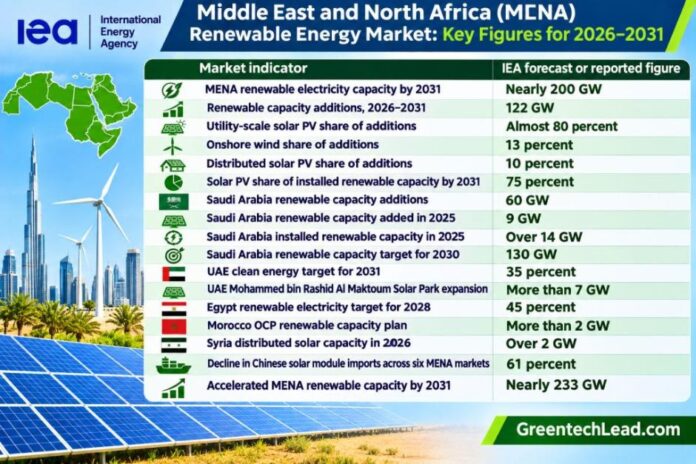
The Middle East and North Africa (MENA) renewable energy market is forecast to more than double its installed renewable electricity capacity to nearly 200 gigawatts (GW) by 2031, driven by large-scale solar projects, government energy diversification programmes, corporate electricity demand and growing investment in energy storage.
According to the IEA Renewables 2026 report, the region is expected to add 122 GW of renewable electricity capacity between 2026 and 2031, with utility-scale solar photovoltaic (PV) projects accounting for almost 80 percent of new installations.
Saudi Arabia will dominate renewable energy expansion, contributing approximately 60 GW, or half of the region’s forecast capacity additions. The United Arab Emirates (UAE), Oman, Egypt, Morocco and Iraq will also support growth through solar, wind and energy storage investments.
The IEA expects solar PV to account for 75 percent of the region’s total installed renewable capacity by 2031, the highest share among major global regions.
1. Middle East Renewable Energy Capacity to Reach Nearly 200 GW
Renewable electricity capacity across MENA will more than double during 2026–2031, reaching almost 200 GW.
The IEA forecasts 122 GW of new renewable capacity over the six-year period, supported by large solar projects, government procurement and corporate power purchase agreements.
Utility-scale solar PV will account for almost 80 percent of new capacity, while onshore wind will contribute 13 percent and distributed solar PV approximately 10 percent. Smaller additions will come from pumped-storage hydropower.
Strong electricity demand from cooling, desalination, data centres, and aluminium, steel and fertiliser production is supporting renewable energy investment.
2. Saudi Arabia to Add 60 GW of Renewable Energy Capacity
Saudi Arabia will remain the largest renewable energy growth market in MENA, accounting for approximately 60 GW of capacity additions between 2026 and 2031.
The country added a record 9 GW of renewable electricity capacity in 2025, increasing its installed renewable capacity to more than 14 GW.
Saudi Arabia’s renewable energy expansion supports its Liquid Displacement Programme, which aims to free up 1 million barrels of oil per day for export by reducing domestic fuel consumption.
The country’s renewable electricity procurement programme targets 130 GW by 2030.
The Saudi Public Investment Fund (PIF) supports bilateral renewable electricity contracts covering 70 percent of the 130 GW target, while competitive procurement accounts for the remaining 30 percent.
However, the IEA has revised Saudi Arabia’s renewable energy forecast downwards because of project delays and supply-chain uncertainties.
3. UAE Renewable Energy Market Expands Solar Capacity and Clean Energy Targets
The United Arab Emirates is expected to remain one of the largest renewable energy markets in the region, supported by utility-scale solar projects and rising demand for clean electricity.
The UAE plans to expand the Mohammed bin Rashid Al Maktoum Solar Park from 5 GW to more than 7 GW.
In January 2026, the UAE increased its clean energy target to 35 percent by 2031, compared with its previous target of 32 percent by 2030.
The IEA has revised its UAE renewable energy forecast upwards because of stronger clean energy ambitions and expansion of existing solar projects.
The country is also developing battery storage and round-the-clock renewable electricity projects to improve the reliability of solar power supply.
The UAE is expected to become the world’s largest solar PV electricity generator on a per-capita basis by 2031.
4. Egypt Accelerates Renewable Energy Target to 45 Percent by 2028
Egypt has emerged as one of the region’s fastest-improving renewable energy markets following rising natural gas import costs.
The government has brought forward its target of generating 45 percent of electricity from renewable sources to 2028, compared with its previous deadline of 2035.
Egypt’s monthly natural gas import bill increased from approximately $560 million to $1.65 billion following the Middle East conflict, according to figures reported by the government in March 2026.
The sharp increase in fuel import costs has encouraged faster renewable energy development.
Egypt is supporting renewable energy growth through competitive solar and wind auctions, corporate power purchase agreements and bilateral renewable electricity contracts.
The IEA has made its largest upward regional forecast revision for Egypt, reflecting stronger renewable electricity procurement and expanding solar, wind and battery storage project pipelines.
5. Oman Renewable Energy Growth Faces Hydrogen Project Delays
Oman is expected to expand renewable electricity capacity through utility-scale solar and wind projects, supported by increasing industrial and commercial electricity demand.
Renewable electricity procurement is also emerging in the country’s oil and gas industry.
However, the IEA has lowered its renewable energy forecast for Oman because of slower-than-expected development of renewable hydrogen projects.
Two renewable hydrogen projects awarded in earlier procurement rounds have been cancelled because of difficulties securing buyers.
Other awarded hydrogen projects have yet to reach final investment decisions.
Despite these challenges, Oman is expanding battery storage investment and exploring round-the-clock renewable electricity procurement.
The IEA also expects Oman to become one of the leading countries globally for solar electricity generation per capita by 2031.
6. Morocco Renewable Energy Investment Supported by Industrial Demand
Morocco is expected to accelerate renewable energy deployment through corporate electricity procurement and industrial decarbonisation projects.
The IEA has revised Morocco’s renewable energy forecast upwards because of stronger corporate power purchase agreement demand.
State-owned mining company OCP is progressing with plans to develop more than 2 GW of renewable electricity capacity.
The investment supports OCP’s target of achieving net-zero emissions by 2040.
Renewable electricity demand is also increasing in Morocco’s fertiliser, cement and desalination industries.
Corporate renewable energy procurement is expected to become an increasingly important driver of new solar and wind projects.
7. Solar PV to Account for 75 Percent of MENA Renewable Capacity
Solar PV will dominate the Middle East and North Africa renewable energy market during the forecast period.
By 2031, solar PV is expected to represent 75 percent of the region’s installed renewable electricity capacity.
The region benefits from strong solar irradiation, large land availability, economies of scale and favourable financing conditions for major electricity projects.
Utility-scale solar projects will account for the largest share of capacity additions.
Distributed solar PV is also expanding, particularly in countries where consumers face unreliable electricity supply or high fuel costs.
In Syria, installed distributed solar capacity increased from less than 500 MW in 2022 to more than 2 GW in 2026.
8. Renewable Energy Procurement Dominated by Auctions and Bilateral Contracts
Bilateral electricity contracts and competitive auctions will remain the two principal procurement mechanisms for renewable energy projects in MENA.
Together, these mechanisms account for more than 80 percent of utility-scale renewable capacity growth during 2026–2031.
Saudi Arabia relies heavily on bilateral contracts supported by PIF, while auctions remain the principal procurement mechanism in the UAE and Oman.
Egypt has resumed competitive renewable electricity auctions after a ten-year interruption.
Corporate renewable electricity procurement is also expanding, particularly among aluminium, steel, silicon, fertiliser and mining companies.
The growth of corporate power purchase agreements is creating additional investment opportunities for renewable energy developers.
9. Middle East Solar Supply Chain Faces 61 Percent Decline in Chinese Module Imports
Renewable energy development in the Middle East faces supply-chain disruption because of the regional conflict and restrictions affecting shipping through the Strait of Hormuz.
Combined Chinese solar module imports by Saudi Arabia, the UAE, Iraq, Jordan, Iran and Lebanon declined 61 percent year on year during the first three quarters of 2026.
The decline has increased uncertainty surrounding equipment deliveries, project construction and investment decisions.
Some renewable energy developers have indicated that financial closures and project agreement signings could be delayed by six to twelve months.
Higher equipment costs, insurance expenses and logistics disruptions are affecting project economics.
The IEA has consequently lowered renewable energy forecasts for Saudi Arabia, Iran and Iraq, where project delays and financing uncertainties remain significant.
10. Middle East Renewable Capacity Could Reach 233 GW Under Accelerated Scenario
The IEA estimates that renewable energy capacity across MENA could reach nearly 233 GW by 2031 under an accelerated development scenario.
This would represent almost 30 percent higher renewable energy expansion than the main forecast.
Achieving this growth would require faster electricity grid development, improved project financing, additional battery storage and regulatory reforms.
Saudi Arabia, the UAE, Egypt, Morocco and Oman are developing battery storage projects to support greater solar electricity integration.
Pumped-storage hydropower projects are also under development or consideration in Morocco, the UAE, Israel, Egypt and Oman.
Hybrid renewable electricity projects combining solar, wind and battery storage could support more reliable electricity supply.
The IEA identifies improved electricity transmission infrastructure, stronger project financing and faster regulatory approvals as important requirements for achieving accelerated renewable energy growth.
Middle East Renewable Energy Market Outlook
The Middle East renewable energy market is entering a period of significant expansion as governments increase investment in solar power, wind energy, battery storage and electricity infrastructure.
Saudi Arabia will remain the largest contributor to regional renewable capacity additions, while the UAE, Oman, Egypt and Morocco will offer opportunities for renewable energy developers, equipment suppliers and investors.
The expansion of renewable electricity is also becoming important for energy security. Oil- and gas-producing countries are using renewables to reduce domestic fuel consumption, while energy-importing markets are seeking to reduce exposure to volatile fossil fuel prices.
However, supply-chain disruptions, project financing challenges and electricity grid limitations could affect the pace of deployment.
The IEA’s accelerated scenario indicates that MENA could reach nearly 233 GW of renewable electricity capacity by 2031 if governments address these constraints and accelerate investment.
BABURAJAN KIZHAKEDATH
