
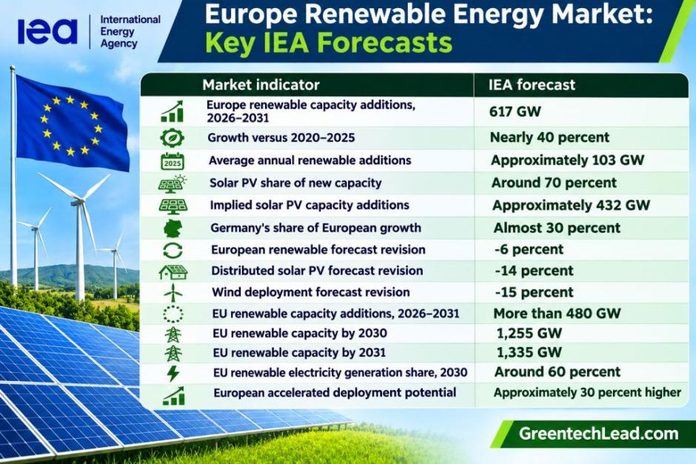
The European renewable energy market is expected to add 617 gigawatts (GW) of renewable power capacity between 2026 and 2031, representing nearly 40 percent growth compared with installations during 2020–2025, according to the International Energy Agency’s (IEA) Renewables 2026 report.
Europe’s annual renewable energy capacity additions are forecast to average approximately 103 GW during 2026–2031, remaining broadly stable despite growing investments in solar photovoltaic (PV), onshore wind and offshore wind projects.
IEA’s Renewables 2026 report indicated that it expects the share of renewables in the European Union’s electricity generation mix to exceed 60 percent by 2030, supported by renewable energy auctions, permitting reforms, corporate electricity procurement and national energy security policies.
However, Europe’s renewable energy industry faces significant challenges from negative electricity prices, grid connection delays, declining rooftop solar incentives and rising offshore wind project costs.
1. Europe Renewable Energy Capacity to Grow by 617 GW by 2031
Europe is projected to install 617 GW of renewable electricity capacity during 2026–2031, nearly 40 percent more than in the previous six-year period.
Annual renewable capacity additions are expected to plateau at approximately 103 GW, indicating that the market will maintain a high installation rate rather than accelerate continuously.
The expansion is driven primarily by solar PV and wind power, supported by policies to reduce fossil fuel imports and strengthen domestic electricity generation.
Europe will remain one of the world’s largest renewable energy markets, although faster growth in emerging economies will increase competition for global renewable energy investment.
2. Solar PV Remains the Main Driver of European Renewable Energy Growth
Solar PV will remain a major contributor to Europe’s renewable electricity capacity additions through 2031.
The IEA has raised its forecast for utility-scale solar PV deployment in the European Union, reflecting higher auction volumes and improved auction award rates in Germany, Italy, Poland and France.
Utility-scale solar projects are benefiting from competitive procurement mechanisms and opportunities to supply electricity to commercial and industrial customers.
However, the outlook for distributed solar PV has weakened across major European markets following changes to financial incentives and electricity compensation mechanisms.
The market is increasingly shifting toward larger solar projects, while rooftop solar developers face more challenging policy and economic conditions.
3. Germany, Italy, France and Poland Strengthen Utility-Scale Solar Markets
Germany, Italy, Poland and France are among the European Union markets supporting stronger utility-scale solar PV deployment through renewable energy auctions.
The IEA has revised its utility-scale solar forecast upward for these countries as auction volumes and award rates improve.
However, policy changes are reducing the attractiveness of distributed solar investments.
Germany faces reductions in feed-in tariffs and changes to net billing under the EEG 2027 framework.
Italy is phasing out renovation-related rebates, while Poland has reduced subsidies and introduced less favorable compensation arrangements for distributed solar generation.
These developments are expected to influence the balance between utility-scale and rooftop solar investments across Europe.
4. Germany to Account for Nearly 30 Percent of Europe’s Renewable Capacity Growth
Germany is expected to remain Europe’s largest renewable energy market, accounting for almost 30 percent of regional renewable capacity additions during 2026–2031.
Based on the IEA’s 617 GW forecast, Germany’s contribution would be approximately 185 GW.
The United Kingdom, Italy, Türkiye, Spain, France, Poland and the Netherlands collectively account for nearly half of Europe’s renewable capacity expansion.
The IEA expects these markets to benefit from solar and wind auctions, corporate power purchase agreements and renewable energy policy support.
5. Solar PV to Represent Around 70 Percent of New European Renewable Capacity
Solar PV is expected to contribute approximately 70 percent of Europe’s renewable capacity additions during 2026–2031.
This implies roughly 432 GW of utility-scale and distributed solar PV installations based on the overall 617 GW forecast.
However, the IEA has reduced its European renewable capacity growth forecast by 6 percent compared with its previous outlook, primarily because of weaker distributed solar PV deployment.
The distributed solar forecast has been reduced by 14 percent as several countries scale back support programs introduced during the energy crisis.
The Netherlands is discontinuing net metering, while Germany, Italy and Poland are modifying financial incentives for smaller solar installations.
6. European Wind Energy Forecast Cut by 15 Percent
The IEA has lowered its European wind energy deployment forecast by 15 percent because of permitting delays and slower project development.
Onshore wind projects face challenges involving planning approvals, grid connections and commissioning schedules.
Portugal is benefiting from larger corporate power purchase agreement volumes, while Hungary is attracting merchant wind projects and Türkiye has simplified certain grid connection procedures.
These improvements are not sufficient to offset slower deployment across several other European markets.
Offshore wind expectations have also been reduced in the Netherlands, Germany, Ireland, Belgium and Lithuania because of delayed project awards and slower infrastructure development.
Nevertheless, European offshore wind installations are expected to accelerate toward nearly 10 GW annually by 2031, led by the United Kingdom.
7. Renewable Energy Auctions to Drive Most European Wind and Solar Investments
Government-backed auctions will remain the primary procurement mechanism for utility-scale renewable energy projects in Europe.
The IEA estimates that auctions offering contracts for difference or fixed-price agreements will support:
More than 80 percent of offshore wind deployment.
Almost 70 percent of onshore wind installations.
Approximately 60 percent of utility-scale solar PV capacity additions.
Corporate power purchase agreements will remain the second most important procurement mechanism for utility-scale solar projects.
Spain and Germany are expected to lead Europe’s corporate PPA market, with growing activity in Greece, Italy, Denmark, Portugal, Sweden and Poland.
8. European Union Renewable Capacity to Reach 1,335 GW by 2031
The European Union is projected to install more than 480 GW of additional renewable capacity between 2026 and 2031, representing almost 80 percent of Europe’s total expansion.
The IEA forecasts EU renewable electricity capacity reaching 1,255 GW by 2030 and 1,335 GW by 2031.
The 2031 capacity figure represents growth of more than 55 percent compared with 2025.
However, renewable electricity generation is expected to remain below the trajectory associated with the EU’s REPowerEU ambitions.
The IEA’s main scenario projects renewables accounting for around 60 percent of EU electricity generation by 2030, compared with the 72 percent level in European Commission modelling consistent with its higher renewable energy ambition.
The IEA’s accelerated scenario reaches the 72 percent generation share through faster permitting, grid investment, renewable auctions and storage deployment.
9. Grid Constraints and Negative Electricity Prices Challenge Renewable Energy Investment
Europe’s renewable energy market faces increasing pressure from limited grid capacity, project curtailment and negative wholesale electricity prices.
The IEA identifies transmission bottlenecks and grid connection delays as major obstacles to accelerating renewable energy installations.
Increasing solar PV generation during daylight hours is reducing wholesale electricity prices in several European markets, weakening revenues for merchant solar projects.
Negative electricity prices are also creating challenges for corporate power purchase agreements and project financing.
Battery energy storage, pumped-storage hydropower, demand response and cross-border electricity interconnections are becoming increasingly important for renewable energy integration.
The IEA has also reduced its pumped-storage hydropower forecast because of slower project development in Spain, the United Kingdom, Croatia, Austria and Romania.
10. EU Renewable Energy Growth Could Accelerate 30 Percent with Policy Reforms
The IEA estimates that Europe’s renewable capacity deployment could increase by approximately 30 percent above its main forecast if governments accelerate grid investment, permitting reforms and renewable electricity procurement.
The European Union’s Net-Zero Industry Act requires member states to apply specified sustainability and resilience criteria to at least 30 percent of annual auction volumes, or alternatively at least 6 GW annually.
Italy became the first EU member state to apply the relevant requirements in its 2025 FER X tender, awarding approximately 1.1 GW to projects meeting supply-chain resilience requirements.
The IEA identifies faster transmission development, improved grid connection procedures, higher auction volumes and greater battery storage investment as important opportunities for increasing renewable electricity deployment.
Outlook for Europe’s Renewable Energy Industry
The European renewable energy market is expected to maintain substantial investment opportunities through 2031, with solar PV accounting for most capacity expansion and wind energy remaining an important contributor.
The IEA’s forecast of 617 GW of renewable additions demonstrates the scale of Europe’s transition toward domestic electricity generation and reduced fossil fuel dependence.
Germany, the United Kingdom, Italy, Spain, France, Poland and Türkiye will remain important markets for renewable energy developers, equipment manufacturers, battery storage suppliers and electricity infrastructure companies.
However, weaker distributed solar incentives, offshore wind development delays and grid constraints could restrict investment growth.
Europe’s ability to accelerate renewable deployment will increasingly depend on transmission investment, battery storage, permitting reforms and the financial viability of solar and wind projects.
BABURAJAN KIZHAKEDATH
