
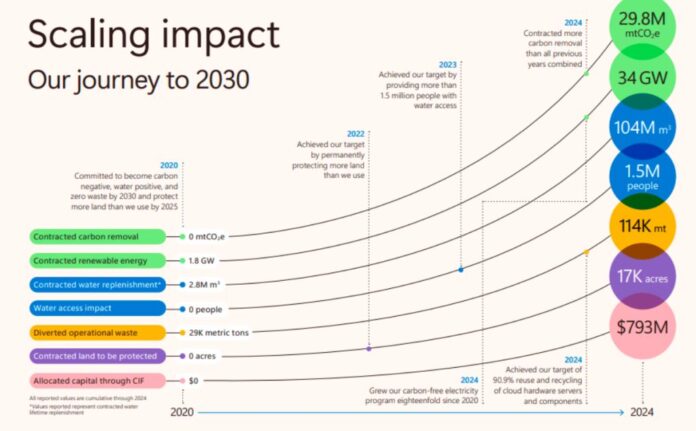
Microsoft’s 2025 Environmental Sustainability Report highlights significant progress toward its 2030 targets of becoming carbon negative, water positive, and zero waste, even as rapid expansion in artificial intelligence and cloud infrastructure increases energy demand.
The company reported a 168 percent rise in total energy use since 2020, driven by the scaling of AI and cloud services. Despite this, Microsoft has successfully decoupled operational emissions from business growth, with revenue increasing by 71 percent over the same period. This demonstrates that investments in clean energy and efficiency can offset the environmental impact of digital expansion.
A major achievement outlined in the report is the 29.9 percent reduction in Scope 1 and Scope 2 emissions from the 2020 baseline. This progress has been enabled by large-scale procurement of carbon-free electricity and the implementation of an internal carbon fee. Microsoft has become the world’s largest corporate buyer of renewable energy, contracting more than 34 gigawatts of capacity across 24 countries.
The company is also leading in carbon removal innovation, securing long-term agreements for nearly 30 million metric tons of carbon removal credits. Under the leadership of Vice Chair and President Brad Smith, these initiatives are designed not only to offset current emissions but also to eliminate Microsoft’s historical carbon footprint dating back to 1975.
“Microsoft remains steadfast in our dedication to achieving the company’s 2030 environmental sustainability commitments,” Melanie Nakagawa, Chief Sustainability Officer of Microsoft, said.
To address the growing environmental demands of AI infrastructure, Microsoft is transforming its datacenter design. New facilities built using hybrid mass timber and steel reduce embodied carbon by up to 65 percent compared to traditional construction methods. In parallel, the adoption of direct-to-chip liquid cooling technology doubles power efficiency and enables zero water usage for cooling, saving an estimated 125,000 cubic meters of water annually per datacenter.
Water sustainability remains a core focus, with Microsoft advancing its goal of becoming water positive by 2030. In 2025, the company secured water restoration projects expected to deliver more than 100 million cubic meters of replenishment over time. A notable initiative in Quincy, Washington, achieved a 97 percent reduction in potable water use through a water reuse system, while also supplying 1.5 million cubic meters of drinking water annually to the local community.
Microsoft has also made strong progress in waste reduction and circularity. The company achieved a 90.9 percent reuse and recycling rate for servers and components and exceeded its construction waste diversion target with an 85 percent rate, six years ahead of schedule. Its latest devices, including Surface Pro 11 and Laptop 7, feature enclosures made from 100 percent recycled aluminum and are designed for high repairability.
Beyond operations, Microsoft has surpassed its ecosystem protection goal by permanently safeguarding more than 15,800 acres of land, exceeding the total footprint of its global operations by 30 percent. The company is also leveraging AI as a tool for climate innovation through initiatives led by Chief Sustainability Officer Melanie Nakagawa. Programs such as the AI for Good Lab use advanced models to accelerate material discovery and improve climate forecasting.
While Scope 3 emissions have increased by 26 percent since 2020, reflecting supply chain expansion, Microsoft is addressing this challenge through a strengthened Supplier Code of Conduct. The company now requires key suppliers to transition to 100 percent carbon-free energy by 2030, aligning the broader value chain with its sustainability ambitions.
Overall, Microsoft’s 2025 sustainability strategy underscores a comprehensive approach that combines emissions reduction, renewable energy leadership, AI-driven efficiency, water stewardship, and circular economy practices, positioning the company at the forefront of sustainable digital transformation.
FASNA SHABEER
