
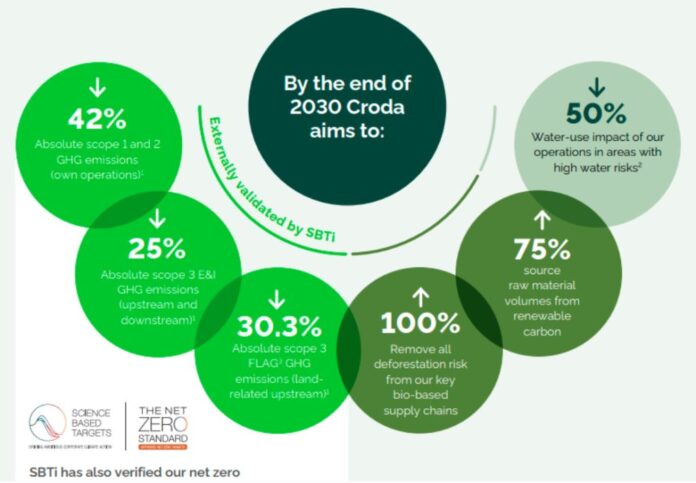
Croda International has strengthened its sustainability leadership in its Annual Report 2025, outlining a data-driven ESG strategy aligned with its purpose of “Smart Science to Improve Lives” and its ambition to become Climate, Nature, and People Positive by 2030.
“Our refreshed sustainability strategy is more focused, prioritising areas that customers value most and where Croda can have the greatest impact,” Danuta Gray, Chair of Croda, said in the Sustainability Report 2025.
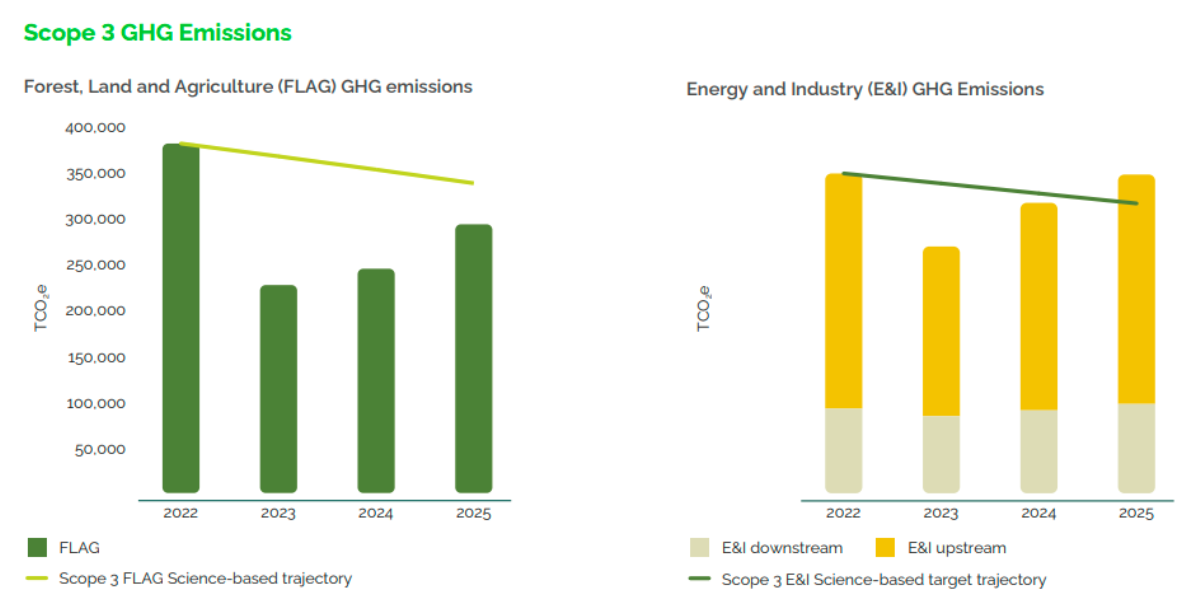
Croda’s climate roadmap is anchored in achieving a net-zero value chain by 2050, with measurable interim progress. By the end of 2025, the company achieved a 34.2 percent absolute reduction in Scope 1 and 2 emissions compared to its 2018 baseline, including a 6.4 percent year-on-year decline driven by process efficiencies and fuel switching. Scope 3 emissions reached 1,330,561 tCO2e, with a 12 percent reduction versus 2018, supported by supplier engagement and Net Zero Roadmaps targeting high-impact value chain emissions.
Croda reported a mixed emissions performance in 2025, reflecting the impact of higher production volumes alongside ongoing decarbonization efforts. Scope 1 and 2 greenhouse gas emissions increased by 1.9 percent compared to 2024, driven by output growth at major manufacturing sites. Scope 2 (location-based) emissions reached 71,544 tCO2e in 2025, up from 70,416 tCO2e in 2024.
Despite this short-term rise, Croda achieved an overall reduction of 8.8 percent in Scope 1 and 2 emissions over the 2022–2025 period. The company’s emission reduction strategy has focused on high-impact sites, supported by initiatives such as transitioning to renewable energy sources including biogas and bioethanol, electrifying manufacturing processes, and adopting new, lower-heat process technologies like biotechnology.
Steve Foots, CEO of Croda, said: “Our Commitment is to be the most sustainable supplier of innovative ingredients and be Climate, Nature and People Positive by 2030.”
Investment in sustainability remains a core priority, with £24.5 million allocated to decarbonization projects in 2025, including electrification of steam boilers and deployment of high-efficiency heat pumps. Croda is also embedding sustainability into innovation, with 85 percent of new product launches delivering environmental benefits, such as biodegradability and lower energy consumption.
Renewable energy adoption continues to accelerate. 84 percent of Croda’s electricity consumption was sourced from renewable energy in 2025, up from 72 percent in 2024. Expansion of on-site solar capacity across India, Brazil, and the UK now contributes around 8 percent of total electricity demand, while renewable sources, including thermal energy, accounted for 31 percent of total energy consumption.
Croda reported higher energy consumption in 2025, with total global usage rising to 908,536,250 kWh from 893,438,131 kWh in 2024, reflecting expanded operational activity. UK operations accounted for 103,350,941 kWh, slightly lower than 104,910,880 kWh in the previous year.
To improve energy efficiency, Croda implemented 16 projects worldwide, delivering annualised savings of 6,627,887 kWh, equivalent to 1,036 tCO2e in emissions reductions.
The company continues to integrate climate considerations into financial decision-making through a shadow carbon pricing mechanism. In 2025, the internal carbon price remained unchanged at £124 per metric ton of CO2e, aligned with UK government benchmarks, and is used to assess investment returns such as IRR and NPV for projects impacting greenhouse gas emissions.
Under its Nature Positive strategy, Croda is advancing sustainable sourcing and land stewardship. 68 percent of organic raw materials are now bio-based, progressing toward a 75 percent target by 2030. The company aims to achieve Land Positive status by saving more land through crop science innovation than is required for sourcing raw materials.
Water stewardship initiatives delivered an 18.5 percent reduction in total water withdrawal since 2018, with all water-stressed sites implementing bespoke management plans. Croda also achieved a 92 percent waste diversion rate from landfill across global operations.
Sustainability is increasingly integrated into financial strategy through a sustainability-linked revolving credit facility, where borrowing costs are tied to ESG performance. In 2025, Croda strengthened its sustainable technologies portfolio through the acquisition of a biotech firm focused on carbon-sequestering ingredients for personal care and life sciences markets.
Looking ahead, Croda targets Climate Positive status by 2030, including a 46.2 percent reduction in Scope 1 and 2 emissions and 13.5 percent reduction in Scope 3 emissions, alongside its Nature and People Positive ambitions. With a clear roadmap to net zero by 2050, Croda is positioning sustainability as a central driver of innovation, investment, and long-term competitive growth.
BABURAJAN KIZHAKEDATH
