
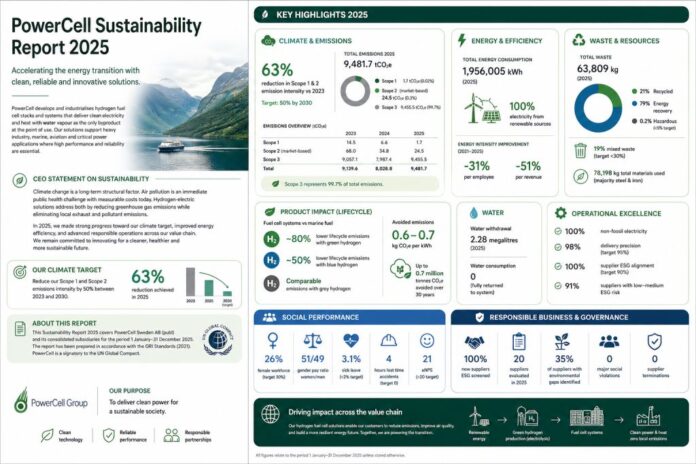
PowerCell has reported significant progress in its Sustainability Report 2025, achieving a 63 percent reduction in Scope 1 and Scope 2 emission intensity, exceeding its target of 50 percent reduction between 2023 and 2030.
Scope 1 emissions of PowerCell fell sharply to 1.7 tCO2e in 2025 from 6.6 tCO2e in 2024 and 14.5 tCO2e in 2023, while Scope 2 emissions (market-based) stood at 24.5 tCO2e.
Total emissions of PowerCell reached 9,481.7 tCO2e in 2025, with Scope 3 emissions accounting for 9,455.5 tCO2e or 99.7 percent, underscoring that the company’s carbon footprint is largely driven by supply chain activities such as procurement and logistics.
Richard Berkling, Chief Executive Officer of PowerCell Group, said: “Our priorities include supporting the scale-up of low-carbon hydrogen, improving system efficiency to reduce hydrogen consumption per delivered kilowatt-hour, and advancing product design to enhance durability, serviceability and future circularity.”
Victor Akerlund is the Chief Analytics & Sustainability Officer of PowerCell, a world leader in hydrogen electric solutions with unique fuel cell stacks and systems.
PowerCell reported total energy consumption of 1,956,005 kWh in 2025 and confirmed that 100 percent of its electricity consumption came from renewable sources.
Energy efficiency of PowerCell improved significantly, with energy intensity declining 31 percent per employee and 51 percent per revenue between 2021 and 2025, indicating that operational growth is being decoupled from energy usage.
PowerCell highlighted the environmental benefits of its fuel cell technology, stating that systems powered by green hydrogen can reduce lifecycle emissions by around 80 percent compared to marine fuels, while blue hydrogen offers about 50 percent reduction and grey hydrogen results in comparable emissions.
Fuel cell systems can avoid approximately 0.6 to 0.7 kg CO2e per kWh and deliver up to 0.7 million tonnes of avoided CO2e emissions over a 30-year lifecycle, depending on hydrogen sourcing.
PowerCell said waste generation increased to 63,809 kg in 2025 from 22,786 kg in 2024 due to higher production volumes, but waste management improved with 21 percent recycled and 79 percent used for energy recovery.
Hazardous waste remained low at 0.2 percent of total waste, while mixed waste stood at 19 percent, below the company’s target of 30 percent.
Material usage rose to 78,198 kg in 2025, driven mainly by steel and iron at 59,032 kg, alongside plastics at 4,112 kg and copper at 2,170 kg, reflecting scaling operations.
Water withdrawal reached 2.28 megalitres, with zero net consumption as all water was returned to the system.
Operational performance indicators remained strong, with delivery precision at 98 percent compared to a 95 percent target, and supplier ESG alignment at 100 percent, exceeding the 90 percent goal, according to PowerCell.
About 91 percent of suppliers were classified as low to medium ESG risk, while all new suppliers underwent ESG screening.
PowerCell evaluated 20 suppliers in 2025, with 35 percent showing environmental gaps, though no major social violations or supplier terminations were reported.
On the workforce side, women represented 26 percent of employees against a 30 percent target, while the gender pay ratio stood at 51 percent women and 49 percent men.
Sick leave was reported at 3.1 percent, above the target of below 2 percent, and lost time accidents totaled 4 hours compared to a zero target.
Employee satisfaction remained positive, with an eNPS score of 21, exceeding the target of above 20.
PowerCell said its sustainability performance reflects strong progress in emissions reduction and renewable energy adoption, though Scope 3 emissions remain a key challenge.
The company added that the sustainability impact of its products is highest when powered by green hydrogen, while continued scaling is increasing material use and waste volumes despite improving controls and governance.
BABURAJAN KIZHAKEDATH
