
Solar and wind energy accounted for more than 95 percent of new electricity generating capacity installed in the United States during the first quarter of 2026, according to Federal Energy Regulatory Commission’s (FERC) Energy Infrastructure Update.
FERC’s Energy Infrastructure Update indicated that solar dominated new power capacity additions with 6,034.4 megawatts (MW), representing 78 percent of the total, while wind contributed 1,316.1 MW, accounting for another 17 percent.
Natural gas added just 382.8 MW, representing less than 5 percent of new generating capacity. Biomass contributed an additional 4.8 MW, while no new capacity was reported for other energy sources.
FERC’s March 2026 report, released on October 29, 2026, highlights the growing contribution of renewable energy to U.S. electricity infrastructure.
Solar Capacity Reaches 175 GW, Surpassing Wind and Nuclear Power
The United States commissioned 143 utility-scale solar generating units during the first three months of 2026, adding more than 6 GW of new capacity.
Solar remained the largest source of monthly generating capacity additions for 31 consecutive months, from September 2023 through March 2026.
During this period, installed utility-scale solar capacity increased from 91.82 GW to 175.34 GW, representing an expansion of 83.52 GW.
By comparison, wind capacity increased by 16.24 GW, while natural gas recorded net growth of only 8.70 GW.
Solar now represents 12.8 percent of total U.S. utility-scale generating capacity, exceeding wind at 163.9 GW, nuclear power at 104.4 GW and hydropower at 101.9 GW.
Wind accounts for 12 percent of installed generating capacity, followed by nuclear power at 7.6 percent and hydropower at 7.4 percent.
Combined, solar and wind represent 24.8 percent of U.S. utility-scale generating capacity.
When hydropower, biomass and geothermal are included, renewable energy sources account for 33.6 percent of total utility-scale generating capacity.
These figures exclude small-scale solar installations, including rooftop systems. Including distributed solar would increase the renewable energy share to more than 35 percent.
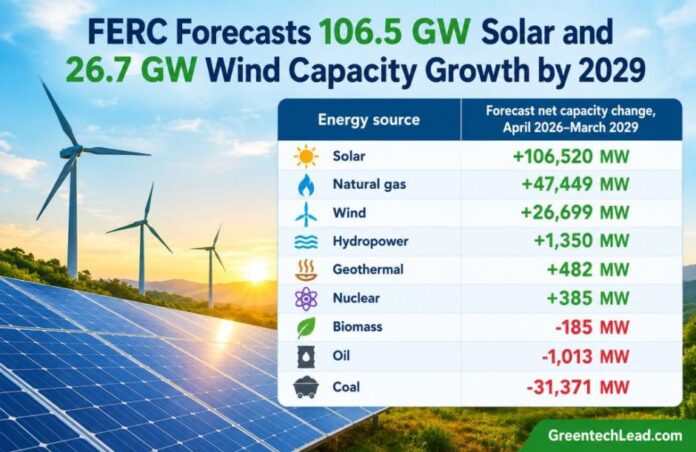
FERC Forecasts 106.5 GW Solar and 26.7 GW Wind Capacity Growth by 2029
FERC projects substantial expansion in renewable energy capacity between April 2026 and March 2029.
Under its high-probability scenario, utility-scale solar capacity is expected to increase by a net 106,520 MW, while wind capacity could expand by 26,699 MW.
Together, solar and wind are projected to add 133.22 GW of net generating capacity over three years.
Solar’s projected capacity expansion is more than four times that of wind and more than twice the expected growth in natural gas capacity.
The combined annual average capacity growth of solar and wind is forecast at 44,406 MW over the next three years, compared with 40,350 MW annually during the preceding two years.
Total net additions across renewable energy technologies are projected to reach 134,866 MW, compared with just 15,450 MW for fossil fuels and nuclear power combined.
Coal is expected to experience the largest reduction in generating capacity, with projected retirements and other changes producing a net decline of 31,371 MW by March 2029.
Solar Could Become Second-Largest U.S. Power Capacity Source by 2029
If FERC’s high-probability projections materialize, utility-scale solar could account for 18.6 percent of U.S. installed generating capacity by April 2029, making it the second-largest generating capacity source after natural gas.
Natural gas is projected to retain the leading position with 40.8 percent of installed capacity.
The combined share of utility-scale renewable energy technologies could exceed 39 percent by the end of the forecast period.
Including small-scale solar installations could push solar’s share above 20 percent and total renewable energy capacity above 40 percent.
Under that broader calculation, natural gas would represent less than 39 percent of total generating capacity.
Both solar and wind are projected to individually exceed coal’s installed generating capacity by March 2029.
Renewable Energy Capacity Could Exceed FERC’s High-Probability Forecast
FERC’s broader pipeline of potential generating capacity additions indicates that renewable energy expansion could be substantially larger than its high-probability scenario.
Net solar capacity additions could reach 235,320 MW during the three-year forecast period, while wind additions could total 62,228 MW.
Hydropower could expand by as much as 9,528 MW, while geothermal capacity could increase by 552 MW.
The SUN DAY Campaign’s executive director, Ken Bossong, said the FERC figures demonstrate the continued expansion of solar and wind despite federal policy obstacles.
The report also highlights the growing difference between renewable energy and conventional generating technologies in planned capacity additions.
Solar and wind together are expected to account for the overwhelming majority of net U.S. power capacity growth through March 2029, while coal and oil generating capacity are projected to decline.
BABURAJAN KIZHAKEDATH
