
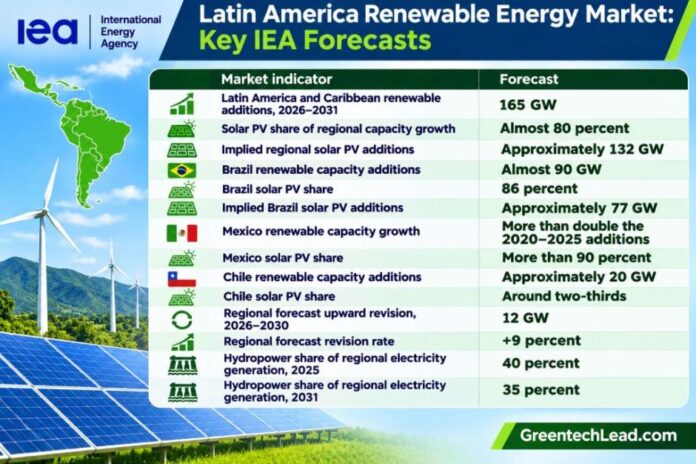
The Latin America renewable energy market is entering a new phase of expansion, with solar photovoltaic (PV) installations expected to become the region’s largest source of installed renewable electricity capacity by the end of the decade, according to the International Energy Agency’s (IEA) Renewables 2026 report.
IEA’s Renewables 2026 report indicated that Brazil will remain the largest renewable energy market in Latin America, with almost 90 gigawatts (GW) of new capacity expected between 2026 and 2031. Chile is projected to add approximately 20 GW, while Mexico is expected to more than double renewable capacity additions compared with 2020–2025.
Solar PV will account for 86 percent of Brazil’s new renewable capacity and more than 90 percent of Mexico’s expansion. In Chile, solar PV will represent approximately two-thirds of additional renewable capacity.
However, transmission congestion, electricity curtailment, permitting delays and falling wholesale electricity prices are creating challenges for renewable energy developers across Latin America.
1. Latin America Renewable Energy Market Maintains Strong Growth Through 2031
Latin America’s renewable energy capacity additions are expected to remain above historical levels during 2026–2031, although annual installations will decline from their 2026 peak.
Brazil’s slower expansion will be a major factor behind this moderation, while Mexico, Chile and Colombia are expected to maintain relatively stable deployment levels.
The region’s renewable energy market is increasingly driven by solar PV competitiveness, corporate electricity procurement and distributed generation.
The IEA has also upgraded its renewable energy outlook for Latin America compared with its previous forecast, reflecting stronger expectations for solar power deployment.
2. Brazil Renewable Energy Market to Add Nearly 90 GW
Brazil will remain Latin America’s largest renewable energy market, with almost 90 GW of additional renewable electricity capacity forecast during 2026–2031.
Solar PV is expected to account for 86 percent of new installations, equivalent to approximately 77 GW.
Distributed solar systems will contribute an increasing share of Brazil’s renewable capacity expansion.
Net metering arrangements, declining solar equipment costs and corporate power purchase agreements are supporting solar PV investments.
However, fewer renewable energy auctions, transmission bottlenecks and rising curtailment are slowing utility-scale solar and wind development.
Brazil’s renewable energy outlook will depend increasingly on electricity grid expansion, storage investment and measures to improve the commercial viability of new projects.
3. Mexico Renewable Capacity Additions to More Than Double
Mexico is forecast to more than double renewable energy capacity additions during 2026–2031 compared with 2020–2025.
Solar PV will contribute more than 90 percent of the country’s new renewable capacity.
Utility-scale solar development is expected to benefit from the reopening of large-scale electricity procurement through a new auction framework led by the Federal Electricity Commission (CFE).
Distributed solar PV will continue benefiting from net metering arrangements.
However, Mexico faces challenges involving electricity grid capacity, project permitting and uncertainty over private-sector participation.
The balance between government control and private investment will be an important factor in determining the pace of renewable energy development.
4. Chile Renewable Energy Capacity to Increase by 20 GW
Chile is expected to install approximately 20 GW of additional renewable electricity capacity between 2026 and 2031.
Solar PV will account for approximately two-thirds of the expansion, equivalent to around 13.3 GW.
Wind power will contribute most of the remaining capacity additions.
Chile’s strong solar and wind resources, together with corporate power purchase agreement demand, continue to support renewable energy investment.
However, transmission congestion and electricity curtailment are weakening project economics.
An increasing number of zero-price electricity trading hours is reducing revenues for renewable electricity producers.
Battery storage deployment and transmission investment will be essential for sustaining Chile’s renewable energy expansion.
5. Latin America and Caribbean Renewable Capacity to Grow by 165 GW
The IEA forecasts 165 GW of new renewable electricity capacity across Latin America and the Caribbean between 2026 and 2031.
Solar PV will account for almost 80 percent of this expansion, equivalent to approximately 132 GW.
The regional forecast reflects stronger distributed solar deployment in Brazil, Mexico and other markets, even as utility-scale solar and wind projects face increasing grid integration challenges.
The IEA expects installed solar PV capacity to overtake hydropower by the end of the decade, making solar the region’s largest renewable technology by installed capacity.
However, hydropower will remain the largest source of renewable electricity generation, with its contribution to regional electricity supply declining from 40 percent in 2025 to 35 percent in 2031.
6. Distributed Solar PV Becomes Latin America’s Largest Renewable Growth Segment
Distributed solar PV is expected to become the largest contributor to renewable capacity additions in Latin America and the Caribbean during 2026–2031.
Brazil will account for most of the growth, supported by net metering, high retail electricity tariffs and declining solar technology costs.
Mexico’s net-metering framework will also sustain distributed solar investments.
The shift toward rooftop and distributed solar represents a significant change from the 2010s, when onshore wind was a leading contributor to the region’s renewable capacity expansion.
7. Latin America Renewable Energy Forecast Raised by 9 Percent
The IEA has increased its renewable capacity forecast for Latin America and the Caribbean by 12 GW, or 9 percent, compared with its previous outlook for the comparable 2026–2030 period.
Nearly three-quarters of the upward revision comes from distributed solar PV, led by Brazil.
Favorable net-metering conditions and declining equipment costs are supporting the improved outlook despite additional grid-use charges in Brazil.
However, the utility-scale solar forecast has been reduced because of weaker expectations in Brazil and Chile.
The regional onshore wind outlook remains broadly unchanged, with improvements in some markets offsetting weaker prospects in Brazil and Mexico.
8. Wind Energy Growth Faces Transmission and Curtailment Challenges
Onshore wind installations across Latin America are expected to remain broadly stable through 2031.
Brazil’s wind market faces constraints from fewer auction opportunities, transmission bottlenecks and renewable electricity curtailment.
Chile is expected to account for a growing share of regional wind capacity additions toward the end of the forecast period.
Wind developers are increasingly exposed to electricity market conditions that affect project revenues, particularly where renewable generation exceeds available transmission capacity or local demand.
9. Battery Storage and Grid Investment Become Critical for Renewable Projects
The rapid expansion of solar PV and wind is increasing the importance of battery energy storage and electricity transmission infrastructure across Latin America.
Brazil and Chile are among the markets where renewable electricity curtailment is affecting project economics.
Chile faces an increasing number of zero-price electricity trading hours, reducing revenues for solar and wind developers.
Battery storage can help shift electricity supply to periods of higher demand, while transmission investment can reduce congestion and improve access to electricity markets.
These developments are making grid infrastructure and energy storage important considerations for renewable project financing.
10. Latin America Renewable Energy Investment Outlook Through 2031
The IEA’s latest outlook indicates continued opportunities for renewable energy developers, solar equipment manufacturers, battery storage providers and electricity infrastructure companies.
Brazil will remain the region’s largest market, while Mexico and Chile offer significant opportunities for utility-scale solar, distributed generation and wind power. The market’s shift toward distributed solar will create opportunities in rooftop installations, commercial and industrial electricity generation and related energy management technologies.
BABURAJAN KIZHAKEDATH
