The global long-duration energy storage (LDES) market is attracting billions of dollars in investment as renewable energy developers, utilities and industrial companies seek alternatives to conventional lithium-ion batteries.
Iron-air batteries, vanadium redox flow batteries and thermal energy storage are emerging as competing technologies, with companies including Form Energy, ESS Tech, Invinity Energy Systems, Rongke Power, Rondo Energy, Antora Energy and Kyoto Group developing commercial projects.
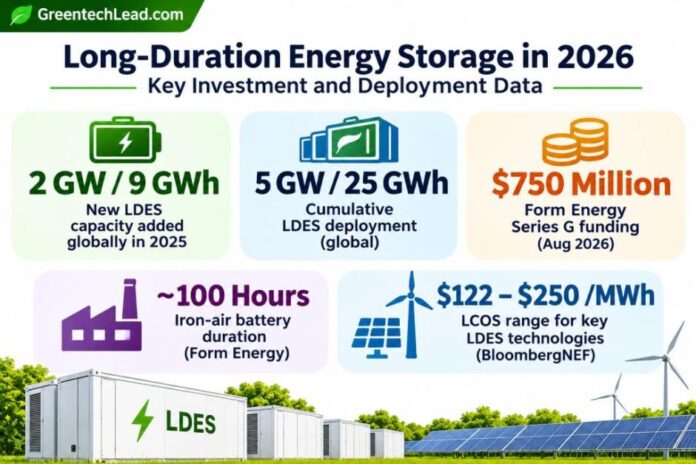
According to the BloombergNEF 2026 Sustainable Energy in America Factbook, approximately 2 GW and 9 GWh of novel long-duration energy storage capacity was installed globally in 2025, bringing cumulative deployment to 5 GW and 25 GWh.
However, announced project pipelines substantially exceed commissioned capacity. Investment returns will depend on capital expenditure (CAPEX), storage duration, efficiency, operating costs, project utilisation and long-term electricity or industrial heat contracts.
Iron-Air vs Flow Batteries vs Thermal Storage: Technology and Cost Comparison
| Technology | Typical application | Cost benchmark |
| Iron-air batteries | Multi-day electricity storage, approximately 100 hours | Commercial LCOS not established |
| Vanadium flow batteries | Daily cycling, renewable integration | $214/MWh |
| Solid-state thermal storage | Industrial heat and steam | $225/MWh |
| Molten-salt thermal storage | Industrial heat and thermal applications | $250/MWh |
| Lithium-ion batteries | Shorter-duration grid storage | $122/MWh |
BloombergNEF’s 2026 analysis provides the levelised cost of storage (LCOS) benchmarks using 2024 cost assumptions.
These figures are not directly comparable across every application. Thermal storage costs primarily reflect heat delivery, while battery costs reflect electricity storage. The modelling also assumes 365 annual cycles and limits counted discharge to 12 hours for longer-duration systems.
Iron-air batteries remain at an earlier commercial stage, making verified project costs and operating performance particularly important.
Form Energy Raises $750 Million for Iron-Air Battery Expansion
Form Energy raised $750 million in Series G financing in August 2026, taking its total equity funding above $2 billion.
The company is developing iron-air batteries capable of storing electricity for approximately 100 hours, targeting grid reliability during extended periods of low renewable generation.
Form Energy reported an approximately 80 GWh project backlog under agreement, including a planned 300 MW/30 GWh system associated with Xcel Energy and Google in Minnesota.
The investment will support manufacturing expansion, product development and commercial deployments.
The company’s Series G financing announcement highlights growing investor interest in multi-day storage technologies.
However, the reported backlog represents contracted and planned projects rather than commissioned storage capacity.
Major Vanadium Flow Battery Projects and Vendors
Invinity Energy Systems – United Kingdom: Invinity delivered a 20.7 MWh vanadium flow battery system for the Copwood Energy Hub in East Sussex in May 2026. The facility integrates battery storage with a 3 MWp solar installation, with grid connection and commercial operations planned for later in 2026.
Invinity and Pacific Steel Group – United States: Invinity secured an order for a 32 MWh flow battery system at Pacific Steel Group’s Mojave Micro Mill in California. The battery will operate alongside a 40 MWp solar installation, supporting renewable electricity supply for steel manufacturing.
Invinity and Dairyland Power – United States: Dairyland Power Cooperative ordered 43 MWh of vanadium flow batteries for deployment across multiple locations in the Midwest. Deliveries are expected to begin in 2027.
Invinity and FlexBase – Switzerland: Invinity was selected to design a flow battery system of up to 1.5 GWh for the Technology Centre Laufenburg, integrating energy storage with an AI data centre and technology campus. The project remains in development.
Rongke Power – China: Rongke Power is expanding vanadium flow battery manufacturing and electrolyte production. Its Dalian operations provide an important commercial reference for grid-scale storage, while its electrolyte manufacturing expansion supports future battery deployments.
NTPC Renewable Energy – India: NTPC’s 16.7 MW/100 MWh vanadium flow battery project at Khavda, Gujarat, represents an important opportunity for non-lithium battery technology in India’s renewable energy market.
Gujarat Industries Power Company – India: GIPCL’s 20 MW/120 MWh vanadium flow battery project at Vadodara adds another domestic reference for long-duration storage procurement.
Other vendors developing flow battery technology include Sumitomo Electric, CellCube, VRB Energy, H2 Inc. and StorEn Technologies.
Thermal Energy Storage Projects: Antora, Rondo and Kyoto Group
Antora Energy – United States: Antora and POET commissioned Project Big Stone in South Dakota in May 2026. The project comprises approximately 5 GWh of thermal storage using more than 200 thermal batteries to supply industrial process heat.
The development demonstrates the commercial potential of thermal storage in energy-intensive manufacturing. Its 5 GWh rating represents thermal energy capacity rather than electricity output.
Rondo Energy – United States: Rondo commissioned a 100 MWh industrial heat battery in California in 2025. The technology stores electricity as high-temperature heat for continuous industrial steam production.
Rondo Energy – Portugal: Rondo, EDP and Heineken are developing a 100 MWh thermal battery to deliver approximately 7 MW of steam to a brewery near Lisbon. Commercial operation is targeted for 2027.
Kyoto Group – Hungary: Kyoto Group’s Heatcube technology uses molten-salt storage to supply industrial process heat and steam. Its commercial development demonstrates opportunities for replacing natural gas in industrial heating applications.
Additional thermal storage vendors include Brenmiller Energy, Electrified Thermal Solutions, EnergyNest and Fourth Power, although their technologies, commercial maturity and output capabilities differ.
The Antora Project Big Stone announcement provides a reference for industrial thermal storage deployment.
India Announces ₹14,500 Crore Storage Funding Programme
India has approved ₹14,500 crore in viability-gap funding for 92 GWh of energy storage capacity during FY2026–27 to FY2030–31.
The programme covers 60 GWh of pumped hydro storage, 30 GWh of battery storage and 2 GWh of emerging technologies.
Total associated investment is estimated at ₹97,600 crore.
The emerging-technology allocation is not exclusively reserved for iron-air, vanadium flow or thermal storage.
India’s storage market is also attracting companies including Invinity Energy Systems, Atri Energy Transition, NTPC, GIPCL and domestic power equipment suppliers.
Invinity entered the Indian market through a partnership with Atri Energy Transition, targeting locally manufactured vanadium flow battery systems for grid and industrial applications.
The government’s energy storage viability-gap funding programme could support commercial adoption, subject to project eligibility and procurement requirements.
Investment Returns: Iron-Air vs Flow Batteries vs Thermal Storage
The three technologies have different revenue models.
Iron-air batteries primarily target multi-day electricity reliability, renewable energy firming and capacity payments. Their economics depend on long-term contracts and system availability rather than frequent daily cycling.
Vanadium flow batteries can earn revenue from energy arbitrage, peak shaving, grid services and renewable integration. Long cycle life and repeated deep discharge may support attractive lifetime economics despite higher upfront investment.
Thermal storage generates value by replacing fossil-fuel consumption, supplying steam and shifting electricity use to lower-cost periods. Long-term industrial heat purchase agreements can improve revenue predictability.
Investors should compare total installed CAPEX, round-trip efficiency, useful energy delivered, operating expenditure, asset life, financing costs and contractual revenue.
A low equipment price does not guarantee attractive returns if utilisation is limited or storage losses are high.
Long-Duration Energy Storage Investment Outlook
The growing project portfolios of Form Energy, Invinity Energy Systems, Rongke Power, Antora Energy, Rondo Energy and Kyoto Group demonstrate increasing commercial interest in alternatives to conventional lithium-ion storage.
However, financing announcements, project backlogs, awarded contracts and operating installations should be evaluated separately.
Iron-air batteries offer opportunities in multi-day grid reliability, vanadium flow batteries in frequent-cycling electricity storage, and thermal batteries in industrial heat decarbonisation.
For investors, the most important indicators are CAPEX per useful MWh, LCOS, verified operating performance, storage efficiency, contracted revenue, project utilisation and internal rate of return.
Long-duration storage technologies will attract sustainable investment when developers demonstrate competitive lifetime costs, dependable performance and creditworthy customers rather than relying primarily on announced capacity and future market projections.
SHAFANA FAZAL