China’s renewable energy expansion is entering a new phase in 2026. With renewable capacity reaching 2.455 TW by mid-year and solar capacity overtaking coal by July, investment is shifting from simply building more solar and wind farms toward integrated projects combining generation, battery storage, pumped hydro, hydrogen and ultra-high-voltage transmission. Major projects such as the 1 GW Jimsar solar-plus-flow-battery development, 400 MW Rudong offshore solar-hydrogen project and 1.7 GW Tiantai pumped-storage plant demonstrate the scale of China’s next clean-energy investment cycle.
China has built the world’s largest renewable-energy system, supported by an equally formidable manufacturing base covering solar modules, wind turbines, batteries, inverters and grid equipment.
By the end of June 2026, renewable power capacity had reached 2.455 TW, representing 60.7 percent of China’s total installed electricity capacity. Solar stood at 1.274 TW, wind at 679 GW and hydropower at 454 GW.
The next challenge is increasingly about making this enormous renewable fleet dispatchable, flexible and better connected to electricity demand.
China Adds 117 GW of Renewable Power in H1 2026
China added 117 GW of renewable capacity during the first half of 2026, representing 73.9 percent of all newly installed power capacity.
Solar additions reached 71.77 GW, comprising 29.55 GW of centralized projects and 42.22 GW of distributed solar. Wind installations added another 38.62 GW, including 37.78 GW onshore and 840 MW offshore.
Renewable electricity generation approached 2 trillion kWh, accounting for 41.2 percent of China’s total electricity generation during the period.
By the end of July, photovoltaic capacity had increased further to 1.286 TW, marginally overtaking roughly 1.285 TW of coal-fired generating capacity.
China is now targeting approximately 3.5 TW of renewable capacity by 2030, including more than 2.8 TW of combined solar and wind. Annual renewable generation is targeted at around 6 trillion kWh.
That expansion creates enormous investment requirements for storage, grids and transmission alongside generation.
Jimsar Combines 1 GW Solar With 1 GWh Flow Battery
One of China’s most important integrated renewable projects is being developed by China Three Gorges in Jimsar, Xinjiang.
The project combines approximately 1 GW of solar capacity with a 200 MW/1,000 MWh vanadium redox flow battery, providing five hours of storage.
The storage EPC contract is valued at approximately RMB 1.93 billion.
Jimsar is significant because it demonstrates an alternative to the lithium-ion batteries dominating today’s BESS market. Vanadium-flow batteries are particularly suited to applications requiring longer storage duration and frequent cycling.
Combining 1 GW of solar with five-hour storage can shift a larger share of electricity beyond daylight hours and make output more predictable.
This is increasingly the investment model China needs: not simply installing cheap solar capacity, but improving the value and availability of every renewable megawatt-hour produced.
Rudong Combines 400 MW Offshore Solar, BESS and Hydrogen
China is also experimenting with more complex combinations of renewable technologies.
The Guohua Investment Jiangsu Rudong project integrates 400 MW of offshore photovoltaic generation, 60 MW/120 MWh of LFP battery storage and a 1,500 Nm³/hour green-hydrogen facility. It achieved grid connection in June 2026.
The project demonstrates how renewable electricity can have several destinations.
Electricity can be supplied directly to the grid, stored in batteries or converted into hydrogen for industrial applications.
This model could become increasingly important as renewable generation expands faster than conventional electricity consumption in some regions. Hydrogen and other power-to-X technologies can potentially create industrial demand for otherwise curtailed renewable generation.
Ningxia Deploys 300 MW/600 MWh BESS
Battery storage is simultaneously becoming much larger.
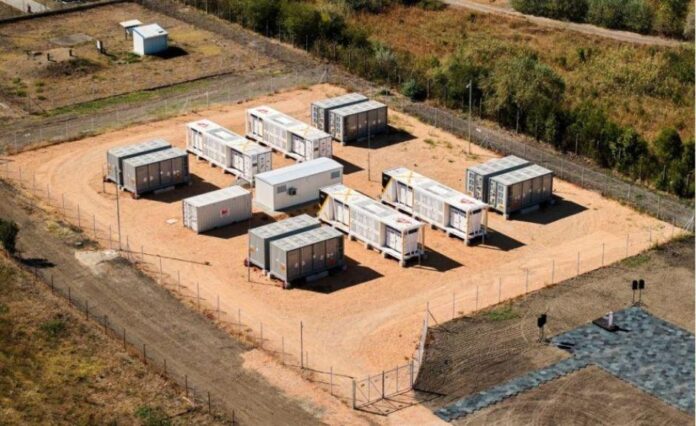
The Ningxia Yongli project in Zhongwei provides 300 MW/600 MWh of LFP storage, comprising three 100 MW/200 MWh stations.
The project supports a 3 GW photovoltaic base and was connected to the grid in June 2026.
It reflects China’s transition from relatively small battery demonstration projects toward utility-scale BESS designed as part of the electricity system.
The China Energy Storage Alliance’s H1 2026 project data also shows increasing technology diversification, including LFP, vanadium-flow batteries, compressed-air storage, semi-solid-state batteries and grid-forming systems.
China’s New Energy Storage Reaches 168 GW
The scale of the wider storage market is becoming equally important.
China’s cumulative power-storage capacity reached 237.7 GW by June 2026, while new-energy storage reached 168.3 GW/448.7 GWh.
New-energy storage capacity increased 59 percent year over year in power terms and 71 percent in energy terms.
Storage costs are also becoming more competitive.
During H1 2026, average winning prices were approximately RMB 602.1/kWh for two-hour storage systems and RMB 541.3/kWh for four-hour systems.
Longer-duration systems therefore achieved lower average equipment costs per stored kWh, although complete project economics also depend on EPC, power-conversion systems, grid connections, civil works, land and financing.
Tiantai Adds 1.7 GW of Pumped Storage
Batteries alone cannot provide all the flexibility required by China’s enormous renewable fleet.
China Three Gorges’ 1.7 GW Tiantai pumped-storage station in Zhejiang entered full operation in June 2026. The facility has four reversible generating units rated at 425 MW each.
Pumped storage absorbs electricity during periods of lower demand and releases it when the grid requires additional power.
It can also provide peak shaving, frequency regulation and emergency support over a much longer operating life than conventional battery systems.
China plans to reach approximately 160 GW of pumped-storage capacity by 2030, making hydro storage a critical part of its renewable integration strategy.
China Tests 400 MWh Molten-Salt Storage
China is also investing beyond electrochemical batteries.
Construction of Huaneng’s Bajiao project began in September 2026. The project combines a 50 MW supercritical CO2 power-generation system with 100 MW/400 MWh of molten-salt thermal storage.
The development is notable because long-duration energy storage is becoming a critical technology gap.
Lithium-ion batteries work well for short-duration balancing, while pumped hydro is effective at very large scale. Technologies including thermal storage, flow batteries and compressed-air storage could fill the space between them.
China’s Solar Module Prices Fall to RMB0.73/W
China’s renewable investment advantage begins with manufacturing scale.
Solar procurement during September 14-20, 2026, covering approximately 5.44 GW of modules, produced an average winning price of around RMB0.73/W.
Low module prices can reduce project capex, but they do not represent the complete cost of a solar farm.
Developers must also pay for inverters, trackers or mounting systems, transformers, cables, civil works, substations, land and grid connections.
For projects in western China, transmission can become particularly important because much of the country’s strongest renewable resource is located far from major coastal electricity-demand centers.
Tracking China’s solar module prices and procurement therefore provides only one component of the overall renewable-investment equation.
China Plans 100 GW Offshore Wind Construction
Wind is the other major pillar of China’s renewable expansion.
Installed wind capacity reached 679 GW by June 2026, including approximately 630 GW onshore and 48.41 GW offshore.
China plans to initiate around 100 GW of offshore wind construction during 2026-2030.
Offshore wind requires substantially different economics from onshore projects because developers must invest in foundations, subsea cables, offshore substations and specialized marine installation.
Its strategic advantage is geography.
China’s biggest electricity-demand centers are concentrated along the eastern and southern coast, allowing offshore wind to produce renewable electricity closer to industrial consumers.
LONGi and JinkoSolar Demonstrate China’s Manufacturing Scale
China’s project expansion is supported by a domestic manufacturing ecosystem operating at extraordinary scale.
LONGi generated RMB 27.045 billion of operating revenue in H1 2026, while sales of its BC modules reached 19.55 GW, up 125 percent year over year. It also reported more than 3 GWh of signed energy-storage orders.
JinkoSolar shipped 29.6 GW of modules during H1 2026, with approximately 70 percent going overseas. Its cumulative module shipments have exceeded 420 GW.
China’s manufacturing advantage extends far beyond solar panels. The ecosystem covers polysilicon, wafers, cells, modules, inverters, wind turbines, battery cells, BESS, transformers and transmission equipment.
The China renewable-energy development framework shows how storage and grid investment are increasingly being integrated with the country’s renewable expansion.
UHV Transmission Becomes Critical to Renewable Investment
China faces a geographic problem that technology alone cannot solve.
Some of its strongest solar and wind resources are concentrated in Inner Mongolia, Xinjiang, Gansu, Qinghai and Ningxia, while much of the electricity demand comes from industrial and population centers in eastern and southern China.
Ultra-high-voltage transmission is therefore becoming part of the renewable investment model.
China is effectively developing two interconnected renewable economies: massive low-cost generation in western and northern regions and increasingly sophisticated consumption, storage and industrial applications closer to the coast.
Storage can shift when electricity is supplied. UHV transmission determines where that electricity can be consumed.
China’s 3.5 TW Renewable Target Changes the Investment Race
China’s renewable-energy market is moving beyond a competition to build the largest solar or wind farm.
With 2.455 TW of renewable capacity already installed by mid-2026 and approximately 3.5 TW targeted by 2030, the critical investment challenge is becoming system integration.
Projects such as Jimsar’s 1 GW solar + 1 GWh flow battery, Rudong’s 400 MW offshore solar-hydrogen-storage development, Ningxia’s 600 MWh BESS and Tiantai’s 1.7 GW pumped-storage station illustrate the direction of the market.
The winners will increasingly be projects capable of combining low-cost generation with storage, transmission and industrial demand.
China’s renewable-energy story is therefore evolving from building solar panels and wind turbines at unprecedented scale toward something considerably larger: an integrated clean-energy infrastructure connecting generation, batteries, pumped hydro, hydrogen, UHV grids and one of the world’s largest renewable manufacturing ecosystems.
SHAFANA FAZAL