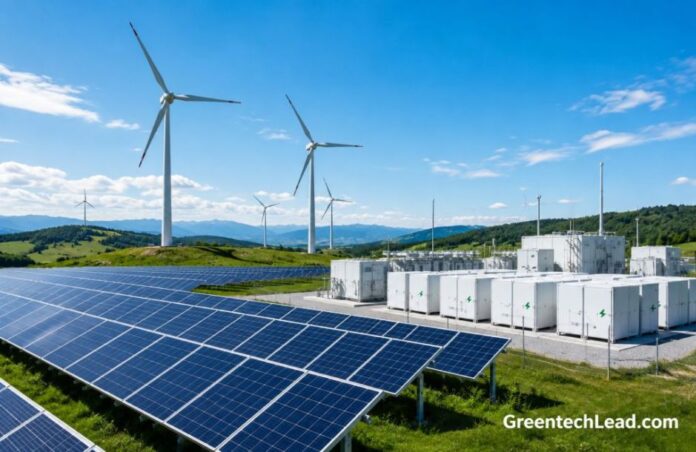
The latest news on renewable energy projects includes announcements on WIND, thyssenkrupp nucera, UKRI, and others.
EU Approves Cross-Border Renewable Projects Including 650 MW Ukraine Wind Farm
The European Commission has awarded Cross-Border Renewable Energy status to three new projects spanning Ukraine, Romania, Poland, Germany and Austria. The largest, WIND, proposes 650 MW of onshore wind near Poltavska, Ukraine, generating approximately 2 TWh annually through cooperation with Romania. DEPLOY plans a 180 MW combined wind and solar facility in Guben, Poland, linked to industrial and district-heating demand across the German border. ZEGA-LINNK will expand the Braunau-Simbach cross-border district-heating system through a 5 MW heat pump and 12–15 MW geothermal borehole. The designation makes the developments eligible to seek financial support for studies and construction through Europe’s Connecting Europe Facility Energy programme.
thyssenkrupp nucera Invests Up to €14 Million in Portugal Electrolyzer Assembly Hub
thyssenkrupp nucera is investing €10 million to €14 million in its first company-operated European electrolyzer-cell assembly hub at Vila Nova de Gaia near Porto, Portugal. The company has signed a lease for a facility exceeding 7,500 square metres, while the Portuguese government is providing approximately €3.7 million through the COMPETE2030 programme. Building construction starts in winter 2026, followed by installation of a semi-automated production line, with cell assembly beginning in 2028. The plant will initially assemble cells for alkaline water electrolysis, including thyssenkrupp nucera’s standardized 20 MW scalum units. Cells for Moeve’s Onuba renewable-hydrogen project will be among the hub’s first production assignments.
UKRI Awards £3 Million to Advance DeepWind Floating Offshore Wind Test Site
UK Research and Innovation has awarded the European Marine Energy Centre £3 million to advance DeepWind, a proposed national test facility for floating and deepwater offshore wind technology in the UK. The two-year funding programme will cover engineering, environmental assessment, regulatory preparation and commercial development required to move the project toward a final investment decision. EMEC aims to deliver the facility by 2030. DeepWind is intended to provide full-scale, plug-and-play infrastructure where developers can demonstrate turbines, floating foundations and associated technologies under metocean and water-depth conditions representative of future UK offshore wind projects. The funding follows earlier feasibility and environmental work supported through The Crown Estate’s Supply Chain Accelerator programme.