Systemair is accelerating its sustainability strategy with new Science Based Targets initiative-approved emissions goals, increased renewable electricity procurement, expanding solar generation and tighter energy-efficiency measures across its global operations.
The ventilation technology company aims to reduce absolute Scope 1 and Scope 2 greenhouse gas emissions by 42 percent by 2030/31, compared with its 2023/24 base year. Systemair has committed to reducing Scope 3 emissions from the use of sold products by 25 percent by 2030/31. Its longer-term ambition is to achieve net-zero emissions across Scope 1, Scope 2 and Scope 3 by 2050/51 at the latest, Systemair Sustainability Report 2025 indicated.
Under the long-term target, Systemair plans to cut emissions in Scope 1 and Scope 2 by 90 percent, while Scope 3 emissions are also targeted to decline by 90 percent. The targets have been validated by the Science Based Targets initiative and are aligned with the Paris Agreement’s 1.5°C ambition.
Systemair Scope 1 and Scope 2 Emissions Fall 10% From Base Year
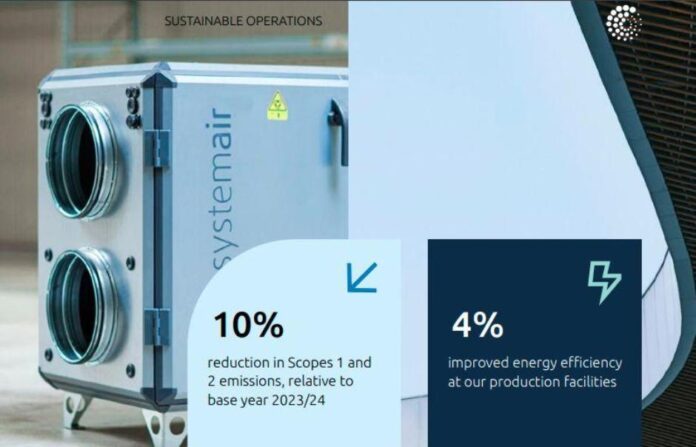
Systemair reported solid progress against its climate goals during 2025/26. Scope 1 and Scope 2 greenhouse gas emissions were 10 percent lower than the 2023/24 base year on an SBTi-adjusted basis. Scope 3 emissions declined 6 percent, while emissions from Scope 3 Category 11, covering the use of sold products, fell 7 percent.
Scope 1 emissions fell to 6,681 tonnes CO2e in 2025/26 from 7,001 tonnes CO2e in 2024/25 and 7,256 tonnes CO2e in 2023/24. This represents an 8 percent reduction from the 2023/24 level.
Market-based Scope 2 emissions were 9,617 tonnes CO2e in 2025/26, compared with 8,445 tonnes CO2e in 2024/25 and 10,062 tonnes CO2e in 2023/24. This puts market-based Scope 2 emissions 4 percent below the 2023/24 base year.
Location-based Scope 2 emissions reached 8,134 tonnes CO2e, compared with 7,603 tonnes CO2e in 2024/25 and 7,725 tonnes CO2e in 2023/24.
Combined Scope 1 and Scope 2 market-based emissions stood at 16,298 tonnes CO2e in 2025/26, versus 15,446 tonnes CO2e in 2024/25 and 17,318 tonnes CO2e in 2023/24. On a location-based basis, combined emissions were 14,815 tonnes CO2e in 2025/26, compared with 14,603 tonnes CO2e a year earlier and 14,981 tonnes CO2e in 2023/24.
Scope 3 Emissions Drop to 9.16 Million Tonnes CO2e
Systemair’s biggest sustainability challenge remains Scope 3 emissions, particularly energy consumed by its ventilation products during operation.
Total Scope 3 emissions declined to 9.156 million tonnes CO2e in 2025/26 from 9.425 million tonnes CO2e in 2024/25 and 9.528 million tonnes CO2e in 2023/24.
Emissions from the use of sold products accounted for the overwhelming majority, reaching 8.860 million tonnes CO2e in 2025/26. This was down from 9.163 million tonnes CO2e in 2024/25 and 9.276 million tonnes CO2e in 2023/24.
The usage phase represented 97 percent of Systemair’s Scope 3 emissions in the 2023/24 base year, which explains why improving the energy efficiency of ventilation equipment is central to its decarbonisation strategy.
Total market-based Scope 1, Scope 2 and Scope 3 emissions declined to 9.172 million tonnes CO2e in 2025/26 from 9.545 million tonnes CO2e in 2023/24, representing a 4 percent reduction. Location-based total emissions were 9.171 million tonnes CO2e, also around 4 percent below the 2023/24 level.
Solar Power Generation Jumps 13% to 3.21 Million kWh
Renewable energy is becoming an increasingly important part of Systemair’s emissions-reduction programme.
Solar panels installed across the company’s operations generated 3.21 million kWh of electricity in 2025/26, an increase of 13 percent from the previous year. This solar generation helped avoid approximately 1,130 tonnes of CO2 emissions during the financial year.
Since 2023/24, Systemair’s solar installations have avoided approximately 2,700 tonnes CO2e compared with electricity supplied from local grids. Around 1,100 tonnes CO2e of that reduction was delivered during 2025/26.
Systemair invested SEK 1.7 million in solar panels in India during 2025/26 as part of its climate transition plan. Since 2022, cumulative investment in solar installations has reached SEK 26.5 million.
Emission-Free Electricity Reaches 9.88 Million kWh
Systemair purchased 9.875 million kWh of emission-free electricity during 2025/26, equivalent to 31 percent of total purchased electricity requirements. The company said this contributed to a 9 percent reduction in electricity-related emissions compared with the market-based base year.
Renewable electricity backed by bundled contractual instruments represented 24 percent of total purchased electricity, while unbundled renewable electricity instruments accounted for zero percent.
Systemair plans to prioritise additional solar installations and buy emission-free electricity as required to support a 60 percent reduction target for Scope 2 emissions related to electricity.
Production Energy Efficiency Improves 4%
Systemair is also targeting lower energy consumption within its manufacturing network.
Energy efficiency at its production facilities improved by 4 percent during 2025/26, supported by equipment optimisation, building improvements and relocation initiatives. The company is targeting a 5 percent improvement in production energy efficiency every year.
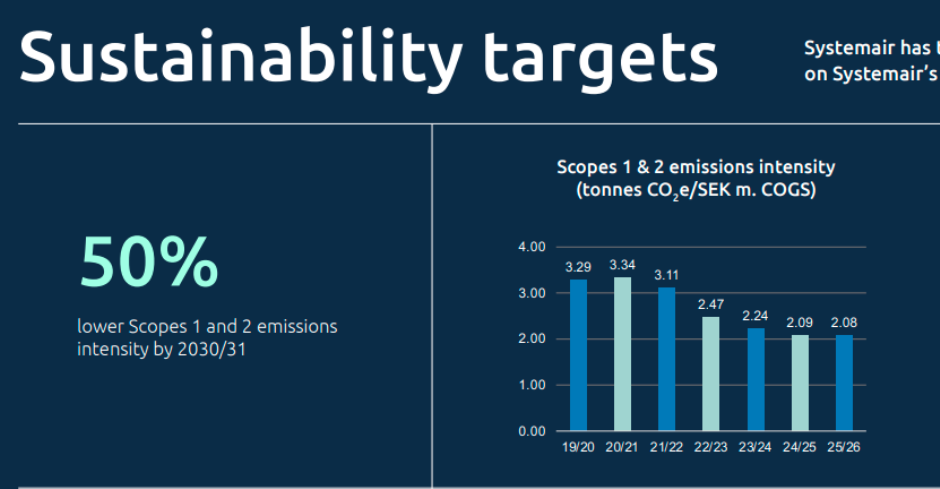
Earlier, Systemair had targeted a 50 percent reduction in Scope 1 and Scope 2 emissions intensity by 2030/31 compared with 2019/20. In 2025/26, emissions intensity stood at 2.08 tonnes CO2e per SEK million of cost of goods sold, a 37 percent reduction from the 2019/20 base year. The company is now discontinuing the intensity target and focusing instead on its SBTi-approved absolute emissions reduction target.
Electric Vehicles Rise to 17% of Systemair Fleet
Electrification of transportation is another element of Systemair’s net-zero roadmap. Electric vehicles represented 17 percent of its vehicle fleet in 2025/26, up from 13 percent in 2024/25. The shift helped lower fossil-fuel consumption and contributed to reductions in Scope 1 emissions.
Vehicle fuels nevertheless remained Systemair’s biggest Scope 1 emissions source at 3,412 tonnes CO2e, representing 51 percent of Scope 1 emissions during 2025/26. Natural gas accounted for 2,766 tonnes CO2e, or 41 percent, while LPG contributed 193 tonnes, fuel oil 99 tonnes and other sources 211 tonnes.
Systemair Links SEK 116 Million of Capex to Climate Transition
Systemair reported SEK 151 million of EU Taxonomy-eligible capital expenditure linked to its Scope 1 and Scope 2 transition plan. Of this amount, SEK 116 million was taxonomy-aligned.
The company is focusing investment on energy efficiency, solar power, fossil-free electricity, electric vehicles and production optimisation as it works toward its 2030 and 2050 climate objectives.
Systemair currently does not use carbon credits or greenhouse gas removals to achieve its emissions targets. Its strategy prioritises direct emissions reductions, though the company expects that neutralisation measures may eventually be needed for residual emissions that cannot be completely eliminated by 2050/51.
With Scope 1 and 2 emissions already 10 percent below the SBTi base year, 3.21 million kWh of solar generation, 31 percent emission-free purchased electricity and SEK 26.5 million invested in solar since 2022, Systemair is increasingly linking energy efficiency and renewable energy investment with its long-term net-zero strategy.
SHAFANA FAZAL