
Samsung Electronics’ 2025 Sustainability Report highlights a major strategic shift toward “Everyday Sustainability,” focusing on reducing environmental impact while maintaining large-scale industrial output. The company is advancing aggressive net-zero goals, particularly across its energy-intensive semiconductor operations, while expanding renewable energy adoption, improving resource efficiency, and strengthening supply chain sustainability.
A key milestone in 2025 is Samsung’s achievement of a 14 percent reduction in absolute Scope 1 and Scope 2 emissions compared to its 2022 baseline. This progress has been driven by advanced process gas treatment technologies and increased renewable energy procurement across global manufacturing facilities. The company is positioning itself to decouple emissions growth from rising semiconductor demand.
The increasing energy demand due to the adoption of advanced technologies presents new challenges for sustainable growth. In particular, the rapid advancement of AI technology and the growth of the IT industry have led to significant increases in energy consumption and carbon emissions in data centers and other sectors.
“As customers demand carbon footprint reduction and the use of carbonfree energy, Samsung is actively exploring and implementing a range of eco-friendly energy solutions,” Young-Hyun Jun, CEO and Vice Chairman of Samsung Electronics, said.
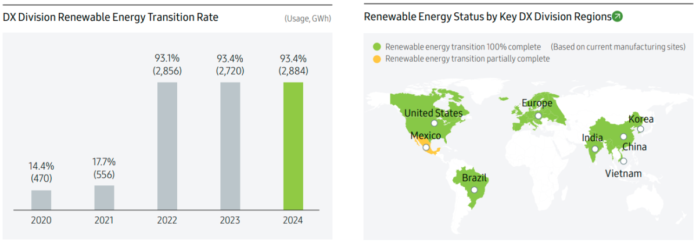
Samsung has also made significant progress in its renewable energy transition, reaching 100 percent renewable electricity usage across all manufacturing sites outside South Korea, including major operations in the United States, Europe, and Vietnam. Within South Korea, the company is working closely with government authorities and utility providers to expand renewable infrastructure and address supply limitations. Under Vice Chairman and CEO Jong-Hee Han, Samsung has committed to matching electricity demand with renewable sources for its DX division globally by 2027, while its DS semiconductor division is aligned with a longer-term net-zero roadmap extending to 2050.
In semiconductor innovation, Samsung is focusing on reducing the energy footprint of AI-driven computing. The company is developing ultra-low-power memory technologies such as HBM3E and DDR5 DRAM to improve energy efficiency in data centers. These solutions aim to lower carbon intensity while supporting high-performance AI workloads. Additionally, Samsung has integrated advanced power management integrated circuits across its products to minimize energy loss and optimize power usage.
Water stewardship and chemical safety remain central to Samsung’s sustainability strategy. The company achieved “Platinum” certification from the Alliance for Water Stewardship at multiple semiconductor facilities, reflecting strong performance in water recycling and reuse. In 2025, Samsung expanded water restoration initiatives to return as much or more water to local ecosystems than it consumes. At the same time, it has strengthened chemical management by replacing several high-impact substances with safer, eco-friendly alternatives, ensuring compliance with global environmental standards.
Samsung is also advancing resource circularity through its “Galaxy for the Planet” initiative. The company has eliminated single-use plastics from mobile packaging and increased the use of recycled materials in its products. In 2025, recycled resins accounted for 25 percent of materials in selected mobile and home appliance products. Samsung aims to raise this to 50 percent by 2030 and achieve 100 percent by 2050. Its Re+ Program, now active in over 50 countries, supports the collection and recycling of electronic waste to recover valuable materials and reduce environmental impact.
Beyond its own operations, Samsung is strengthening sustainability across its supply chain. The company’s Sustainability Management Support program provides technical and financial assistance to more than 100 key suppliers, enabling them to adopt science-based emissions targets and transition to renewable energy. Samsung has also enhanced its human rights oversight by conducting comprehensive audits to ensure fair labor practices and safe working conditions across its global supply network.
Overall, Samsung Electronics’ 2025 sustainability strategy reflects a comprehensive approach that integrates emissions reduction, clean energy adoption, sustainable product design, and responsible supply chain management, positioning the company as a leader in environmentally conscious innovation in the technology sector.
FASNA SHABEER
