
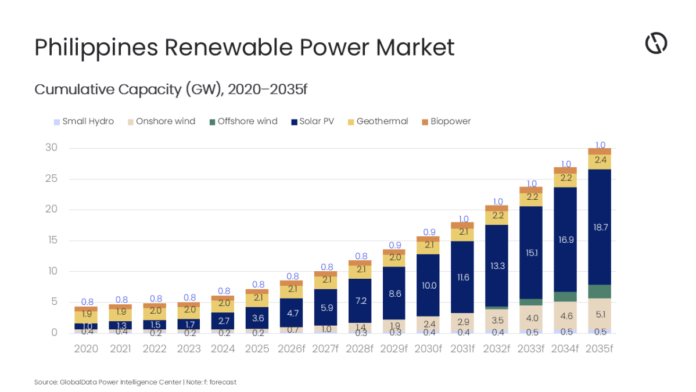
The Philippines power sector is entering a significant transition phase, with renewable energy set to expand rapidly while thermal generation continues to underpin grid stability. According to GlobalData, total renewable power capacity is forecast to surge from about 7.1GW in 2025 to nearly 30GW by 2035, driven primarily by strong growth in solar PV and wind energy.
Solar PV is expected to be the largest contributor, with capacity rising from 3.6GW in 2025 to around 18.7GW by 2035. The sector added approximately 899MW in 2025 alone, largely from utility-scale projects awarded under the Green Energy Auction Program. More than 10GW of renewable capacity has already been awarded across auction rounds, with commissioning scheduled between 2026 and 2029. Rooftop solar adoption is also accelerating among commercial and industrial users, supported by net metering and declining technology costs.
Wind energy is gaining momentum, with total capacity projected to grow from about 0.5GW to 7.4GW by 2035. While current onshore installations remain modest at around 519MW, over 2.5GW of new capacity has been awarded. Offshore wind presents a major long-term opportunity, with service contracts exceeding 60GW, though most projects are still in early development stages.
Policy and regulatory reforms are strengthening investment flows. The liberalization of foreign ownership in 2022, along with frameworks such as Renewable Portfolio Standards and streamlined approvals via EVOSS and the Green Lane, are improving project execution and accelerating renewable deployment.
Despite this momentum, thermal power will remain central to the energy mix. Coal-fired capacity is expected to increase from 13.0GW in 2025 to 15.4GW by 2035, while natural gas capacity will more than double from 5.1GW to over 10.3GW, supported by LNG infrastructure. Oil-based capacity will remain stable at around 3.4GW, primarily for peak demand support.
The Philippines is also planning to introduce nuclear energy, with initial capacity of approximately 0.3GW by 2035, adding a new source of baseload power.
Major companies
ACEN Corporation – Scaling Solar and Wind Portfolio
ACEN Corporation is among the fastest-growing renewable energy players in the Philippines, with more than 2.4 GW of attributable capacity across solar, wind, and geothermal assets. The company continues to expand through large-scale investments and international partnerships, including a $1.2 billion joint venture with BrightNight to develop up to 1 GW of renewable capacity. ACEN is advancing major domestic projects such as a 300 MW solar farm in Zambales and a 345 MW wind project in Quezon. Its strategy centers on scaling utility-scale renewables, integrating battery storage, and leveraging corporate power purchase agreements to drive long-term growth across Asia-Pacific markets.
AboitizPower – Diversifying into Renewables and Storage
Aboitiz Power Corporation is accelerating its transition toward clean energy by expanding its renewable portfolio across solar, hydro, and geothermal assets. The company has invested in projects such as a 179 MW solar facility in Zambales and is deploying battery energy storage systems to improve grid reliability. AboitizPower is also exploring international expansion, including investments in regional renewable platforms. While maintaining some exposure to thermal energy, it is shifting capital toward sustainable generation and flexible capacity solutions. Its broader investment strategy combines renewables with LNG and storage infrastructure, enabling a balanced transition while supporting rising electricity demand in the Philippines.
First Gen / EDC – Leading Geothermal Power Generation
First Gen Corporation, through its subsidiary Energy Development Corporation, remains a dominant force in geothermal energy, with more than 2,800 MW of installed capacity. The company continues to invest in geothermal expansion, alongside hydro and solar projects, ensuring stable baseload renewable supply. Recent deal activity includes ongoing discussions with global investors such as GIC and Macquarie for a potential multi-billion-dollar stake sale in EDC, reflecting strong investor confidence. First Gen’s strategy focuses on long-term energy security by strengthening baseload renewables while complementing them with flexible generation assets, positioning the company as a key enabler of the Philippines’ clean energy transition.
Solar Philippines / Terra Solar – Mega Solar and Storage Expansion
Solar Philippines is driving utility-scale solar expansion through landmark projects such as the Terra Solar initiative, developed in partnership with Meralco. The Terra Solar project, with a planned capacity of 3.5 GW solar and 4.5 GWh battery storage, is among the largest in Southeast Asia. The company’s investments focus on integrating large-scale solar with storage to ensure reliable power delivery. Solar Philippines is also active in securing long-term supply agreements and financing for future developments. Its strategy emphasizes scale, cost competitiveness, and grid integration, positioning it as a leading force in the country’s solar-driven energy transition.
Citicore Renewable Energy – Rapid Solar Capacity Growth
Citicore Renewable Energy Corporation is rapidly expanding its solar footprint, targeting approximately 2.5 GW of installed capacity by 2026. The company has strengthened its capital base through a $90 million IPO, enabling accelerated project development across multiple solar sites. Citicore is also investing in battery storage to complement intermittent renewable generation and improve grid stability. Its project pipeline includes utility-scale solar farms designed to meet growing demand from commercial and industrial customers. The company’s strategy focuses on scaling solar deployment quickly, supported by strong financing and execution capabilities, making it one of the most dynamic renewable energy developers in the Philippines.
Vena Energy – Regional Renewable Investment Expansion
Vena Energy is an international renewable energy developer with a growing presence in the Philippines through solar and wind investments. Backed by global institutional investors, the company focuses on large-scale renewable projects supported by long-term power purchase agreements. Vena Energy continues to expand its regional portfolio by deploying capital into high-growth Southeast Asian markets, including the Philippines. Its strategy emphasizes utility-scale project development, operational efficiency, and sustainable infrastructure investment. By leveraging global expertise and financing capabilities, Vena Energy is playing an increasingly important role in accelerating renewable energy adoption and supporting the country’s transition toward a low-carbon power system.
BABURAJAN KIZHAKEDATH
