
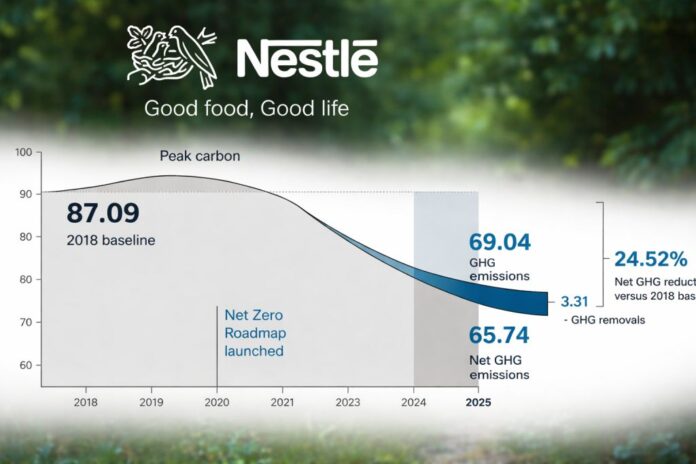
Nestle, Sustainability Report 2025, has revealed a pivotal shift in the company’s sustainability journey. Having reached peak carbon emissions, Nestle is now focused on delivering absolute reductions while continuing business growth through its long-term “Creating Shared Value” strategy.
Strong Progress Across Climate, Agriculture and Circularity
Nestle’s 2025 performance reflects measurable progress across its three core sustainability pillars – climate action, regenerative agriculture, and circular packaging.
Climate and Emissions Reduction
Nestle has exceeded its near-term climate target, achieving a 24.52 percent reduction in greenhouse gas emissions compared to its 2018 baseline, surpassing the original 20 percent goal.
A major highlight is the sharp reduction in Scope 3 emissions, particularly in Forest, Land and Agriculture (FLAG), which declined by nearly one-third in 2025. This is significant as supply chain emissions account for the majority of Nestle’s carbon footprint.
The company has also made notable strides in clean energy adoption, reaching 98.6 percent renewable electricity across its manufacturing operations, moving close to its 100 percent target.
Regenerative Agriculture and Nature Protection
Nestle has outperformed its regenerative agriculture milestone, with 27.6 percent of key ingredients sourced from farmers using regenerative practices, well above the 20 percent target for 2025.
Efforts to protect ecosystems and biodiversity have also advanced:
96.7 percent deforestation-free supply chain assessment across critical commodities such as palm oil, soy, cocoa and coffee
49.8 percent of key ingredients responsibly sourced, strengthening traceability and ethical sourcing standards
In water stewardship, Nestle reduced water usage by 2.9 million cubic meters in 2025, with targeted action in high water-stress regions.
Circular Packaging: Progress with Challenges
While progress is evident, Nestle continues to face challenges in achieving its ambitious plastic reduction goals.
Virgin plastic usage reduced by 28 percent, falling short of the one-third reduction target
87.5 percent of plastic packaging designed for recycling, moving toward full circularity
Plastic collection and recycling systems established in 12 major countries, covering 10 percent of total plastic footprint
These figures indicate momentum, but also highlight the complexity of transforming global packaging systems.
Investment Strategy Driving Sustainable Growth
Nestle’s sustainability roadmap is anchored in the principle that long-term value creation comes from responsible business practices.
Key Strategic Focus Areas
Climate Strategy: Focus on reducing Scope 3 emissions, which represent around 95 percent of total emissions
Regenerative Food Systems: Financial support and incentives for farmers transitioning to sustainable practices
Portfolio Optimization: Increased investment in sustainable growth segments such as coffee, petcare and nutrition
Innovation and R&D: Advancing packaging solutions through the Nestle Institute of Packaging Sciences to reduce reliance on virgin plastics
This integrated approach ensures sustainability is embedded across operations, supply chains and product innovation.
Future Sustainability Targets
Nestle has set clear long-term goals aligned with global climate priorities:
2030 target: Reduce greenhouse gas emissions by 50 percent compared to 2018 levels
2030 target: Source 50 percent of key ingredients from regenerative agriculture
2050 goal: Achieve net zero emissions across the entire value chain
Conclusion
Nestle’s 2025 sustainability performance demonstrates a transition from target-setting to measurable impact. With emissions peaking and reductions underway, alongside strong progress in regenerative agriculture and circularity, the company is positioning sustainability as a core growth driver.
However, gaps in plastic reduction targets underline the ongoing challenges in scaling global environmental solutions. Moving forward, execution across supply chains and innovation in materials will be critical to meeting its ambitious 2030 and 2050 commitments.
BABURAJAN KIZHAKEDATH
