The world’s largest solar panel manufacturers are entering a tougher competitive phase in 2026 as record manufacturing capacity, falling utilization and aggressive pricing change the definition of industry leadership.
LONGi, JinkoSolar, JA Solar and Trina Solar remain among the biggest global module suppliers, while Tongwei, Canadian Solar, Astronergy, DMEGC and other manufacturers compete through scale, technology and international manufacturing.
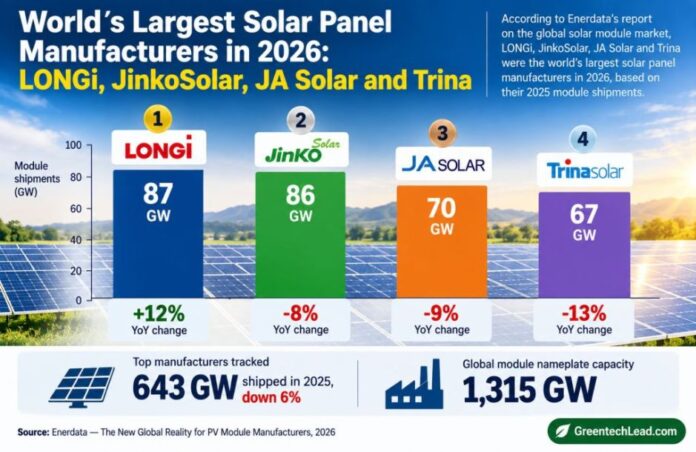
Enerdata’s report on global solar module estimates that shipments fell 6 percent to 643 GW in 2025, despite global solar installations reaching a record 664 GW. At the same time, global nameplate module manufacturing capacity jumped 27 percent to 1,315 GW. That means the industry had more than twice as much manufacturing capacity as tracked shipments, with aggregate utilization falling to roughly 49 percent.
The figures explain why the 2026 solar manufacturing race is no longer simply about who owns the biggest factories. Technology, capacity utilization, profitability, geographic diversification and supply-chain resilience are becoming equally important.
Largest Solar Panel Manufacturers: LONGi and JinkoSolar Lead Shipments
Enerdata’s assessment places LONGi at approximately 87 GW of module shipments in 2025, narrowly ahead of JinkoSolar at 86 GW.
JA Solar followed with around 70 GW, while Trina Solar shipped approximately 67 GW. Tongwei reached about 43 GW, Canadian Solar 40 GW and Astronergy 37 GW.
The shipment ranking demonstrates the enormous scale achieved by Chinese photovoltaic manufacturers. But it also shows that the industry’s largest companies are competing in an increasingly difficult market.
LONGi’s estimated shipments increased from 78 GW in 2024 to 87 GW in 2025, while JinkoSolar’s shipments fell from 93 GW to 86 GW.
The narrow difference means there is no overwhelming volume leader. LONGi and JinkoSolar effectively form the top tier, followed by JA Solar and Trina Solar.
For developers and investors following the global solar energy market, however, annual shipments tell only part of the story.
LONGi Ranks No. 1 in Wood Mackenzie 2026 Solar Manufacturer Ranking
A broader assessment produces a different picture.
Wood Mackenzie ranked LONGi Green Energy first in its Global Solar PV Module Manufacturer Ranking 2026. The research firm assessed 48 manufacturers across 10 countries, representing 65 percent of global production capacity and 83 percent of global shipments.
Rather than ranking manufacturers purely by shipments, Wood Mackenzie examined 10 criteria including capacity utilization, technology maturity, vertical integration, financial performance, R&D, supply-chain resilience, certification and ESG performance.
China continues to dominate. Nine of the 12 manufacturers sharing the top 10 positions were Chinese-headquartered companies. But non-Chinese manufacturers are becoming more competitive in markets protected by tariffs, domestic-content rules and other trade barriers. India’s Adani Solar ranked sixth, Singapore-based ELITE Solar eighth and South Korea’s Qcells tenth.
Wood Mackenzie also awarded 25 manufacturers Grade A status for 2026, based on operational strength, reliability and transparency.
The result shows why “largest solar panel manufacturer” and “best solar panel manufacturer” are increasingly different questions.
Solar Manufacturing Capacity Reaches 1,315 GW — But Utilization Falls to 49%
The biggest challenge facing solar manufacturers in 2026 is overcapacity.
Global module manufacturing capacity expanded from approximately 1,039 GW in 2024 to 1,315 GW in 2025, according to Enerdata. Yet tracked shipments declined from 687 GW to 643 GW.
The result was a dramatic deterioration in industry-wide utilization, from around 66 percent in 2024 to 49 percent in 2025.
The mismatch between capacity and demand is enormous:
Module manufacturing capacity: 1,315 GW
Tracked module shipments: 643 GW
Global solar installations: 664 GW
Average capacity utilization: ~49 percent
LONGi operated at an estimated 67 percent utilization against 130 GW of capacity, while JinkoSolar’s utilization was around 57 percent against 150 GW, according to Enerdata.
That changes the economics of solar manufacturing. Building another 20 GW or 50 GW factory provides little advantage if manufacturers cannot operate it efficiently or sell its output profitably.
The industry’s most important manufacturing metric is therefore shifting from nameplate GW to profitable GW.
Solar Price War Creates $5.5 Billion Loss for Chinese Manufacturers
Overcapacity has helped lower module prices and solar project costs, but it has created severe financial pressure for manufacturers.
Wood Mackenzie estimates that leading Chinese solar manufacturers recorded a combined $5.5 billion loss in 2025 despite maintaining enormous shipment volumes.
That compares with combined losses of approximately $4 billion in 2024 among the top 10 manufacturers identified in Wood Mackenzie’s previous ranking.
The trend reveals the central contradiction facing the solar industry: global demand remains strong, yet excessive manufacturing capacity is making it difficult for suppliers to convert demand into sustainable profits.
Large vertically integrated manufacturers face particular pressure because wafer, cell and module factories carry substantial fixed costs.
For developers, low module prices can improve solar project economics and investment returns. For manufacturers, however, prolonged price compression increases the importance of factory utilization, technology differentiation and access to higher-value markets.
TOPCon Dominates Solar Technology With More Than 80% Share
Technology is becoming the next major competitive battleground.
Wood Mackenzie says TOPCon represented more than 80 percent of shipments among its top 10 manufacturers in 2025, while mainstream TOPCon module efficiency reached 24.8 percent.
This effectively confirms the transition toward N-type technology among leading manufacturers.
JinkoSolar has built one of the industry’s largest TOPCon businesses through its Tiger Neo platform. LONGi, meanwhile, is pushing aggressively into back-contact technology.
The longer-term competition will increasingly focus on which architecture can deliver the best combination of module efficiency, manufacturing yield, degradation, material consumption, reliability and cost per watt.
The ultimate objective is not simply higher laboratory efficiency. Manufacturers must translate higher efficiency into lower lifetime electricity costs for developers.
LONGi Pushes Tandem Solar Cell Efficiency to 35.5%
The technology race is already moving beyond today’s TOPCon and BC modules.
In July 2026, LONGi announced a 35.5 percent conversion efficiency for its crystalline silicon-perovskite tandem solar cell, certified by the European Solar Test Installation.
The result improved on LONGi’s previous records of 33.9 percent in November 2023, 34.6 percent in June 2024 and 35.2 percent earlier in 2026.
LONGi also reported 34.3 percent efficiency on a 261 cm² tandem cell and 32.2 percent on a 274 cm² cell — dimensions closer to potential industrial applications. Tandem modules have reached independently certified efficiencies of 31.4 percent and 29.4 percent.
These remain technology milestones rather than evidence of mass-market tandem manufacturing. The commercial challenge is producing such cells reliably and inexpensively at gigawatt scale.
If manufacturers succeed, tandem architectures could eventually provide another major step-change in solar power density.
China Still Dominates — But Solar Manufacturing Is Becoming Global
China remains the center of the global photovoltaic supply chain, with dominant positions across polysilicon, wafers, cells and modules.
But tariffs, incentives and domestic-content requirements are changing where new factories are built.
Wood Mackenzie reports that nine of its top 10 solar manufacturers now operate manufacturing facilities in at least two countries.
The United States and India are particularly important alternatives.
Canadian Solar, for example, has been expanding U.S. module and cell manufacturing, while First Solar operates a 3.3 GW DC manufacturing facility in India based on its cadmium-telluride thin-film technology.
India’s growing manufacturing base also gives domestic companies an opportunity to challenge Chinese suppliers in selected markets, particularly where local-content requirements and supply-chain diversification influence procurement.
This makes solar manufacturing investment increasingly a question of industrial policy as well as electricity economics.
Capacity Utilization Becomes a Key Measure of Solar Leadership
Interestingly, the biggest manufacturers are generally using their factories more efficiently than the wider industry.
While Enerdata calculates overall industry utilization at around 49 percent, Wood Mackenzie says average capacity utilization among its top 10 manufacturers reached 70 percent in 2025, improving from 67 percent in 2024.
That gap is important.
Large suppliers can benefit from established customer relationships, international sales channels, bankability and economies of scale. Smaller manufacturers with underutilized factories face greater risk if low prices persist.
Consolidation therefore appears increasingly likely, particularly among companies unable to differentiate their technology or access protected regional markets.
Solar Manufacturers Expand Into Battery Storage
Solar manufacturers are also reducing their dependence on module margins by expanding into battery energy storage, project development and integrated energy solutions.
Canadian Solar is one prominent example, combining PV manufacturing with large-scale battery storage and project development.
Trina Solar is similarly building a substantial energy-storage platform, while other leading manufacturers are expanding their solar-plus-storage offerings.
The strategy makes sense as renewable penetration increases. Batteries can shift solar electricity into higher-value periods, reduce curtailment and provide grid-support services.
For manufacturers, storage creates another revenue pool beyond solar modules and potentially increases the amount of value captured from each renewable-energy project.
Who Are the World’s Largest Solar Panel Manufacturers in 2026?
By shipment volume, LONGi and JinkoSolar are the two manufacturers to beat, with estimated 2025 shipments of 87 GW and 86 GW respectively. JA Solar at approximately 70 GW and Trina Solar at 67 GW form the next major tier.
But shipment leadership should not be confused with overall competitiveness.
LONGi ranks first in Wood Mackenzie’s broader 2026 manufacturer assessment and is aggressively developing BC and tandem technologies. JinkoSolar remains a giant in TOPCon and global module manufacturing. JA Solar retains enormous vertically integrated scale, while Trina Solar is building a broader solar-plus-storage business.
Meanwhile, Canadian Solar, Tongwei, Astronergy, Adani Solar, Qcells, First Solar and others are creating different competitive models based on technology, localization or vertical integration.
The defining figure for the industry may therefore be neither 87 GW nor 86 GW.
It is 49 percent — the estimated utilization rate of global solar module manufacturing capacity in 2025.
With 1,315 GW of factories chasing 643 GW of tracked shipments, the next phase of the solar manufacturing race will be won not simply by companies capable of producing the most panels, but by manufacturers that can operate factories efficiently, commercialize better technology, diversify supply chains and remain financially resilient.
In 2026, solar manufacturing leadership is shifting from maximum capacity to maximum value from every gigawatt.
SHAFANA FAZAL