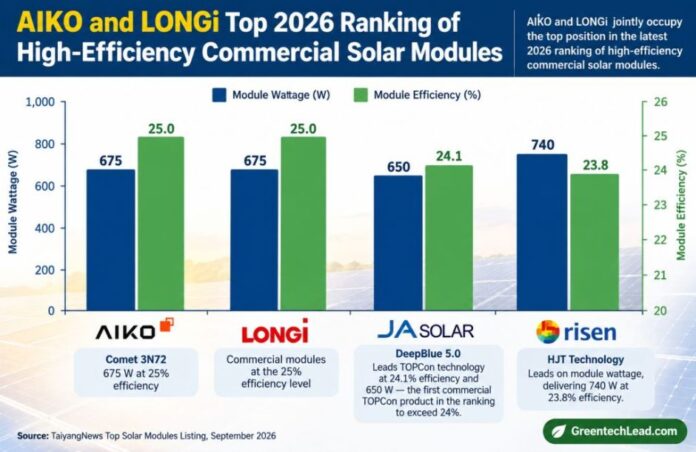
Solar panel efficiency has crossed an important commercial threshold in 2026, with AIKO and LONGi reaching 25 percent efficiency in commercially available modules, while JA Solar leads TOPCon at 24.1 percent and Risen Energy pushes HJT module output to 740 W.
The efficiency race is becoming important as solar developers try to generate more electricity from limited roof and land area while reducing balance-of-system costs. However, the highest efficiency figure does not automatically identify the best module. Cost per watt, power density, temperature performance, bifaciality, degradation and lifetime energy generation can have an equally important impact on project economics.
The September 2026 TaiyangNews ranking tracks 38 commercially available high-efficiency modules from 31 manufacturers. Back-contact technology leads at 25 percent, followed by TOPCon at 24.1 percent, while HJT leads the power-output race with 740 W at 23.8 percent efficiency.
Solar Panel Efficiency Reaches 25% Commercial Milestone
The biggest solar technology development in 2026 is the arrival of 25 percent module efficiency in commercial products.
AIKO and LONGi jointly occupy the top position in the latest 2026 ranking of high-efficiency commercial solar modules. AIKO’s Comet 3N72 delivers 675 W at 25 percent efficiency, while LONGi has also commercialised modules at the 25 percent level.
JA Solar’s DeepBlue 5.0 leads TOPCon technology at 24.1 percent efficiency and 650 W, becoming the first commercial TOPCon product in the ranking to exceed 24 percent. Risen Energy’s HJT technology leads on module wattage, delivering 740 W at 23.8 percent efficiency.
The shift is particularly striking when compared with PERC. The current TaiyangNews listing indicates that PERC modules do not exceed 21.7 percent, demonstrating the industry’s migration toward N-type TOPCon, HJT and back-contact architectures.
High-efficiency products are also becoming mainstream: modules exceeding 22.5 percent represented 53 percent of the tracked products by the end of the first half of 2026, compared with just 16 percent in January 2024.
AIKO and LONGi Lead the Back-Contact Solar Race
Back-contact technology currently represents the commercial efficiency frontier because electrical contacts are moved to the rear of the cell, reducing front-side shading and increasing the surface available to capture sunlight.
AIKO’s commercial Comet 3N72 reaches 25 percent efficiency and 675 W. Its product specifications extend to approximately 655-690 W and up to 25.5 percent efficiency, while its G4 Infinite Ultra platform has achieved a company-reported 25.6 percent mass-production efficiency and up to 690 W.
LONGi is pursuing its Hybrid Interdigitated Back Contact, or HIBC, architecture. Its EcoLife commercial module reached 25 percent mass-production efficiency in April 2026.
The technological potential is considerably higher. LONGi reported an independently certified 28.13 percent HIBC cell efficiency in April and a research module efficiency of 26.4 percent. The gap between these records and today’s 25 percent commercial products shows the potential for further efficiency improvements as manufacturing processes mature.
TOPCon vs HJT vs Back Contact: Which Technology Is Better?
There is no single winner for every solar application.
Back-contact technology currently provides the highest commercial module efficiency at 25 percent, making it particularly attractive for rooftops and other space-constrained projects where maximum watts per square metre are valuable.
TOPCon offers slightly lower peak efficiency but benefits from a huge manufacturing ecosystem. JA Solar’s 24.1 percent DeepBlue 5.0 leads the technology in the current commercial ranking, while other major manufacturers including JinkoSolar are producing modules in the upper-23-percent range.
HJT, meanwhile, provides compelling power output, thermal characteristics and bifacial performance. Risen Energy’s Hyper-Ion Pro reaches 740 W and 23.8 percent efficiency.
Consequently, buyers should compare annual electricity generation rather than treating module efficiency as the only procurement metric.
740 W Does Not Necessarily Mean Higher Efficiency
One of the most important distinctions for solar buyers is between wattage and efficiency.
Efficiency measures how much incoming solar radiation a module converts into electricity. Wattage measures total electrical output under standard test conditions.
A physically larger 740 W module at 23.8 percent efficiency can therefore generate more rated power than a smaller 675 W module at 25 percent efficiency, even though the latter converts sunlight more efficiently.
This matters differently for utility and rooftop installations. Utility developers must consider tracker dimensions, transportation, structural requirements, string design, inverter compatibility and installation costs.
Rooftop projects are more constrained by area, making power density particularly valuable. LONGi’s EcoLife product delivers approximately 250 W/m², demonstrating how higher efficiency can allow more generating capacity to be installed on the same roof.
Does 25% Solar Efficiency Justify a Higher Module Price?
The economic case depends on whether additional energy generation and balance-of-system savings compensate for the module premium.
A useful 2026 benchmark comes from a 1.3 GW Chinese procurement, where average bids were approximately CNY 0.72/W for TOPCon modules and CNY 0.778/W for back-contact modules.
That puts the BC premium at approximately CNY 0.058/W, or slightly more than 8 percent. The procurement specified minimum efficiencies of 22.8 percent for TOPCon and 23.8 percent for back-contact modules.
Paying the premium can make economic sense where higher power density reduces land, structural steel, mounting, cabling or labour requirements. In large projects with abundant inexpensive land, however, lower-cost TOPCon products could produce a more attractive levelised cost of electricity.
Temperature Performance Matters in India
Headline efficiency is measured under standard laboratory conditions, but solar panels routinely operate at substantially higher temperatures.
This makes temperature coefficient particularly important in India, the Middle East and other hot solar markets.
AIKO’s Comet 3N72 specifications include a temperature coefficient of approximately -0.26 percent per degree Celsius. Better thermal behaviour means less output is lost as module temperature increases.
Bifaciality also matters for utility-scale installations. Bifacial panels generate electricity from both the front and rear surfaces, although actual gains depend on ground reflectivity, mounting height, trackers, row spacing and shading.
This is one reason HJT remains competitive despite not leading the efficiency table.
Degradation Can Change the 30-Year Economics
Solar developers should also consider how much power a module retains throughout its operating life.
Leading products increasingly specify degradation of approximately 1 percent during the first year and around 0.35 percent annually thereafter. Such performance can leave modules with close to 89 percent of original output after 30 years.
For investors, this means a 25 percent module with weaker long-term degradation performance could potentially produce less lifetime economic value than a slightly less efficient module with stronger reliability.
Warranty terms, mechanical loading, moisture resistance, thermal cycling and potential-induced degradation therefore belong alongside efficiency in procurement decisions.
India Faces a Solar Manufacturing Cost Challenge
The technology race has major implications for India’s rapidly expanding solar manufacturing sector.
A May 2026 study by the Council on Energy, Environment and Water found that Indian solar-cell manufacturing is nearly 40 percent more expensive than Chinese production, while Indian capital expenditure is around 109 percent higher. Silver paste costs Indian manufacturers approximately 24 percent more.
The CEEW analysis of India’s solar-cell manufacturing competitiveness also shows the technological challenge facing domestic manufacturers. TOPCon lines can require nearly 12 months for process optimisation, compared with 7-8 months for PERC. TOPCon accounted for only around 29 percent of domestic cell capacity in the study, while PERC represented nearly 50 percent.
Capital intensity is another issue. CEEW estimates that setting up TOPCon cell production in India costs around US$70 million per GW, versus an average of approximately US$33.5 million per GW in China.
As global module efficiency moves above 24-25 percent, India’s manufacturing competitiveness will therefore depend not merely on adding gigawatts but on adopting advanced technologies quickly and lowering production costs.
Perovskite-Silicon Tandem Could Drive the Next Efficiency Leap
The next major technology transition could eventually move solar well beyond today’s 25 percent commercial benchmark.
Perovskite-silicon tandem cells use multiple light-absorbing layers to capture a broader part of the solar spectrum than conventional single-junction silicon.
Laboratory results already exceed today’s commercial silicon-module efficiencies substantially. But manufacturing yield, durability, encapsulation, stability and cost remain obstacles to mass deployment.
In the near term, TOPCon, HJT and back-contact technologies are therefore likely to continue dominating the commercial efficiency competition while tandem technology progresses toward industrial scale.
Which Solar Panels Are Most Efficient in 2026?
For commercially tracked modules, the answer is currently AIKO and LONGi at 25 percent efficiency. AIKO specifications extend to 25.5 percent, with the company reporting 25.6 percent mass-production efficiency for its latest platform.
JA Solar leads commercial TOPCon at 24.1 percent, while Risen Energy’s HJT module leads the power-output race at 740 W and 23.8 percent efficiency.
But efficiency alone should not decide a solar investment.
The best module is the one that converts efficiency into the lowest lifetime electricity cost after considering price per watt, watts per square metre, temperature coefficient, bifacial gain, degradation, reliability, installation costs and financing.
Solar technology has crossed the 25 percent commercial efficiency threshold in 2026. The next stage of competition will be about turning each additional percentage point into higher lifetime energy generation without making the module uneconomic.
SHAFANA FAZAL