Evolution Mining is accelerating its sustainability and decarbonisation strategy as renewable electricity procurement helps the Australian gold miner reduce greenhouse gas emissions and advance toward its net-zero Scope 1 and Scope 2 target by 2050 or earlier.
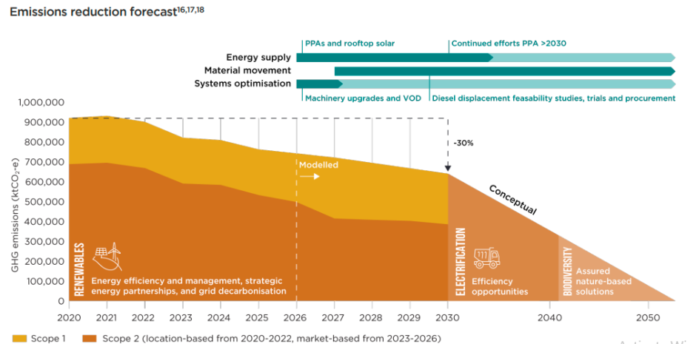
Evolution Mining’s FY26 climate performance shows total market-based Scope 1 and Scope 2 emissions falling to 741,336 tonnes of CO2 equivalent (tCO2-e), approximately 19 percent below its FY20 baseline of 919,167 tCO2-e. The company has set an interim target to reduce absolute Scope 1 and Scope 2 emissions by 30 percent by 2030 from FY20 levels, Evolution Mining Sustainability Report 2025 indicated.
The emissions target covers CO2, CH4, N2O and SF6 and places renewable energy procurement at the centre of Evolution Mining’s near-term decarbonisation strategy.
Evolution Mining GHG Emissions Fall to 741,336 tCO2-e
Evolution Mining’s FY20 emissions baseline comprised 231,823 tCO2-e of Scope 1 emissions and 687,344 tCO2-e of Scope 2 emissions, producing combined emissions of 919,167 tCO2-e.
By FY26, market-based Scope 2 emissions had dropped sharply to 496,812 tCO2-e, a reduction of about 190,532 tCO2-e from the FY20 level. Scope 1 emissions, however, increased to 244,524 tCO2-e, compared with 231,823 tCO2-e in FY20.
The figures underline the importance of electricity procurement to Evolution Mining’s overall climate strategy. Scope 2 represents approximately 70 percent of combined Scope 1 and Scope 2 emissions, making cleaner electricity one of the company’s biggest opportunities to reduce its carbon footprint.
On a location-based basis, Scope 2 emissions reached 650,974 tCO2-e in FY26, taking combined location-based Scope 1 and Scope 2 emissions to 895,498 tCO2-e. This compares with market-based combined emissions of 741,336 tCO2-e, highlighting the impact of Evolution’s renewable electricity arrangements.
Renewable Energy Drives at Least 180 ktCO2-e Emissions Reduction
Evolution Mining estimates that its decarbonisation initiatives delivered at least 180 kilotonnes of CO2 equivalent (ktCO2-e) of emissions reductions during FY26.
Renewable-energy power purchase agreements were the primary contributor to these reductions, reinforcing the role of clean electricity procurement in the miner’s journey toward its 2030 and 2050 climate targets.
Almost 50 percent of electricity purchased across Evolution Mining’s portfolio in FY26 came from renewable or low-emission sources.
At the Cowal and Northparkes operations, approximately 75 percent of electricity consumption was supplied from renewable sources, largely through power purchase agreements.
Evolution’s Red Lake operation achieved an even higher clean-energy share, with around 80 percent of electricity coming from renewable or low-emission sources, primarily because of the composition of the local electricity grid.
Evolution Mining Expands Renewable PPAs Through 2030
Evolution Mining has renewable-energy PPAs supporting its Cowal and Northparkes operations. These contracts are structured to deliver incremental increases in renewable electricity supply through 2030, supporting the company’s target of cutting Scope 1 and Scope 2 emissions by 30 percent.
The company also spent approximately $5 million during FY26 on voluntary Large-scale Generation Certificates associated with renewable electricity supplied to Cowal and Northparkes.
The combination of PPAs and renewable-energy certificates provides Evolution with a mechanism to reduce market-based Scope 2 emissions while it evaluates longer-term opportunities to decarbonise its operations.
Evolution Mining Targets 30% Emissions Reduction by 2030
Evolution Mining’s climate strategy sets a 30 percent absolute reduction in Scope 1 and Scope 2 GHG emissions by 2030, using FY20 as the baseline.
Against the FY20 level of 919,167 tCO2-e, FY26 market-based emissions of 741,336 tCO2-e indicate that the company has already delivered an approximately 19 percent reduction.
Evolution ultimately aims to achieve net-zero Scope 1 and Scope 2 emissions by 2050 or earlier.
Its strategy prioritises direct emissions reductions rather than relying heavily on carbon offsets. Over the longer term, Evolution may consider assured, high-integrity nature-based offsets or credits for emissions that are difficult to eliminate.
Australian Operations Stay Below 100,000 tCO2-e Safeguard Threshold
None of Evolution Mining’s Australian operations exceeded the Australian government’s 100,000 tCO2-e Scope 1 emissions threshold under the Safeguard Mechanism during FY26.
Carbon pricing nevertheless represents a potential financial exposure as climate regulation evolves. Evolution’s climate modelling assumes carbon prices ranging from $31 to $80 per tCO2-e over time.
The company estimates potential additional carbon-compliance costs of around $3 million to $9 million annually in the short to medium term. Longer-term additional costs are estimated at approximately $7 million.
These figures demonstrate the growing connection between carbon management, energy procurement and operating costs for mining companies.
Renewable Electricity Becomes Central to Evolution Mining Net-Zero Strategy
Evolution Mining’s FY26 sustainability performance demonstrates that electricity procurement is currently delivering the largest measurable gains in its decarbonisation programme.
Market-based Scope 1 and Scope 2 emissions have fallen from 919,167 tCO2-e in FY20 to 741,336 tCO2-e in FY26, while decarbonisation initiatives delivered at least 180 ktCO2-e of emissions reductions during the latest financial year.
With nearly 50 percent of purchased electricity across its portfolio coming from renewable or low-emission sources, renewable electricity penetration reaching around 75 percent at Cowal and Northparkes and 80 percent at Red Lake, Evolution Mining is increasingly using clean power procurement to advance toward its 30 percent emissions reduction target by 2030 and net-zero ambition by 2050 or earlier.
SHAFANA FAZAL