
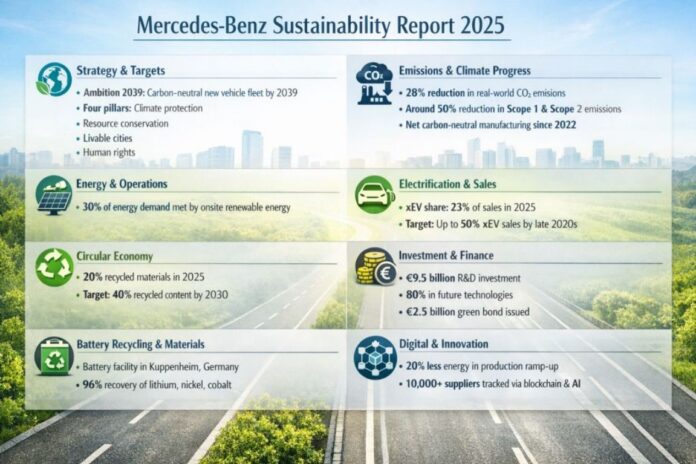
Mercedes-Benz is accelerating its sustainability transformation through its “Ambition 2039” strategy, targeting a carbon-neutral new vehicle fleet across the entire value chain by 2039. The company is combining electrification, green manufacturing, and circular economy principles to reduce lifecycle emissions while scaling next-generation mobility solutions.
“Mercedes-Benz, as part of its Ambition 2039 strategy, aims to create the entire Mercedes-Benz new vehicle fleet net carbon-neutral across all stages of the value chain and its entire life cycle. The Group sees the electrification of its vehicles as a very important lever,” Mercedes-Benz Chairman Ola Kallenius said in the report.
In 2025, Mercedes-Benz achieved a 28 percent reduction in real-world CO2 emissions from its new passenger car fleet in Europe compared to 2020 levels, meeting its interim decarbonization targets. Production remains a critical focus area, with all manufacturing plants maintaining net carbon-neutral operations since 2022. The company has also expanded renewable energy generation, with 30 percent of energy demand at German facilities now met through onsite solar and wind installations.
Electrification continues to reshape the company’s product portfolio. The share of xEVs, including battery electric vehicles and plug-in hybrids, reached 23 percent of total sales in 2025. Mercedes-Benz is targeting up to 50 percent xEV sales by the late 2020s, reflecting its transition toward an electric-first future, although adoption rates vary across global markets.
The company is also making steady progress in circular economy initiatives. Recycled materials accounted for 20 percent of the average vehicle by weight in 2025, with a long-term goal of increasing this to 40 percent by 2030. This approach supports resource efficiency while reducing dependency on primary raw materials, according to the Mercedes-Benz Sustainability Report 2025.
Sustainability-focused investments remain central to Mercedes-Benz’s strategy. The company allocated €9.5 billion to research and development in 2025, with around 80 percent directed toward future technologies such as electric drivetrains, advanced software platforms, and solid-state battery innovation. To support its green transition, Mercedes-Benz issued a €2.5 billion green bond, its largest to date, aimed at financing electric vehicle architectures and low-carbon supply chains, including green steel sourcing.
A major milestone in 2025 was the launch of its battery recycling facility in Kuppenheim, Germany. Using an advanced hydrometallurgical process, the plant achieves a recovery rate exceeding 96 percent for critical materials such as lithium, nickel, and cobalt, strengthening supply chain resilience and reducing environmental impact.
The Ambition 2039 framework is built on four pillars: climate protection, resource conservation, livable cities, and human rights. Mercedes-Benz has already reduced Scope 1 and Scope 2 emissions by around 50 percent compared to 2018 levels. It is also advancing closed-loop recycling systems for aluminum and steel, while expanding smart mobility solutions such as its Level 4 Intelligent Park Pilot across major global airports.
Digital transformation is playing a key role in driving sustainability outcomes. The company leverages digital twins powered by NVIDIA Omniverse to simulate and optimize production processes, reducing energy consumption during ramp-up phases by 20 percent for new vehicle models like the CLA. Additionally, blockchain and AI technologies are being used to enhance supply chain transparency, tracking carbon footprints and labor standards across more than 10,000 suppliers.
BABURAJAN KIZHAKEDATH
